


Hiring the right growth marketing expert can make or break your B2B startup’s success. Here’s the short version of what you need to know:
- Why It Matters: Growth marketers focus on revenue, not just visibility. They own the full customer funnel – acquisition, conversion, retention – and tackle bottlenecks that block growth.
- When to Hire: Don’t jump the gun. If you’ve got fewer than 20 paying customers or no repeatable acquisition process, it’s too early.
- Types of Help:
- Full-time hires: Best for Series A+ startups with ongoing growth needs.
- Fractional CMOs: Great for senior-level strategy without the $347K/year salary.
- Consultants: Ideal for specific, short-term projects like SEO audits or paid search campaigns.
- What to Look For: A solid growth marketer prioritizes revenue metrics (CAC, LTV, pipeline) and uses data-driven experiments to solve problems. Avoid candidates who focus on vanity metrics like traffic or leads.
- Costs:
- Freelancers: $2K–$8K per project
- Fractional CMOs: $5K–$25K/month
- Full-time hires: $110K–$200K/year
Pro Tip: Start with a 90-day pilot or fractional engagement to test results before committing full-time.
Want the full breakdown? Keep reading for a step-by-step guide to hiring smarter.
MIA Podcast #03: How to Find & Hire a Growth Marketer
sbb-itb-e8c8399
What Growth Marketing Expertise Actually Means for B2B Startups
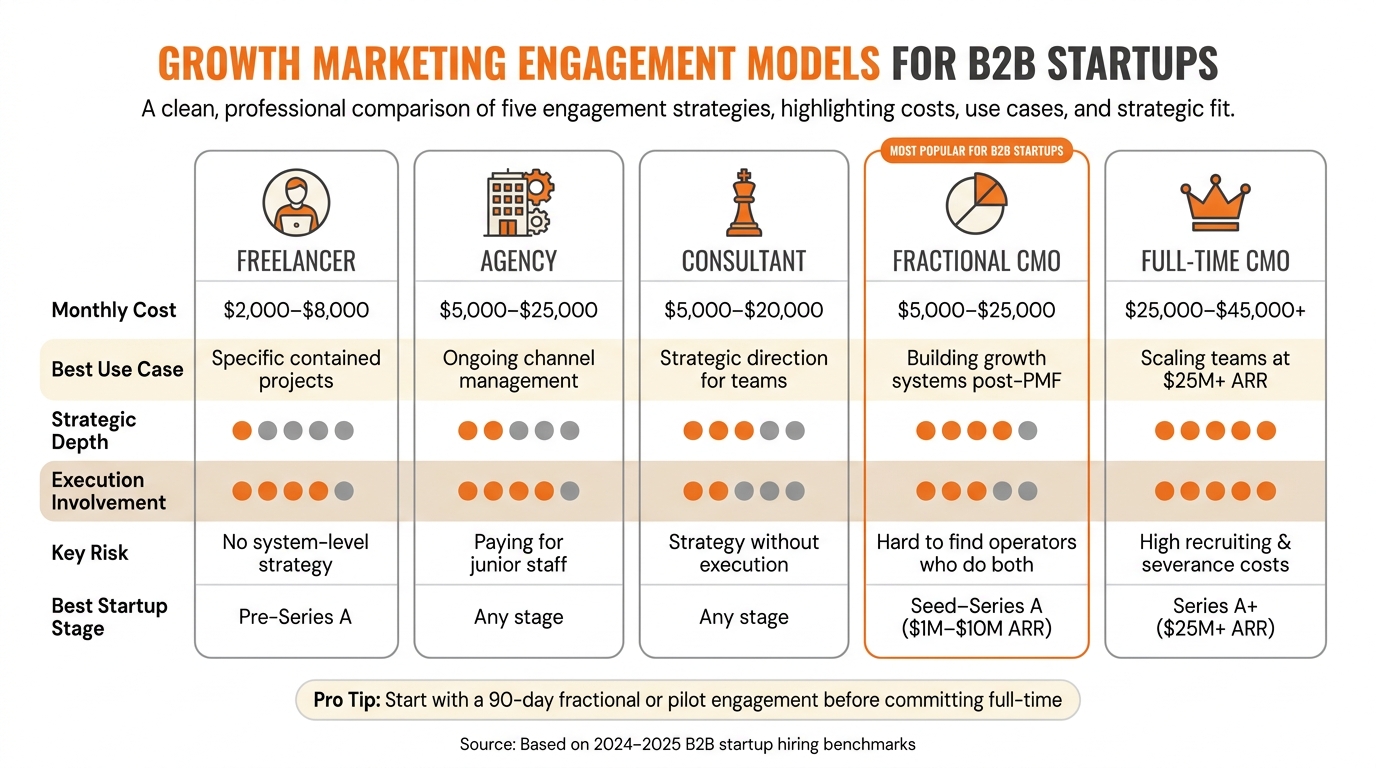
Growth Marketing Engagement Models: Cost, Use Case & Fit for B2B Startups
The term "growth marketer" gets thrown around a lot, but it’s often misunderstood. Before drafting a job description or hiring a consultant, it’s worth clarifying what this role entails – and how it stands apart from other marketing titles you may have worked with before.
What a Growth Marketing Expert Actually Does
A growth marketer takes full ownership of the customer funnel – covering acquisition, activation, conversion, retention, and revenue expansion. Their focus is on identifying where the funnel breaks down, figuring out why, testing solutions, and scaling what works.
This role is less about running campaigns and more about solving problems. For example, they’ll dive into cohort data or analyze conversion rates to uncover issues, like a drop in demo-to-opportunity rates. As Bruce Hogan, Co-founder & CEO of SoftwarePundit, explains:
"Creating business value is the northstar metric for growth marketers. They should understand the impact of accelerating customer acquisition, boosting retention, and improving conversion rates." [4]
The metrics growth marketers track – CAC payback period, pipeline sourced, trial-to-paid rate, net revenue retention – are all tied directly to revenue. This focus on measurable outcomes is what makes hiring for growth a distinct challenge.
Understanding the specifics of this role helps differentiate a growth marketer from a generalist.
Growth Expert vs. Generalist: What’s the Difference?
A generalist marketer ensures everything keeps moving – managing content calendars, sending emails, collaborating with sales, and keeping operations smooth. This is valuable for early-stage startups, but it’s not the same as growth marketing.
A growth marketer approaches challenges diagnostically. For instance, if your pipeline isn’t growing despite an increase in leads, they won’t just suggest more LinkedIn posts. Instead, they’ll pinpoint the issue – is it targeting, messaging, or lead qualification? – and design a test to address it.
"A strong growth marketer can improve CAC efficiency, activation, pipeline quality, and retention. A weak one can burn budget and still make the dashboard look busy." – Prose Media [3]
Here’s a quick comparison of the two roles:
| Growth Expert | Generalist Marketer | |
|---|---|---|
| Primary focus | Fixing revenue/funnel constraints | Keeping marketing operations consistent |
| Metrics owned | Pipeline, CAC, LTV, conversion rates | Activity and execution metrics |
| Approach | Diagnostic and experiment-driven | Tactic and channel-driven |
| Best fit | Post-product-market fit, scaling growth | Early stage, setting up foundational processes |
Which Role Do You Actually Need?
Deciding between a growth expert and a generalist depends on your startup’s stage, budget, and challenges. Most B2B startups typically choose from three options: an in-house growth lead, a fractional CMO, or a channel-specific consultant.
- An in-house growth lead is ideal if you’ve established a repeatable growth strategy and need someone full-time to run experiments and own revenue outcomes.
- A fractional CMO works well if you need senior-level strategy without committing to the $347,000 annual salary of a full-time executive [1]. They typically provide 10–25 hours of guidance per week. Knowing when to hire a fractional CMO is critical for founders who need to bridge the gap between early-stage hustle and a full-scale marketing department.
- A channel-specific consultant is the right pick if you already know the area you want to focus on – like SEO or paid search – and need deep expertise in that one channel.
A true fractional expert comes with a clear exit plan. Their goal is to solve a specific problem and transition the work to a full-time hire when the time is right. If someone can’t explain what “done” looks like for their engagement, that’s a red flag [9].
Is Your Startup Falling Behind Its AI-Native Competitors?
How to Scope Your Growth Needs Before You Start Hiring
Before diving into the search for a growth expert, take a step back and define your challenges and the scale of growth you’re aiming for. This should align with your revenue goals. Too many founders skip this step and end up overpaying for senior strategists to handle tasks better suited for junior team members – or hiring specialists when the real need is to establish foundational growth strategies.
Where Is Your Startup Right Now
Before drafting a job description, evaluate whether your startup is ready for a growth hire. The right time to hire is when you’ve achieved a few key milestones: more than 20 paying customers (not referrals), monthly churn under 3%, and at least a basic, repeatable acquisition process – even if it’s still manual [6]. Without these signals, a growth hire won’t solve the core issues holding you back.
"The growth hire is not the cause of growth. The growth hire amplifies growth that already exists in an embryonic form." – Udit [6]
Your startup’s stage also determines the type of growth expert you should seek. If you’re still pre-product-market fit, your focus should be on rapid learning – testing channels, refining messaging, and validating product-market fit through lean experiments. Once you’ve reached product-market fit (typically around $1M–$10M ARR), the priority shifts to scaling what works and improving metrics like customer acquisition cost (CAC) and lifetime value (LTV) [9][2]. Hiring a senior growth leader too early is a common and costly mistake. Seed-stage companies have spent $180,000 to $250,000 on growth hires who failed to generate incremental ARR because their acquisition strategies weren’t ready [6].
Here’s a useful exercise to clarify your readiness: write a single paragraph describing what you want to achieve in six months. Be specific, like "Increase qualified marketing pipeline from $50,000 to $100,000 per month." If you can’t articulate this vision, it’s a sign to pause before hiring.
Once you’ve assessed your stage, the next step is choosing the right type of engagement to tackle your growth challenges.
Choosing the Right Engagement Type for Your Goals
After identifying your current stage and desired outcomes, consider whether you need a full-time hire, a fractional expert, or a project-based consultant.
- Full-time hires are ideal when growth is a continuous, integrated effort requiring daily collaboration with teams like product and sales. This is most common at Series A and beyond [2].
- Fractional experts are better suited for startups that need senior-level strategy but can’t yet justify the expense of a full-time executive. These professionals usually work 1–4 days a week, making them a great fit when your core business elements – like your ideal customer profile (ICP) and go-to-market strategy – are already in place [8].
- Project-based consultants are the right choice for focused, time-limited tasks, such as conducting an SEO audit, testing a new channel, or supporting a product launch [7][9].
One important note: when hiring a fractional expert, their time commitment is exactly what you pay for – don’t expect more than the agreed-upon days.
The table below breaks down these engagement models:
Engagement Types Side by Side
| Model | Best Use Case | Pros | Cons | Approx. Monthly Cost |
|---|---|---|---|---|
| Advisory | Founders needing strategic input; handling execution themselves | Low cost; flexible | No operational involvement | $2,000 – $5,000 [9] |
| Fractional (Part-Time) | Post-PMF startups needing senior leadership without full-time overhead | Senior judgment at a fraction of the cost | Attention shared with other clients | $7,000 – $16,000 [9] |
| Embedded Fractional | Active scaling or hiring mode; needs deep integration | 3–4 days/week; closely integrated with the team | Expensive; still not fully dedicated | $15,000 – $25,000 [9] |
| Project/Consultant | Channel validation or specific deliverable (e.g., paid search audit) | Low commitment; specialized expertise | Limited long-term impact; not embedded in culture | Varies by project [7] |
| Full-Time Hire | Ongoing growth ownership; Series A and beyond | 100% focus; builds institutional knowledge | High overhead; high cost of a bad hire | $110,000 – $200,000+/yr [5][6] |
The key is to align the engagement model with your actual needs. For example, hiring a full-time Head of Growth to run a three-month experiment is as misaligned as bringing in a project-based consultant when you need someone to lead and develop a team. Choose based on the scope of work, not just your budget.
How to Find and Vet Qualified Growth Marketing Experts
Once you’ve identified the type of engagement you need, the next step is finding someone who can deliver results – not just someone who aces the interview. Matching your candidate search to your growth priorities is key to bringing in talent that drives revenue.
Where to Find Strong Candidates
The best growth marketers aren’t usually hanging out on generic job boards. A referral from a trusted founder is often the safest bet since it comes with firsthand validation of the candidate’s skills. But if your network doesn’t yield results, there are other effective channels to explore.
Specialized talent platforms like MarketerHire rigorously screen applicants, accepting only the top 1%. They can match you with a candidate in as little as 48 hours [12]. For example, in 2025, B2B startup Loot used MarketerHire to secure growth talent and achieved a 28% increase in its customer base [2]. If you’re looking for fractional leadership, networks like Outcome Marketing connect you with fractional CMOs who follow structured go-to-market frameworks, ensuring the strategy remains actionable even after the engagement ends [11].
If you’re more hands-on with sourcing, communities like Demand Curve and GrowthHackers are excellent places to find experienced candidates.
"You can have an expert spun up almost instantly, which is a rare luxury in the business world." – Austen Allred, Co-Founder and CEO, Bloom Institute of Technology [12]
Once you’ve identified potential candidates, the next step is evaluating their approach and expertise.
Green Flags, Red Flags, and What to Look For
One common hiring trap is focusing too much on a candidate’s past results without digging into how they achieved them. To truly assess their potential, find out if they owned specific metrics and can clearly articulate how they influenced those numbers.
Green flags include candidates with a T-shaped skill set – broad knowledge across the marketing funnel paired with deep expertise in one area. Look for someone who can pinpoint problems before proposing solutions and who uses a structured approach to experimentation. This means starting with a hypothesis, setting clear success metrics, and knowing when to pivot if an idea doesn’t work [5]. Those who build scalable systems, like automated email workflows or referral programs, often bring more long-term value than those chasing quick wins [2].
On the flip side, red flags are just as telling. Be wary of candidates who rely on a single playbook from their previous role, assuming it will work for your business [13]. Steer clear of those who focus on boosting traffic and leads while neglecting revenue and pipeline growth [13]. Also, be cautious of senior leaders from large companies who are accustomed to managing big budgets and teams – they may struggle in early-stage environments where hands-on execution is critical [6].
Technical skills are non-negotiable. A strong B2B growth marketer should confidently navigate tools like HubSpot, Salesforce, GA4, and Mixpanel without needing much guidance [10].
Once you’ve narrowed down your candidate list, reference checks are crucial for validating their strengths.
How to Run a Reference Check That Actually Tells You Something
Generic praise during reference calls won’t help you make a confident decision. Instead, ask targeted questions like:
- What specific metric did this person own, and how did it change under their leadership?
- Can you describe a growth experiment they ran that didn’t work, and how they handled the outcome?
- Would you trust them to lead growth at a scrappy, resource-constrained startup?
These types of questions push references to provide concrete examples rather than vague endorsements [6].
Another way to get more candid feedback is to ask for a second-degree reference. At the end of the call, request the name of someone else who worked closely with the candidate, then reach out to that person. These secondary contacts, who aren’t prepped by the candidate, often provide unfiltered insights into their reliability, collaboration style, and actual impact [6].
"Technical skills can be taught. Obsession can’t." – GotUsers [13]
It’s worth noting that only about one in three senior growth hires succeeds at a startup [13]. Thorough reference checks are one of the few tools you have to avoid costly hiring mistakes.
How to Interview and Choose the Right Candidate
The interview process is where you move beyond surface-level qualifications to find someone who can genuinely drive growth. It’s not about testing their knowledge of marketing theory – it’s about seeing how they solve real problems under a bit of pressure. This phase is your chance to identify candidates who not only understand growth metrics but can also translate that understanding into measurable revenue outcomes.
Questions to Ask in the First Call
The first call should feel more like a conversation than a formal interview. Start with a direct question: "Which metric did you personally own, and how did it change under your ownership?" [5] This helps you pinpoint their individual contributions rather than letting them hide behind team accomplishments.
Next, introduce a scenario to test their problem-solving instincts. For example: "Lead volume is up, pipeline is flat, and CAC is rising. How do you diagnose that in your first 30 days?" [3] A strong candidate won’t rush to offer tactics. Instead, they’ll ask clarifying questions, break the problem into parts, and outline a logical sequence for their analysis. This kind of structured thinking is exactly what you’re looking for.
Here’s a breakdown of six essential question types to guide your initial calls:
| Question Type | What to Ask | What It Reveals |
|---|---|---|
| Metric Ownership | "Which metric did you personally own, and how did it change?" [5] | Distinguishes contributors from passive observers |
| Strategic Prioritization | "What metric would you own first here, and why?" [3] | Shows their ability to identify your biggest bottleneck |
| Diagnostic Thinking | "Lead volume is up, pipeline is flat, CAC is rising – how do you diagnose that?" [3] | Tests their ability to separate traffic and conversion issues |
| Experimentation Process | "Tell me about a growth experiment that failed and what you did with the data." [5] | Reveals how they adapt and learn from setbacks |
| Resource Allocation | "How would you allocate a $30K/month budget across channels at our stage?" [5] | Evaluates their judgment with limited resources |
| Cross-functional Execution | "Tell me about a growth initiative that depended on teams outside your reporting line. How did you get it shipped?" [3] | Measures their influence and collaboration skills |
Once you’ve assessed their strategic thinking, it’s time to evaluate their hands-on abilities through practical exercises.
Practical Exercises to Test Real Skills
"A great interview does not predict a great growth hire." – Matt Pru, Founder, Stackmatix [5]
To validate a candidate’s skills, use a three-step approach: a background screen, a take-home assignment, and a live working session [5].
For the take-home assignment, provide a simplified version of your growth challenges. Ask for a 90-day plan that includes 5–7 specific experiments, their hypothesis for the most effective CAC channel, and evidence they understand your company’s stage [6]. Don’t expect a polished presentation – focus on the substance of their ideas.
For senior candidates, consider paying them to complete a small, tactical task, like drafting a 5-email drip sequence or outlining a cold outreach campaign. This quickly reveals whether they can execute or if they’re more comfortable delegating [13].
The live session is the most revealing part of the process. Over 60 to 90 minutes, have them analyze an anonymized dataset from your acquisition funnel. Ask them to prioritize channels based on CAC and conversion rates, and observe how they explain their reasoning in real time [6].
How to Evaluate Answers When You’re Not a Marketer
Even if you’re not a marketing expert, you can still evaluate candidates effectively by focusing on a few key signals.
Start with the clarity test: if their explanation feels confusing or hard to follow, that’s a communication issue on their part – not yours [13]. The best candidates can articulate their thinking clearly, even to non-technical audiences. Also, listen for revenue-focused language. Words like revenue, CAC, SQLs, and pipeline should dominate their answers. If they’re stuck talking about leads or impressions without tying those to revenue, that’s a red flag [13].
To keep your assessments fair, grade each candidate on a 1–5 scale across five categories: Funnel Diagnosis, Experimentation Quality, Channel Depth, Cross-functional Execution, and Stage Fit [3]. Decide on the weighting for each category before the interviews begin to avoid being swayed by a candidate’s confidence or charisma during the debrief [3].
What Growth Marketing Experts Cost and How Pricing Works
Once you’ve zeroed in on strong candidates, the next question is usually: how much will this cost? The answer depends on the type of engagement you choose, with pricing reflecting the level of responsibility, strategic input, and deliverables involved.
Typical Pricing by Engagement Type
A common pitfall for founders is focusing too much on the lowest price they’ve come across. Pete Boyle, Founder of Growth Models, explains:
"If you spend under $5,000 per month on growth marketing… you’re probably getting tactical work without strategic architecture." [14]
That’s a helpful starting point. Here’s how pricing typically breaks down:
- Freelance growth marketers charge $75–$200 per hour or $2,000–$8,000 per project. This is ideal for specific, task-driven work.
- Marketing agencies range from $5,000–$25,000 per month. They’re execution-focused, but the level of strategic depth can vary widely.
- Consultants charge $200–$500 per hour or $5,000–$20,000 per month. They provide strategic advice but often leave execution to you.
Fractional CMOs offer a mix of strategy and oversight. Their fees typically scale with your company’s revenue stage: $5,000–$15,000 per month for early-stage companies ($1M–$10M ARR), $10,000–$25,000 per month at the growth stage ($10M–$50M ARR), and $20,000–$50,000 per month for mature businesses.
For full-time CMOs, salaries range from $150,000–$200,000 at the Seed/Series A stage and $200,000–$275,000 at Series B. When factoring in benefits and recruiting fees, the total first-year cost can climb to $580,000–$650,000 [15][17].
Knowing these benchmarks helps you align your budget with realistic expectations.
How to Match Price to Scope and Expected Outcomes
Your budget should reflect the value you’re expecting to receive. For instance, a fractional CMO charging $10,000 per month to build a lead generation system you own offers a different return than an agency charging the same amount to run ads from their own accounts.
Before committing, ensure your contract specifies asset ownership. Deliverables like email sequences, landing pages, and SOPs should be created in your accounts, not the vendor’s [14]. To keep incentives aligned, negotiate for 20–30% of the retainer to be tied to measurable KPIs like pipeline growth or ARR influenced [18].
If you’re not ready for a full-time CMO but need consistent strategic guidance, a fractional leader can be a smart interim solution. Companies using fractional marketing leadership have seen average revenue growth of 29%, compared to 19% for those without it [16].
Pricing Models at a Glance
| Model | Typical Monthly Cost | Best Use Case | Key Risk |
|---|---|---|---|
| Freelancer | $2,000–$8,000 | Specific, contained projects | No system-level strategy |
| Agency | $5,000–$25,000 | Ongoing channel management | Paying for junior staff instead of results |
| Consultant | $5,000–$20,000 | Strategic direction for teams | Strategy may not translate into execution |
| Fractional CMO | $5,000–$25,000 | Building growth systems | Hard to find operators who do both strategy and execution |
| Full-Time CMO | $25,000–$45,000+ | Scaling teams at $25M+ ARR | High recruiting and severance costs |
With these costs in mind, the next step is ensuring the engagement is set up for success, particularly in the critical first 90 days.
How to Set the Engagement Up for Success
The period right after signing a contract is critical. Those first weeks set the stage for whether the collaboration thrives or gets bogged down by unclear expectations.
What to Focus on in the First 90 Days
One common misstep founders make is expecting instant results before the expert has had time to get oriented. On average, a new growth hire needs 30–60 days to ramp up before delivering meaningful outcomes [5]. Keep this in mind when planning the first 90 days.
Start strong on Day 1 by granting access to essential tools like GA4, your CRM, paid media dashboards, and past experiment documentation. Within the first week, schedule introductions with your Product, Sales, and Engineering teams. This ensures the expert understands your technical constraints and pipeline realities [2].
Here’s how to structure the first 90 days into three focused phases:
| Phase | Focus | Deliverables |
|---|---|---|
| Days 1–30 | Audit & Infrastructure | Tech stack setup, funnel bottleneck identification, data audit [19][2] |
| Days 31–60 | Experimentation | Initial A/B tests, messaging refinement, creative testing [19][2] |
| Days 61–90 | Scaling & Roadmap | Scalable growth strategy, 12-month testing roadmap, ROI reporting [19][2] |
As Jonathan Martinez explains:
"An experienced growth marketer should have a clear 30, 60, 90-day plan after they join." [19]
It’s also essential to agree early on which single metric they’ll own first – whether that’s pipeline, activation, calculating CAC, or trial-to-paid conversion. Without clarity, efforts can become scattered, and slow results might lead to blame-shifting [3]. By aligning these phases with the revenue-driven strategy outlined earlier, you ensure immediate goals are met while laying a foundation for sustainable growth.
Once this groundwork is in place, shift your focus to adapting and expanding the expert’s role as your business needs evolve.
How to Grow the Relationship as Your Needs Change
After nailing the first 90 days, the next step is to adjust the engagement as your startup grows. For example, a fractional expert who audited your funnel at Series A might not be the right person to lead a full demand generation strategy at Series B – and that’s perfectly fine.
Many B2B startups adopt a hybrid model as they scale. In this setup, one in-house marketer drives overall strategy while external specialists or agencies handle execution for specific channels like paid search, SEO, or content [21][3]. This approach allows you to expand capacity without immediately building a large internal team.
If the collaboration isn’t delivering, the root cause is often misaligned expectations. Geoff Roberts, Co-founder of Outseta, sums it up well:
"When a first marketing hire doesn’t work out, in most instances it’s because expectations aren’t aligned both ways." [20]
To avoid this, revisit the scope every 90 days. As your needs evolve, adjust the expert’s responsibilities, metrics, and communication cadence before frustration sets in. This proactive approach ensures the relationship stays productive and aligned with your goals.
Conclusion: What to Take Away From This Guide
Growth marketing isn’t some instant fix. Seed-stage companies have spent between $180,000 and $250,000 on growth hires that didn’t generate a single dollar of incremental revenue – a clear reminder that timing is just as important as talent [6]. The problem often isn’t the hire itself; it’s bringing someone on board before the company is ready.
Before you start hiring, focus on identifying your startup’s biggest bottleneck – whether it’s traffic, conversion, or retention. Then, look for the specific expertise needed to address that issue. At the seed stage, a generalist who can experiment with channels makes sense. But by Series A, you’ll need a specialist who can scale what’s already working.
"A strong growth marketer can improve CAC efficiency, activation, pipeline quality, and retention. A weak one can burn budget and still make the dashboard look busy." – Prose Media [3]
This underscores the importance of making data-driven hiring decisions. When evaluating candidates, ask for specifics: What were the baseline metrics? What results did they personally drive? What happened after their initial wins? A clear 90-day plan with measurable goals is essential for setting the stage for long-term success. To minimize risk, consider starting with a 90-day pilot or fractional CMO engagement. This approach lets you test for real results before committing full-time [3][6].
FAQs
How do I know if I’m actually ready to hire a growth marketer?
You’re ready to bring on a growth marketer once you’ve nailed down a proven, repeatable acquisition channel that consistently delivers results and needs someone to take full ownership. On top of that, having a clear 12-month growth strategy is key to ensuring their efforts are focused and effective. Hiring too soon – before these foundations are set – can lead to wasted time, resources, and energy. The priority should be creating predictable growth, not chasing every possible channel, before adding a dedicated marketer to your team.
What should I ask to prove a candidate really drove revenue (not just activity)?
When evaluating candidates, aim for examples that tie their work to measurable revenue outcomes. Ask about scenarios where their actions directly influenced key metrics like customer acquisition, conversion rates, or overall revenue growth. For instance, you could say, "Can you walk me through a campaign where your strategies led to a measurable increase in revenue or boosted customer lifetime value?"
Scenario-based questions are also a great way to dig deeper. You might ask, "Can you describe a time when you identified a revenue bottleneck? What steps did you take to address it, and what were the results?" This approach not only highlights their problem-solving skills but also gives insight into their ability to drive tangible business results.
What should I expect a growth expert to deliver in the first 90 days?
In the first 90 days, a growth expert focuses on laying the groundwork for sustainable growth. This starts with evaluating existing channels, pinpointing obstacles, and deciding which experiments to tackle first. Deliverables during this period include crafting a well-organized testing plan, syncing efforts with sales and product teams, and outlining a clear growth roadmap. Early achievements might include acquiring initial customers, enhancing key funnel metrics, and setting a solid plan for scaling. Collaboration across teams and a strong reliance on data will be central to these efforts.