


Think SEO is all you need? The rise of Generative Engine Optimization (GEO) is flipping the script on how content gets discovered and used, including how to show up in AI search. While SEO focuses on ranking pages for clicks, GEO is about structuring content so AI tools like ChatGPT, Perplexity, and Google AI cite it in their answers. Here’s the key difference: SEO drives traffic to your site; GEO makes your content show up in AI-generated responses – even if users never visit your page.
Key Takeaways:
- SEO optimizes for search engine rankings and clicks.
- GEO ensures your content gets cited in AI responses, prioritizing facts, clear structure, and entity recognition.
- By 2026, 93% of Google AI sessions result in zero external clicks, making GEO essential for visibility.
- SEO success depends on keywords and backlinks, while GEO prioritizes fact density, schema markup, and factual precision.
Quick Comparison:
| Dimension | SEO | GEO |
|---|---|---|
| Goal | Drive clicks to your site | Get cited in AI-generated answers |
| Key Signals | Keywords, backlinks, domain authority | Fact density, entity clarity, structured data |
| Output | Ranked links | Synthesized conversational answers |
| User Behavior | Clicks to external pages | Zero-click satisfaction |
| Success Metric | Rankings & traffic | Citations & AI share of voice |
Why it matters: SEO gets your page into search rankings, but GEO ensures your content is part of the AI conversation. Both strategies work together, and ignoring either could mean missing opportunities in 2026’s AI-driven landscape.
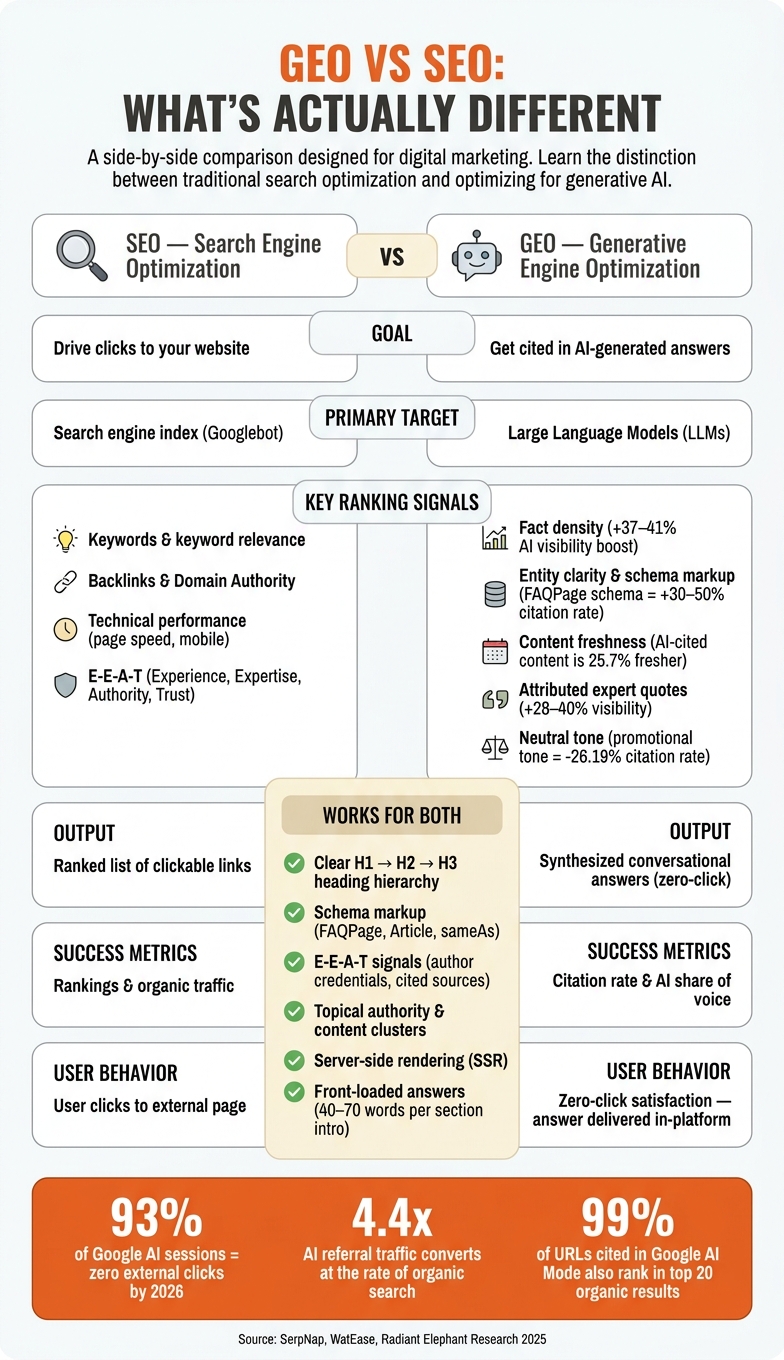
GEO vs SEO: Key Signals, Tactics & Metrics Compared
Core Differences Between GEO and SEO
How Traditional Search Engines Work
Traditional search engines like Google operate through a three-step process: crawl, index, and rank. Here’s how it works: bots scan websites to gather data, catalog that information, and then algorithms rank pages based on a mix of factors like keywords, backlinks, and domain authority. The result? A ranked list of links. Users click on one of those links, land on your site, and that visit counts as a success. The system is designed to direct traffic to external pages.
How Generative Engines Work
Generative engines such as ChatGPT, Perplexity, and Google AI Mode take a completely different approach. They rely on Large Language Models (LLMs) and Retrieval-Augmented Generation (RAG) to craft responses instead of just listing links. When users ask questions in plain language, these engines deliver direct answers – often without requiring a click. This concept is known as zero-click satisfaction, where the engine’s primary goal is to answer the question directly rather than act as a directory.
"Traditional SEO gets you into the ‘room’ (the retrieval set), but GEO makes you the ‘speaker’ (the citation)." – SerpNap Team [7]
The algorithms behind generative engines also prioritize different signals. While SEO focuses on link equity and keyword optimization, GEO emphasizes fact density, clarity of entities, and structured content hierarchy. For instance, research highlights that 68.7% of ChatGPT citations follow logical heading structures (H1 → H2 → H3) [3], and incorporating statistics into your content can boost its inclusion in AI-generated responses by 37% to 41% [2][3].
These distinctions fundamentally change how marketers approach content creation.
What This Means for Marketers
The shift from click-driven SEO to citation-driven GEO requires a whole new mindset to optimize AI brand visibility. Instead of focusing solely on rankings, success now depends on earning citations within AI-generated answers. In GEO, your content’s value lies in being referenced within an AI’s response, even if users never visit your site. Interestingly, a page that doesn’t rank in the top 10 on Google can still become a frequently cited source in AI outputs.
"Either you show up or you don’t. If you’re not in the actual citations in the answer that was given, you might as well not have played the game." – Dharmesh Shah, Co-founder, HubSpot [8]
This marks a shift in visibility metrics. In SEO, success is tied to ranking positions, while in GEO, it’s all about your share of voice in AI-generated responses. To achieve this, content must be designed for easy extraction by AI rather than solely for user engagement.
| Dimension | SEO | GEO |
|---|---|---|
| Primary Target | Search engine index (Googlebot) | Large Language Models (LLMs) |
| Output | Ranked list of links | Synthesized conversational answer |
| Core Signal | Keywords & backlinks | Fact density, entity clarity, structured data |
| User Behavior | Clicks to external pages | Zero-click satisfaction |
| Success Metric | Rankings & organic traffic | Citations & share of voice in AI responses |
| Discovery | Crawler indexing | RAG retrieval & entity recognition |
sbb-itb-e8c8399
GEO vs SEO: How Ranking Signals Differ
SEO Signals: What Traditional Search Engines Measure
Traditional SEO relies on a handful of core signals to determine rankings. Keyword relevance helps search engines understand what a page is about. Backlinks and Domain Authority indicate the credibility of that page. Then there’s technical performance – factors like page speed, mobile optimization, and crawlability – that ensures the page is even indexed. On top of it all, E-E-A-T (Experience, Expertise, Authoritativeness, Trustworthiness) acts as a qualitative filter to sort high-quality content from the rest. These signals work together to secure a coveted top-10 spot and drive clicks.
"SEO gets you found. AEO makes you the answer. GEO gets you cited." – SERPs.io [5]
GEO Signals: What Generative Engines Look For
Unlike traditional search engines that prioritize ranking pages, generative engines focus on extracting accurate facts. This shift in purpose means the signals that matter most are different.
Factual precision is the top priority. Adding statistics can boost AI visibility by 37%–41% [2][4], while including attributed expert quotes can improve visibility by another 28%–40% [2]. On the flip side, content with a promotional tone is 26.19% less likely to be cited [4]. In short, overly salesy content hurts your chances of being referenced.
Entity recognition is another critical factor. Generative engines rely on internal graphs of brands, people, and concepts. If your brand is inconsistently mentioned across your site or third-party platforms, the engine struggles to identify you confidently, leading to fewer citations. Schema markup, especially FAQPage schema, can increase citation rates by 30%–50% on platforms like Perplexity [6]. Additionally, content freshness is far more important than many SEO teams realize – AI-cited content tends to be 25.7% fresher than traditionally ranked pages [3][2].
"The unit of optimisation shifts from ‘page’ to ‘fact.’ A page can be cited for a single statistic it contains, even if 90% of its content is irrelevant to the query." – WatEase Team [9]
Where GEO and SEO Overlap
Despite their differences, GEO and SEO share some common ground. Practices like clear heading hierarchies, structured content, and consistent entity definitions benefit both. A well-organized page with logical H1 → H2 → H3 structures is easier for Googlebot to crawl and for an LLM to extract facts from.
E-E-A-T signals also play a dual role. Author credentials, cited sources, and verifiable expertise are vital for both traditional SEO and AI-driven GEO. Similarly, server-side rendering (SSR) is essential for both systems – AI crawlers can’t process JavaScript, and SSR remains a best practice for SEO crawlability [2][6].
The key distinction lies in the purpose: for SEO, structure and signals improve rankings. For GEO, they enhance extraction efficiency, making it easier for an LLM to isolate and use specific facts from your content. This difference fundamentally changes how each signal is applied.
| Signal | SEO Impact | GEO Impact |
|---|---|---|
| Backlinks / Domain Authority | High | Low (r²=0.032 citation variance) [2] |
| Brand web mentions | Moderate | High (0.664 correlation with AI visibility) [2][4] |
| Schema markup (FAQPage) | Moderate | High (increases citation rate by 30–50%) [6] |
| Keyword relevance | High | Low (semantic matching replaces keyword density) |
| Statistics & data points | Low | High (+37–41% visibility boost) [2][4] |
| Content freshness | Moderate | High (AI-cited content is 25.7% fresher on average) [3][2] |
| Promotional tone | Neutral | Negative (-26.19% citation probability) [4] |
GEO vs SEO: How the Tactics Differ
Tactics That Work for Both GEO and SEO
Some strategies serve both traditional SEO and Generative Engine Optimization (GEO) effectively. For instance, building topical authority with hub-and-spoke content clusters not only improves search rankings but also enhances recognition by large language models (LLMs). Similarly, rewriting H2s as questions aligns content with both Google search queries and natural-language prompts used by conversational AI. Another shared tool is schema markup – especially FAQPage, Article, and sameAs entity linking – which helps secure rich results in Google and improves data extraction for AI systems.
A critical structural practice is front-loading your answers. Research indicates that 44.2% of LLM citations are drawn from a page’s introduction [3]. Pairing concise, 40–70 word answers at the start of each section with logical heading hierarchies increases your chances of being featured in both Google snippets and AI responses. These shared tactics lay the groundwork for success in both disciplines before diving into their unique strategies.
Tactics That Are Specific to SEO
SEO relies on tactics designed to drive clicks, which don’t always translate to GEO success. Link-building, targeting SERP features (like featured snippets and People Also Ask boxes), and optimizing for Core Web Vitals are classic SEO practices aimed at improving visibility and engagement in search results. However, these methods don’t directly impact how generative engines decide what to cite.
Certain SEO practices can even harm GEO performance. Keyword stuffing has been shown to reduce AI visibility by 10% in peer-reviewed tests [4]. Similarly, a promotional tone, common in conversion-focused content, correlates with a -26.19% likelihood of being cited by AI systems [4].
"Keyword stuffing, the tactic that still shows up in half the ‘GEO checklists’ floating around LinkedIn? It did nothing. Sometimes performed worse than baseline." – Radiant Elephant [2]
Tactics That Are Specific to GEO
GEO, by contrast, focuses on securing citations and ensuring accurate data extraction. This requires a different approach to content structure. Semantic chunking – creating self-contained passages that make sense when pulled out of context – is a core skill. To increase credibility, aim for factual density by including one hyperlinked, authoritative statistic every 150–200 words [4]. Incorporating attributed expert quotes can also improve AI visibility by 28%–40% [2][4].
Technical adjustments further support GEO strategies. Adding an llms.txt file at your site root provides AI crawlers with a clear site summary [6][4]. Using the sameAs property in your schema to link to verified sources like Wikipedia or LinkedIn helps AI systems confirm your brand’s legitimacy [2][4]. Finally, auditing your robots.txt file to explicitly allow AI crawlers like GPTBot, ClaudeBot, PerplexityBot, and Google-Extended is essential. Blocking these bots means your content won’t appear in AI citations [4][9].
"Either you show up or you don’t. If you’re not in the actual citations in the answer that was given, you might as well not have played the game." – Dharmesh Shah, Co-founder, HubSpot [8]
SEO vs GEO: Understanding the Key Differences
Understanding these differences is the first step in learning how to rank in AI search results using both GEO and AEO tactics.
How SEO Teams Can Add GEO to Their Work
Integrating GEO into SEO workflows requires a shift in both mindset and metrics, reflecting the differences in how search engines and AI systems process and display information.
Changing How You Define Success
Traditional SEO success metrics, like ranking #1 on Google, don’t fully apply when it comes to GEO. For AI-driven platforms like ChatGPT, Perplexity, Gemini, and Claude, the key metric becomes citation rate – the percentage of relevant AI-generated answers that mention your brand. This shift highlights the importance of ensuring your content is referenced within AI responses.
Another critical metric is AI referral traffic, which you can track in GA4 by setting up a custom channel group for domains like chatgpt.com and perplexity.ai. Why prioritize this traffic? Because visitors referred through AI platforms convert at rates between 14.2% and 15.9%, compared to 1.76% to 2.8% for traditional organic search [8].
Additionally, monitor branded search lift in Google Search Console. As AI systems increasingly cite your content, you’re likely to see an increase in branded search queries – a clear indicator that your GEO efforts are gaining traction.
With these metrics in place, content teams need to refine their workflows to align with AI extraction priorities.
Changes to Content Team Workflows
To optimize for GEO, content teams must rethink their approach to content creation. Start by enhancing your content briefs. Each brief should include two or three natural-language prompts – questions users might input into AI platforms like ChatGPT. This ensures the content is designed for AI extraction from the outset.
Next, adjust how your content is structured. Each H2 should begin with an answer capsule – a 40–60 word summary that directly addresses the heading’s question. This practice improves the chances of your content being cited by AI systems, as they prioritize concise and relevant information.
Two other key adjustments include:
- Factual density: Include at least one hyperlinked, authoritative statistic every 150–200 words. Research shows that incorporating statistics can increase AI visibility by 31% to 37% [8].
- Neutral tone: Avoid promotional language, as it correlates with a -26.19% drop in AI citations [11]. Carefully review drafts to eliminate any marketing-heavy phrasing.
"AI systems don’t just want answers – they want answers they can trace back to authoritative sources. The age of unsourced content marketing is over." – Rand Fishkin, Co-founder, SparkToro [11]
How to Track GEO Performance
Once your content production process aligns with GEO goals, tracking performance becomes essential. Start with a weekly prompt audit: test 20–30 relevant queries across at least two AI platforms. Record when and where your brand is cited and track how it’s described to better understand citation trends [6].
Additionally, monitor competitors’ citations to identify content gaps and prioritize updates. Tools like Surfer SEO‘s AI Tracker (starting at $99/month [1]) and Otterly.ai can help automate parts of this process, though manual checks remain important for accuracy.
Finally, don’t abandon traditional SEO metrics. Rankings, organic traffic, and Core Web Vitals still matter for searches that don’t result in AI-generated answers. Aim to create a reporting dashboard that integrates both traditional SEO metrics and GEO-specific ones – citation rate, AI referral traffic, and branded search lift. This holistic view will help you understand how these channels interact and evolve over time.
Conclusion: Running GEO and SEO Together
As of early 2026, Google continues to dominate, delivering 345x more traffic than all AI tools combined [10]. However, AI-referred sessions are on a steep rise, growing 527% year-over-year in the first half of 2025 [10] and converting at an impressive 4.4x the rate of standard organic search [10]. The takeaway? SEO and GEO aren’t rivals – they’re complementary strategies. Overlooking either means missing out on significant traffic and revenue opportunities.
Approximately 99% of URLs cited in Google’s AI Mode also rank in the top 20 organic results [10]. In essence, SEO ensures your content gets into the retrieval pool, while GEO determines if your brand is the one mentioned in AI-generated answers. A strong SEO framework is crucial for succeeding with GEO, making it clear why SEO remains essential even as GEO changes the game.
"A shop that only does classic SEO will leave money on the table in 2026. A shop that abandons SEO for ‘pure GEO’ is selling you hype." – Oleg Kovalev, Founder, ASP Marketing [12]
To align your 2026 budget with this evolving landscape, the smart move is to maintain SEO at steady levels while channeling growth investments into GEO-focused tactics like page rewrites, fact-loading, schema updates, and citation monitoring [10]. With a 70% skill overlap between SEO and GEO tasks [12], your current team can likely handle these shifts without needing an overhaul.
"The teams that win 2026 are not the ones that picked SEO or GEO. They are the ones that figured out fast that the substrate is the same and the writing is different." – Hugo Debrabandere, Co-founder, Clairon [10]
Content strategies now need to emphasize structure, factual accuracy, and direct answers. That said, the core principles of creating authoritative, well-indexed content remain unchanged. The teams that view GEO as an additional layer on top of a strong SEO foundation – not as a substitute – will be the ones capturing both clicks and citations in this new era. For those needing immediate results, following a roadmap to show up in AI search can accelerate visibility.
FAQs
How do I measure GEO success?
To gauge the effectiveness of Generative Engine Optimization (GEO), keep an eye on a few important metrics. Start with tracking AI bot crawl activity – for example, whether bots like GPTBot are interacting with your site. Pay attention to changes in branded search volume and direct traffic driven by AI-generated content. Don’t overlook customer feedback, as it can provide valuable insights into how your content resonates.
You can also test platforms like ChatGPT or Perplexity to see if your content is being referenced. Additionally, leverage tools that monitor citation trends or evaluate your site structure to gain a clearer picture of your performance. The key here is to prioritize long-term trends rather than relying solely on traditional SEO metrics, which may not fully capture the impact of GEO efforts.
What content changes boost AI citations fastest?
Including structured data, such as FAQPage schema, alongside direct citations, statistics, and expert quotes can lead to a noticeable boost in AI citations. Studies suggest that pairing schema with factual and quote-driven content can improve citation rates by as much as 40% within just 7–14 days. The key is to prioritize clear, data-supported content to achieve these results efficiently.
Which technical settings help or block AI crawlers?
To make sure AI crawlers can access your content, use server-side rendering (SSR) or static site generation (SSG) so that content is available without relying on JavaScript. Fine-tune your robots.txt file to allow AI-specific user agents like GPTBot, while blocking crawlers intended solely for training purposes if necessary. Be cautious with CDN settings – default AI block toggles can unintentionally block crawler access at the edge. Proper setup ensures AI crawlers can navigate your site without issues.