

Product-Led Growth (PLG) isn’t optional anymore – it’s the default for scaling AI-native software. By 2026, success hinges on delivering value in under 60 seconds, leveraging AI-driven task automation, and ditching outdated free-tier models. The best PLG consultants today are focused on fast activation, AI-powered onboarding, and pricing models tied to outcomes.
Here’s the quick rundown:
- Time-to-value is everything: Users expect results in seconds, not minutes.
- AI changes the game: It’s not about clicks anymore – it’s about AI agents completing tasks.
- Pricing has shifted: Forget per-seat models; think pay-per-task or pay-per-outcome AI pricing.
- Free tiers are fading: High AI costs mean tighter trials and usage caps.
- PLG + Sales = Growth: Blending self-serve and enterprise sales is the new standard.
The Top 7 PLG Consultants in 2026
- Lillian Pierson: AI-native workflows, WaaS/RaaS pricing, and instant onboarding.
- Wes Bush: "Warp Speed" activation (<60 secs) and reverse trials.
- Elena Verna: Lovable product growth and freemium-first strategies.
- Kyle Poyar: Usage-based pricing and AI-powered outcomes.
- Casey Winters: Predictive activation moments and AI-managed expansion.
- Ramli John: AI-automated onboarding and reverse trials.
- Leah Tharin: API-driven experiences and hybrid PLG-sales models.
Quick Comparison
| Consultant | Focus Areas | Unique Strength |
|---|---|---|
| Lillian Pierson | AI workflows, pricing models | Task delegation, WaaS/RaaS pricing |
| Wes Bush | Fast activation, reverse trials | "Warp Speed" onboarding (<60 secs) |
| Elena Verna | Product growth, freemium strategies | Minimum Lovable Product concept |
| Kyle Poyar | Usage-based pricing, fast onboarding | AI-native product outcomes |
| Casey Winters | Predictive moments, pricing frameworks | Work/Results-as-a-Service models |
| Ramli John | AI automation, reverse trials | "Bowling Alley" onboarding updates |
| Leah Tharin | API-driven growth, hybrid PLG-sales | Embedded agents, enterprise scaling |
What to Avoid
- Free tiers without limits: AI costs demand tighter controls.
- Slow onboarding: If it takes longer than 60 seconds, it’s too slow.
- Old pricing models: Per-seat pricing doesn’t work for AI-native products.
If your consultant isn’t talking about AI-driven task automation, WaaS/RaaS pricing, or blending PLG with sales, you’re stuck in 2020. The right expert can help you scale faster, cut costs, and stay ahead in 2026.
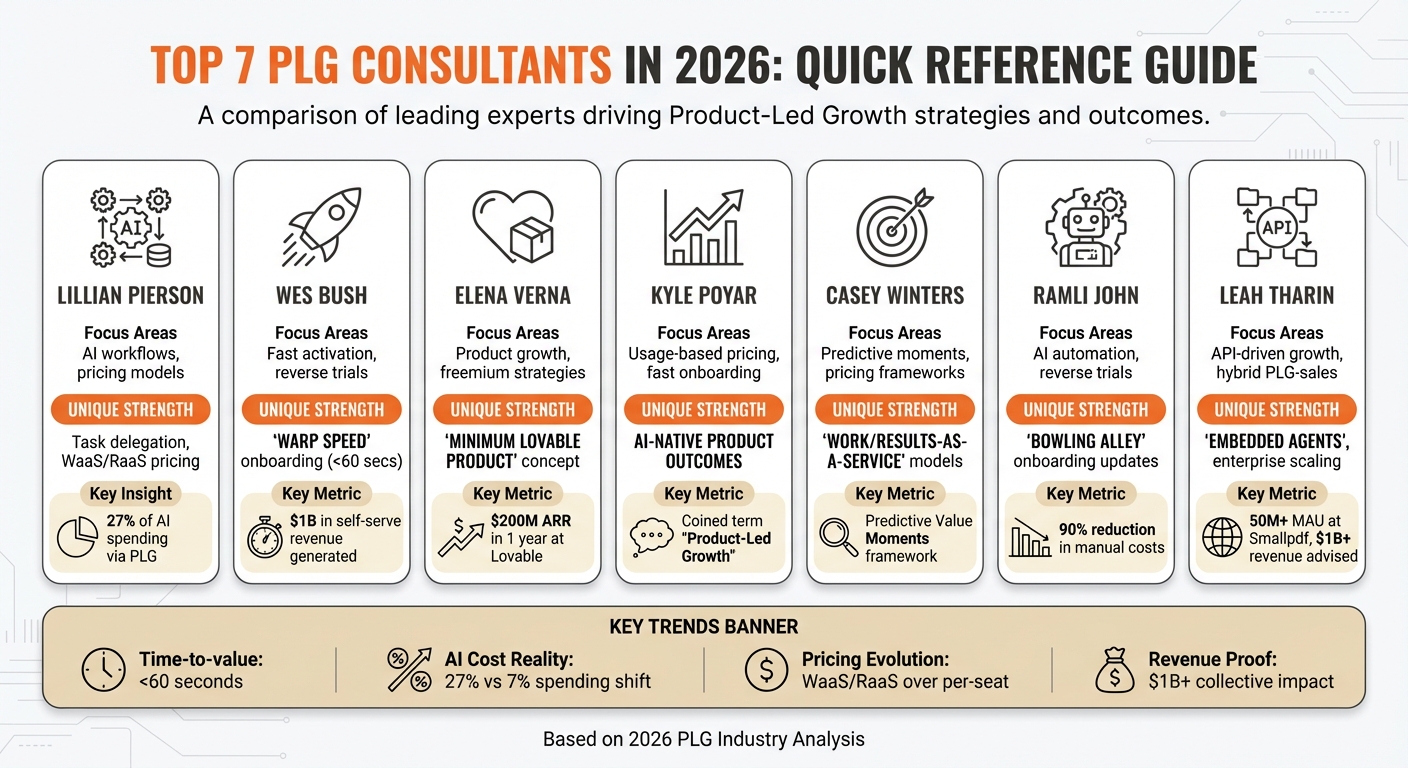
Top 7 PLG Consultants 2026: Specializations and Unique Strengths Comparison
How PLG Consulting Changed in 2026
The role of a Product-Led Growth (PLG) consultant has undergone a dramatic transformation. Back in 2020, many consultants stuck to generic strategies that, while once effective, are now considered outdated – and even counterproductive. With the rise of AI-native products, which come with high costs of goods sold (COGS) due to API calls and GPU processing, old free-tier models no longer make sense in this new landscape [1].
Today’s consultants have taken on a more dynamic role, acting as General Managers of Self-Serve Revenue. Their focus is on connecting the product experience directly to measurable financial outcomes. This shift means they are responsible for key metrics like activation, retention, monetization, and expansion, while overseeing the entire self-serve revenue pipeline. To achieve this, modern consultants implement strategies such as reverse trials – offering 7–14 days of full access before introducing a paywall – credit-based usage caps, and pricing models tied to outcomes [1].
The market itself has evolved to demand faster, more tangible results. The benchmark for time-to-value has shrunk drastically, moving from the "first session" to under 60 seconds [1]. Consultants who still rely on lengthy, multi-step onboarding processes are stuck in the past. The best advisors today design AI-powered experiences that immediately engage users by identifying their goals and configuring the product for them in real time.
Another key development is the rise of Product-Led Sales (PLS) hybrid models, which blend self-serve adoption with enterprise sales strategies. Self-serve data now fuels sales teams, providing them with qualified leads and usage insights. This approach helps companies break through the revenue limitations of purely PLG models. Take Cursor, for example: the company hit $200M in Annual Recurring Revenue (ARR) before hiring its first enterprise sales representative [1]. This dual strategy requires consultants to deeply understand both the nuances of product experience and the complexities of enterprise go-to-market approaches.
AI has also redefined the very concept of a "user." Traditional PLG strategies focused on human interactions – like clicks and feature usage. But now, the emphasis has shifted to AI agents completing tasks on behalf of users. Consultants are prioritizing "delegation metrics", which measure the point at which users trust an AI agent to handle tasks, over the old "aha moments" tied to feature discovery. This fundamental change forces a complete rethinking of activation, onboarding, and pricing strategies from the ground up. AI isn’t just changing how products work – it’s reshaping the entire playbook for PLG consultants.
sbb-itb-e8c8399
Red Flags When Hiring PLG Consultants
The world of Product-Led Growth (PLG) has evolved dramatically, and not all consultants have kept pace. Many still rely on outdated strategies that fail to address the rising costs of AI, sluggish onboarding processes, and pricing models that no longer work. For example, if a consultant suggests free tiers without discussing usage caps or credit limits, it’s a clear sign they’re stuck in an earlier era. AI costs can escalate fast – each API call and GPU process chips away at your margins. Consultants who ignore these realities risk draining your budget while offering little in terms of sustainable solutions. This oversight often leads to bloated costs and slow onboarding, leaving your product lagging behind.
Another major red flag? Proposals that involve drawn-out onboarding processes. If a consultant suggests multi-step workflows or lengthy manual walkthroughs, it’s time to look elsewhere. In 2026, the benchmark is delivering value in under 60 seconds. As Wes Bush, Founder of ProductLed, succinctly explains:
"If your product takes 5+ minutes to deliver value, you’re losing to someone who does it in 30 seconds" [1].
Modern consultants rely on AI-driven flows to instantly tailor the user experience based on intent, eliminating the need for static, step-by-step checklists.
The shift in PLG also demands a new focus on metrics. Traditional models, which emphasize human interactions like page views and logins, are no longer sufficient. Today, the emphasis is on "delegation metrics", which measure how effectively AI agents complete tasks on behalf of users. If a consultant is still stuck analyzing human-driven metrics without addressing AI’s role in activation and success, they’re missing the bigger picture. The definition of a "user" has expanded – it’s no longer just about humans clicking buttons, but also about AI agents delivering results. Metrics like successful task handoffs and user trust in AI outputs are now critical for gauging success.
Pricing models are another area where outdated thinking can be costly. If a consultant only talks about per-seat pricing, they’re behind the curve. The landscape has shifted toward models like "Work as a Service" (WaaS), where users pay per task completed, or "Results as a Service" (RaaS), where payment is tied to delivered outcomes [1]. These models are particularly well-suited to AI-native products. A consultant who can’t differentiate between these approaches or apply them effectively is unlikely to help your business thrive.
Here’s a quick comparison to help you spot outdated thinking versus modern PLG expertise:
| Warning Sign (Outdated) | Positive Indicator (2026 Standard) |
|---|---|
| Indefinite free access | Time-boxed or credit-based trials to manage AI costs |
| Focuses on "Aha Moments" via human clicks | Prioritizes success in AI-driven task delegation |
| 10-step manual tutorials | AI configures the experience in under 60 seconds |
| Per-seat pricing | Per-task (WaaS) or per-outcome (RaaS) models |
| Treats all users the same | Uses adaptive AI flows tailored to user intent |
| Sees PLG and Sales as separate functions | Adopts hybrid "Product-Led Sales" approaches |
1. Lillian Pierson
Lillian Pierson is a leading voice in modern PLG consulting, blending her deep knowledge of data strategy with a focus on AI-native product growth.
Expertise in AI-native PLG strategies
Pierson’s work revolves around creating AI-native workflows that allow users to delegate tasks to AI agents effectively. She focuses on measuring the success of these AI-driven tasks and building user trust, ensuring that her strategies align with both technical innovation and cross-functional PLG alignment[1].
Proven track record with activation, onboarding, and monetization
Pierson taps into the 27% of AI application spending that relies on PLG motions to reshape activation models and foster meaningful user engagement[1]. Her approach has shown results in the fast-changing world of AI-native PLG, helping companies stay ahead.
Delivering fast time-to-value
By streamlining onboarding with AI-powered flows, Pierson eliminates the need for drawn-out manual processes. Her focus on delivering personalized, immediate experiences ensures users find value right from their first interaction.
A fresh perspective on AI-driven onboarding, usage, and pricing
Pierson advocates for WaaS (Workflows-as-a-Service) and RaaS (Results-as-a-Service) pricing models instead of traditional per-seat pricing[1]. These models tie costs directly to outcomes, making them a better fit for AI-powered products where expenses scale with usage rather than headcount. Her expertise in data strategy helps businesses implement these models effectively from the start.
2. Wes Bush
Wes Bush, the founder of ProductLed and author of Product-Led Growth and Product-Led Scale (with over 100,000 copies sold), has been at the forefront of driving PLG (Product-Led Growth) transformations. His work has helped more than 324 SaaS companies overcome revenue stagnation, collectively generating over $1 billion in revenue[3].
Expertise in activation, onboarding, and monetization
During his time at Vidyard, Bush introduced a Chrome extension that quickly gained over 100,000 users. His consultancy has worked with more than 400 companies, resulting in $1 billion in self-serve revenue[1]. He also created the "ProductLed Method", a nine-part framework designed to help SaaS companies scale their ARR (Annual Recurring Revenue) from thousands to millions[3]. This method forms the backbone of his strategies for activation and growth.
Focus on fast time-to-value
Bush emphasizes what he calls "Warp Speed" activation – delivering value to users in under 60 seconds[1]. One standout example is Cursor, an AI code editor that reached $200 million ARR before even hiring an enterprise sales rep, thanks to its ability to deliver value in just 15 seconds[1]. His philosophy is clear: onboarding processes that take longer than five minutes introduce unnecessary friction and risk losing users.
"Time-to-value will be redefined to under 60 seconds; slow activation will lose to products that deliver results immediately." – Wes Bush, Founder, ProductLed[1]
Vision for AI-driven onboarding, usage, and pricing
Bush’s strategies extend beyond activation to rethinking onboarding and pricing models. He advocates for "UI-less PLG", where products scale using APIs, CLI tools, and embedded agents instead of traditional web interfaces[1]. His forward-looking approach focuses on AI agents that don’t just assist users but handle tasks entirely, aligning with the growing expectation for seamless, automated functionality by 2026.
On pricing, Bush pushes for models like "Work as a Service" (pay-per-task) and "Results as a Service" (pay-per-outcome), moving away from outdated per-seat pricing structures[1]. He also recommends reverse trials – offering 7 to 14 days of full access before introducing a paywall – to avoid the pitfalls of free tiers that drain resources[1].
"If you’re building an AI product without a PLG motion, you’re choosing the hardest possible path." – Wes Bush, Founder, ProductLed[1]
3. Elena Verna
Elena Verna, Head of Growth at Lovable, has shifted the playbook for growth in the AI era. With experience at Miro, Amplitude, Dropbox, and SurveyMonkey, she was deeply involved in traditional SaaS PLG strategies. However, her work at Lovable showcases her ability to adapt to the demands of AI-driven growth.
Track record in activation, onboarding, and monetization
Under Verna’s leadership, Lovable achieved extraordinary ARR milestones: $10M in just 60 days, $100M in 8 months, and $200M within a year[5][1]. These achievements highlight her focus on delivering immediate value and rethinking how users engage with products. Her concept of the "Minimum Lovable Product" raises the bar beyond the MVP, aiming to create instant user attachment[5].
"60% to 70% of traditional growth tactics no longer apply in AI." – Elena Verna, Head of Growth, Lovable[5]
Mastery of AI-native PLG methods
Verna’s strategies challenge traditional conversion methods, focusing on AI-native approaches. She emphasizes offering the product for free as the most effective growth driver, even more impactful than paid advertising. Additionally, she shifted the responsibility for activation from growth teams to product teams, stressing the need for tighter product integration in AI-focused businesses. Her guiding principle: if the product isn’t exponentially better, no amount of optimization will make it successful[5]. This mirrors the growing demand for advisors who can align product experiences with measurable revenue outcomes.
Rethinking onboarding, usage, and pricing in the AI era
A strong advocate for freemium models over trial periods, Verna also pushes for regular product-market recalibration every quarter[5]. She has been outspoken about eliminating lengthy onboarding processes, favoring instant AI-powered configurations. At Lovable, her team delivers working code to users in under 60 seconds[5][1]. This streamlined approach to onboarding and her preference for freemium pricing reflect her commitment to connecting product experiences directly to tangible results.
"Activation now belongs to product teams, not growth teams." – Elena Verna, Head of Growth, Lovable[5]
4. Kyle Poyar
Kyle Poyar, a Partner at OpenView, is credited with coining the term "Product-Led Growth" (PLG) [8]. He stands out by challenging outdated content strategies and steering companies toward AI-native approaches. While many still rely on the "2018 Slack playbook" with its magic links and viral loops, Poyar highlights what he calls "PLG False Starts" and leads the way in adapting to AI-driven transitions [7].
His philosophy centers on creating seamless, fast user experiences, reflecting the modern demand for delivering value in under 60 seconds. Poyar’s strategies emphasize moving away from manual configurations and embracing AI-enabled instant results.
AI-Driven Onboarding, Usage, and Pricing
Poyar’s viewpoint is refreshingly direct: the fastest-growing companies today eliminate barriers to value entirely [7]. He champions AI-native products that skip lengthy setups, offering users the results they need in 60 seconds or less. This approach addresses a critical reality – users are quick to abandon products that introduce friction, especially when AI-powered alternatives promise immediate outcomes [7].
Expertise in Activation, Onboarding, and Monetization
Poyar has built a reputation for his work in pricing models, funnel optimization, and SaaS benchmarks. He strongly supports usage-based pricing frameworks tailored for AI-native solutions [6][9]. His research reveals that PLG companies achieve a median enterprise value twice that of the public SaaS index [8][6]. Additionally, $10 million in ARR is often the pivotal point where PLG strategies significantly boost growth [6].
"We had so many debates about not only names, but also what the core tenants were, what was required to be product-led… Just like a stand-up comedian goes to tons of open mics and tests how the audience will respond to a joke, that’s what we had to do to pick a name that would really work." – Kyle Poyar, Partner at OpenView [8]
Poyar’s advice is highly actionable: define a clear success moment for users and harness AI to deliver it within 60 seconds. Rather than competing on price alone, he encourages companies to use AI to redefine their product’s core value – shifting from being a "manual tool" to delivering an "automated outcome" [7].
5. Casey Winters
Casey Winters is reshaping the concept of activation in 2026, emphasizing AI delegation over traditional metrics of success [1].
Expertise in Activation, Onboarding, and Monetization
Winters advocates for a bold shift in SaaS pricing models, moving away from the standard seat-based or feature-based approaches. Instead, he introduces outcome-focused frameworks like "Work as a Service" (WaaS) and "Results as a Service" (RaaS). These models tie pricing directly to the results delivered by AI, reflecting the growing reliance on automation over manual workflows in 2026.
A cornerstone of his strategy is the use of "Predictive Value Moments." By identifying and delivering features at just the right time, Winters enables hyper-personalized experiences that not only improve activation but also reduce the time it takes for users to see value [2]. This approach seamlessly integrates with his broader views on onboarding and product usage.
Vision for AI-Driven Onboarding, Usage, and Pricing
Winters advocates for AI-powered expansion strategies that analyze usage patterns to pinpoint when customers are primed for plan upgrades. He argues that modern product-led growth (PLG) in 2026 must move beyond traditional, human-centric user interfaces. Instead, he envisions agent-based workflows where the product autonomously delivers value [1].
This AI-managed approach to onboarding, usage, and expansion has become essential for scaling software designed for the AI era [1]. Winters’ strategy exemplifies the shift toward aligning product experiences directly with revenue generation, a recurring theme in today’s evolving PLG landscape.
6. Ramli John
Ramli John, the author of Product-Led Onboarding, has redefined how companies approach onboarding by focusing on simplifying the user journey [4]. Fast forward to 2026, and his work has expanded far beyond the traditional step-by-step guides many associate with onboarding.
Expertise in AI-Native PLG Strategies
John now emphasizes "AI-Enabled Automation for Scale," a concept where intelligent systems take over manual processes in onboarding, support, and reporting [10]. His vision revolves around creating "Smart Teams" – lean, AI-integrated organizations capable of outperforming traditional competitors without increasing staff [10]. This isn’t just about adding a chatbot; it’s about fundamentally rethinking how users interact with and experience value from a product right from the start.
The shift is timely. By 2026, 27% of AI spending is tied to product-led growth (PLG) strategies, compared to just 7% in traditional SaaS models [1]. Companies that fail to adapt to this reality risk falling behind. John’s transition from standard tutorials to AI-driven automation highlights the dramatic changes shaping PLG strategies in today’s market.
Proven Success in Activation, Onboarding, and Monetization
John’s innovative strategies are supported by measurable market shifts. His "Bowling Alley Framework", designed to guide users straight to key value moments, has been updated for the AI era with "Warp Speed" onboarding. This new approach uses AI to instantly tailor the user experience based on intent, making multi-step walkthroughs obsolete [1][2][4]. According to the CEO of visp.net, John’s team has been "meticulous in planning and executing our PLG strategy… instrumental in driving our product-led growth initiatives forward" [10].
These strategies address critical challenges in user conversion and retention. John’s consulting approach removes friction in the user journey, ensuring higher activation and retention rates [10]. One standout recommendation is the use of reverse trials – offering 7 to 14 days of full product access before introducing a paywall. This method demonstrates value upfront, moving away from outdated free-tier models [1]. When paired with AI automation, especially in reporting, companies have seen manual costs drop by as much as 90% [10].
John’s work exemplifies how AI and PLG can combine to deliver faster, smarter, and more cost-effective growth strategies.
7. Leah Tharin
Leah Tharin combines hands-on operational know-how with a sharp strategic perspective in product-led growth (PLG) consulting. As the Head of Product and Growth at Jua.ai, she works closely with AI-native products every day [11]. Her impressive track record includes scaling Smallpdf to over 50 million monthly active users and guiding GotPhoto past $20 million in ARR as Chief Product and Growth Officer (CPGO) [11].
Expertise in AI-Native PLG Strategies
Tharin’s approach redefines traditional activation metrics by focusing on AI task delegation as a key measure of success. This shift highlights a fresh way to think about product scalability. By 2026, spending on AI applications through PLG strategies is projected to hit 27%, a stark contrast to just 7% for traditional SaaS – a fourfold increase [1].
She emphasizes API-integrated product experiences, moving away from static dashboards. Growth now stems from APIs, CLIs, and embedded agents that seamlessly integrate into existing workflows [1]. Her philosophy centers on achieving measurable, AI-driven outcomes. Through her advisory work, Tharin has helped over 434 companies generate more than $1 billion in self-serve revenue [12].
A Clear Vision for AI-Driven Onboarding, Usage, and Pricing
Tharin brings a well-defined framework to modern PLG metrics. She guides founders in identifying a "first strike" moment – an early, impactful win for users, such as creating an AI-powered presentation or instantly analyzing contracts [12].
On pricing, she is at the forefront of moving beyond traditional per-seat models. Instead, she champions Work-as-a-Service (pricing per task) and Results-as-a-Service (pricing per outcome) [1]. Her expertise in B2B PLG enables founders to layer enterprise sales onto self-serve adoption strategies [11].
Tharin also shares her insights through educational programs. Her Maven course on Product-led Growth in B2B is priced at $950, while her WARP Week intensive on achieving 60-second AI activation costs $1,297 [11][12]. These offerings reflect the broader industry trend toward outcome-based pricing models.
Conclusion
The current era of Product-Led Growth (PLG) is shaped by AI-driven strategies and the need to deliver immediate value, leaving traditional growth methods in the dust. AI-native products are setting new benchmarks for speed – take Cursor, for instance, which hit $200M ARR before even hiring its first enterprise sales representative[1]. The old models of free tiers and manual onboarding simply can’t keep up, especially when 27% of all AI application spending now flows through PLG channels[1].
Finding the right consultant is crucial. Look for someone who goes beyond buzzwords and demonstrates a deep understanding of how AI is transforming everything – from activation through agent delegation to rethinking outdated free-tier approaches that can quickly drain resources[1].
"If you’re building an AI product without a PLG motion, you’re choosing the hardest possible path." – Wes Bush, Founder, ProductLed[1]
The consultants mentioned above showcase how AI-powered PLG can revolutionize activation, onboarding, and revenue generation. Experts like Lillian Pierson, Wes Bush, and Elena Verna have collectively helped companies generate over $1 billion in self-serve revenue by treating PLG as a fundamental organizational shift, not just a product feature[1]. Their strategies highlight how AI-native methods can accelerate growth while avoiding the traps of outdated models.
When assessing consultants, focus on three key areas: expertise in AI-native strategies that enable near-instant activation, the ability to align sales and product teams seamlessly, and experience in scaling enterprise PLG strategies that integrate traditional sales without losing momentum. Steer clear of advisors offering vague "growth hacking" solutions or clinging to obsolete free-tier models.
The pace of innovation leaves no room for trial and error. Recent success stories underscore the impact of modern PLG approaches. Companies like Lovable reached $100M ARR in just 8 months, while Genspark hit $155M ARR within 10 months[1]. The right consultant can condense years of learning into a matter of months, helping you tackle AI pricing transparency and complexities and build the agility needed to stay ahead in 2026.
FAQs
What does “value in under 60 seconds” look like in a real product?
Delivering "value in under 60 seconds" is all about giving users something meaningful right away. Whether it’s letting them complete a simple task, instantly access key features, or solve an immediate problem, the focus is on speed and impact. The idea is to cut down on barriers, speed up their engagement, and make sure they experience the product’s main benefit almost instantly.
How do I pick between usage-based, pay-per-task, and pay-per-outcome pricing?
Choosing the right pricing model hinges on your product’s features, what customers expect, and the value it delivers. Usage-based pricing is a great fit when consumption varies, like for API calls. Pay-per-task links charges to specific actions, making it suitable for task-oriented workflows. Meanwhile, pay-per-outcome emphasizes measurable results and is often used in AI-focused products. Make sure your pricing aligns with the value you offer, provides clear transparency for customers, and allows for accurate tracking of results.
What proof should a PLG consultant show before I hire them?
A PLG consultant needs to showcase concrete examples of past work they’ve successfully delivered and articulate a clear stance on how AI is shaping onboarding, user engagement, and pricing strategies. Be cautious of consultants who lean on generic growth tactics or outdated frameworks. Instead, prioritize those with a deep, current grasp of product-led growth and its shifting impact on revenue generation.