

Here’s the bottom line: If you’re building a B2B tech company and need technical execution for go-to-market (GTM) success, there are three standout options in 2026: Data-Mania, Six & Flow, and Kalungi. Each has a unique approach to solving GTM challenges, from streamlining complex workflows to integrating AI into revenue operations.
Quick Takeaways:
- Data-Mania: Best for technical founders and AI/data-driven companies. Their Growth Engine Audit & Gap Map™ pinpoints revenue bottlenecks in under 5 minutes, making them ideal for startups needing fast, actionable insights.
- Six & Flow: Perfect for companies with fragmented CRMs or siloed teams. They specialize in HubSpot implementations, AI-driven processes, and aligning sales, marketing, and customer success.
- Kalungi: Tailored for B2B SaaS startups with $500K–$10M ARR. Their T2D3 framework focuses on rapid growth, fractional leadership, and building lightweight GTM models.
Key Differences:
Data-Mania excels in simplifying technical complexity for market growth, Six & Flow focuses on AI-powered CRM unification, and Kalungi prioritizes scalable SaaS growth through structured playbooks.
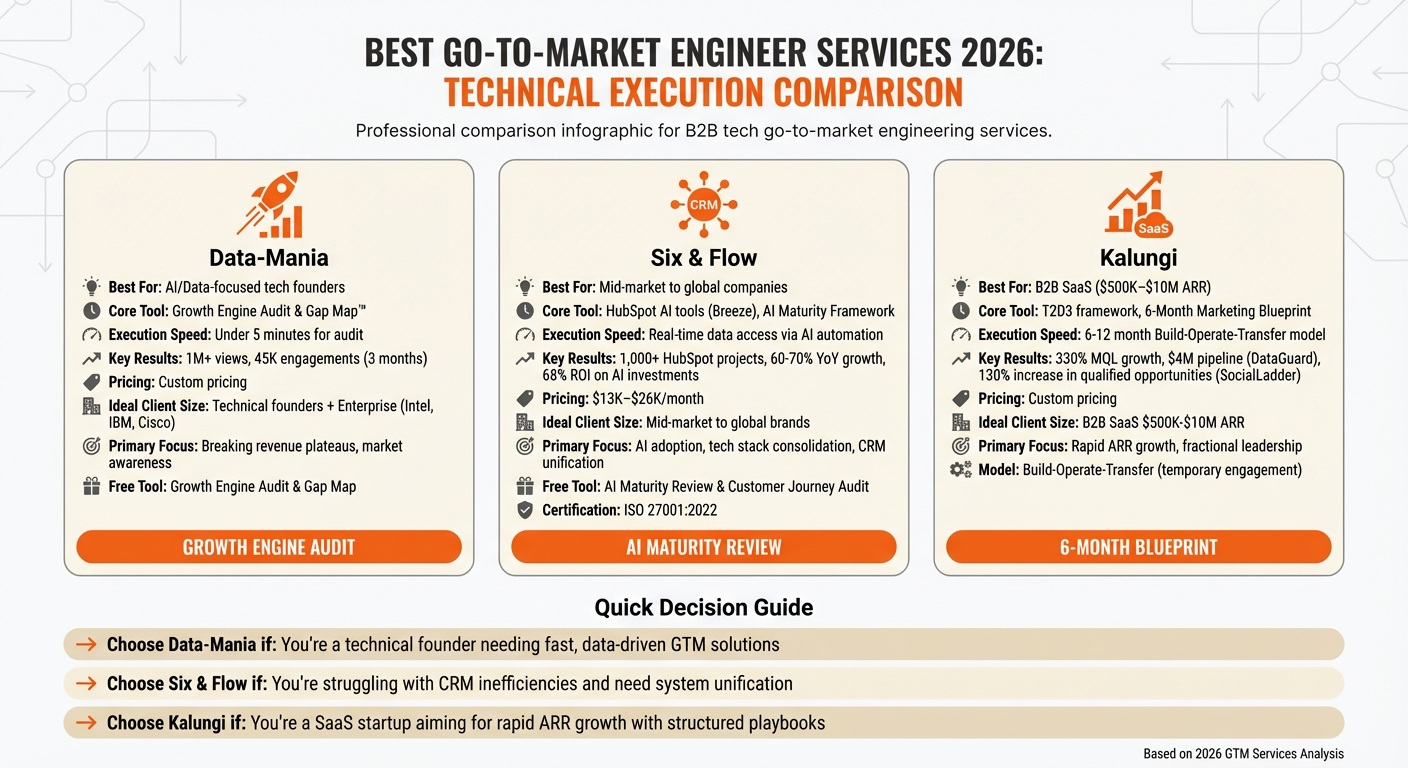
Quick Comparison Table:
| Provider | Best For | Core Tool/Method | Standout Results | Pricing |
|---|---|---|---|---|
| Data-Mania | AI/Data-focused tech founders | Growth Engine Audit & Gap Map™ | 1M+ views, 45K engagements (3 months) | Custom pricing |
| Six & Flow | Mid-market to global companies | HubSpot AI tools (e.g., Breeze) | 1,000+ HubSpot projects, 60-70% YoY growth | $13K–$26K/month |
| Kalungi | B2B SaaS ($500K–$10M ARR) | T2D3 framework, fractional leadership | 330% MQL growth, $4M pipeline (DataGuard) | Custom pricing |
Who’s the best fit for you? If you’re a technical founder looking for fast, data-driven GTM solutions, Data-Mania is the clear choice. For companies struggling with CRM inefficiencies, Six & Flow offers the expertise to unify your systems. And if you’re a SaaS startup aiming for rapid ARR growth, Kalungi delivers structured, scalable results.
Data-Mania vs Six & Flow vs Kalungi: Go-to-Market Services Comparison 2026
Data-Mania‘s Technical Execution Capabilities
Methods and Tools
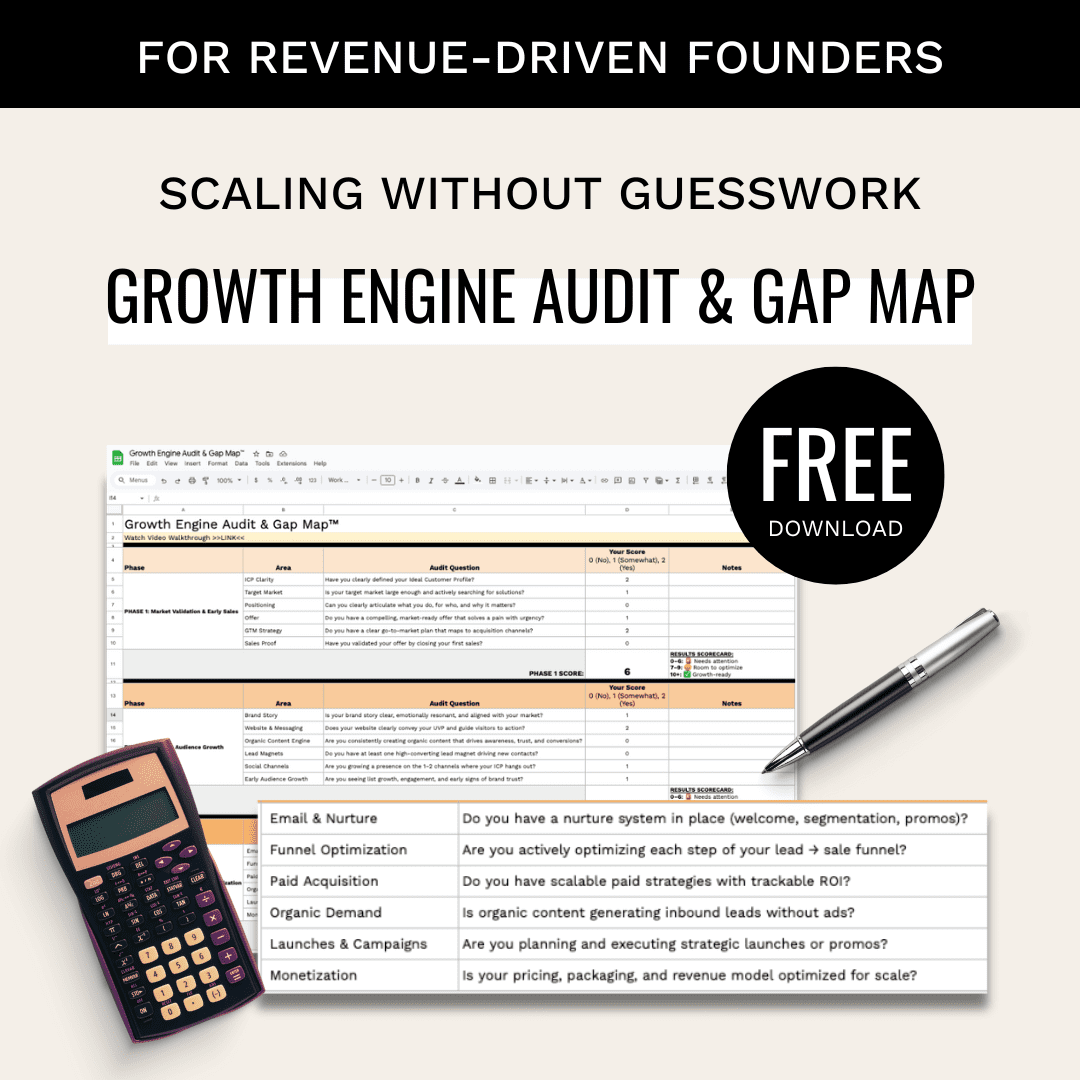
At the heart of Data-Mania’s technical execution lies the Growth Engine Audit & Gap Map™, a proprietary diagnostic tool designed to pinpoint revenue bottlenecks in under five minutes. This tool evaluates three critical phases – Market Validation, Brand Growth, and Monetization – helping businesses identify where to channel their efforts for the greatest impact[4].
What makes this approach stand out is its ability to simplify complex technical concepts into actionable insights. As Matt Carter, Global Program Director at IBM, highlights:
Lillian Pierson’s gift for turning complex and high-technical information into engaging, approachable and consumable content is paired with an innate understanding of trending or soon-to-be trending technology topics.[4]
This skill is particularly valuable for companies in Data and AI, where translating intricate product details into market-ready strategies can be a significant challenge. Data-Mania’s methods bridge this gap, delivering strategies that are both practical and impactful.
Case Studies and Results
Data-Mania’s results speak volumes about its effectiveness. For instance:
- A three-month outreach campaign for IBM attracted over 1,000,000 views and 45,000 engagements[4].
- A brand awareness project with Armor Cloud generated 8,700 engagements[4].
- SheetRocks’ CEO credited a major market breakthrough to Data-Mania’s expertise. As Tony Garvan, Founder & CEO of SheetRocks, put it:
As a technical founder, I was pretty naive around what it really would take to get a big product to market. Working with Lillian was really, really, a critical part of us getting to the next level in our business.[4]
These examples illustrate how Data-Mania’s strategies drive measurable outcomes, helping companies achieve their growth goals.
Strengths in B2B Tech Growth
Data-Mania excels at solving go-to-market (GTM) challenges for technical industries. Its collaborations with leading names like Intel, Cisco, Dell, and National Geographic[4] highlight its expertise in navigating complex markets. Matt Brown, Head of Global Growth at SingleStore, shared:
In Data & AI, it is a rare find to come across someone as dedicated and adept as Lillian Pierson. Her partnership with us has been nothing short of transformative. Her approach is characterized by a genuine curiosity and a commitment to understanding every facet of our brand. This has enabled her to craft strategies that are not only effective in bringing our product to market, but also in ensuring that it resonates with our target audience.[4]
This deep technical insight enables Data-Mania to design scalable growth systems tailored for revenue-focused founders. By addressing the unique challenges of highly technical markets, they help businesses overcome plateaus and unlock new opportunities for growth.
Six & Flow’s Technical Execution Capabilities
Methods and Tools
Six & Flow takes a RevOps-driven approach to GTM (go-to-market) engineering, seamlessly connecting marketing, sales, and customer success teams through a unified data layer and standardized processes[6].
At the core of their methodology is the "More ≠ More" principle, which focuses on simplifying tech stacks by cutting out underutilized tools. As they put it:
"Waste elimination in your GTM tech stack is not merely a cost-cutting measure; it’s a strategic move for sustainable growth."[5]
Their execution framework is anchored on three pillars:
- Strategy: Includes journey mapping, API scoping, and developing a scalable data architecture.
- Implementation: Focuses on system structuring and tool setup.
- Enablement: Provides training and ongoing optimization.
For AI adoption, Six & Flow employs their proprietary FLAIR Framework, designed to guide B2B teams from experimental AI usage to scalable, strategic applications within GTM operations[9].
As a HubSpot Elite Partner with over a decade of expertise, Six & Flow delivers more than just basic setups. They excel in advanced technical implementations, prioritizing data normalization and entity mapping. By restructuring customer, company, and deal records into a unified schema, they help eliminate inefficiencies. They also provide custom integrations, CRM migrations, and automated data hygiene using HubSpot’s AI tools, such as Breeze, which replaces manual data entry with automated enrichment and scoring[2].
These strategies consistently deliver measurable outcomes, as highlighted in their case studies.
Case Studies and Results
Having completed over 1,000 projects, Six & Flow has demonstrated impressive growth, achieving 70% year-over-year revenue growth in 2022 and 60% from 2022 to 2023. Notably, about 90% of their revenue comes from the HubSpot partner program[8].
For CFO Centre, Six & Flow implemented a global HubSpot solution to address fragmented data and disconnected international teams. Through in-depth workshops and a comprehensive data migration process, they enabled a 100% digital sales process, unifying operations worldwide[9]. Craig Keenan, Project Lead at The Citation Group, described their work consolidating nine brands into a single HubSpot instance for streamlined reporting and operations:
"The team works very digitally and gets the job done to the schedule provided, using great expertise. They are very flexible and understanding of challenges."[8]
In another project for Janes, Six & Flow successfully integrated four enterprise technology systems within a tight 12-week deadline. Meanwhile, Tiffany Tippin, COO of Mommy Labor Nurse, shared her experience after an 8-month optimization project that empowered her team to independently manage HubSpot:
"We have had an amazing experience, and have truly been blown away with S&F’s level of commitment! They have gotten to know our business inside and out."[8]
Strengths in B2B Tech Growth
Six & Flow’s strategic leadership is a driving force for B2B tech growth. Their fractional leadership services, priced between $13,000 and $26,000 per month, help clients turn single leads into multiple revenue opportunities. Richard Wood, CEO of Six & Flow, explains:
"With HubSpot, we can help our clients take a single lead or opportunity and turn it into three or four opportunities that they can sell into."[8]
Unlike agencies that view HubSpot as just a campaign tool, Six & Flow designs it as a comprehensive "revenue engine", breaking down silos between departments[7]. Their ISO 27001:2022 certification for information security management highlights their commitment to secure and scalable solutions for B2B tech firms. As one of the few independent Elite HubSpot Partners – and the second to achieve this status – they continue to demonstrate their expertise and success in high-volume projects[8].
Navigating B2B GTM Strategies and Execution | XQL Podcast Ep.20
sbb-itb-e8c8399
Kalungi‘s Technical Execution Capabilities
Kalungi has carved out a streamlined, results-oriented approach tailored specifically for B2B SaaS companies, building on insights from various GTM engineering strategies used by others.
Methods and Tools
At the core of Kalungi’s approach is the T2D3 framework, designed to triple Annual Recurring Revenue (ARR) for two years in a row, followed by doubling it in the third year[12][13]. This is executed through a 6-Month Marketing Blueprint, which includes over 100 detailed project cards organized in Trello, offering a clear roadmap broken down month by month[10][12].
Kalungi’s methodology also incorporates the Three Fs – Focus (market segmentation), Feasibility (market penetration potential), and Fit (technical and competitive alignment)[13]. They categorize SaaS growth into four stages: Coach, Start, Scale, and Profit, each requiring tailored technical strategies and team setups[12].
One standout feature of Kalungi’s approach is their commitment to the "lightest GTM model that works." Co-founder Stijn Hendrikse demonstrated this with MightyCall, a SaaS startup that achieved profitability without a sales team by relying on a zero-touch GTM model centered on product experience and optimized content[11]. As a HubSpot partner, Kalungi also rebuilds martech stacks from scratch, implementing custom attribution models to track MQL-to-SQL conversion rates. Co-founder and Head of Technology Fadi George emphasizes the importance of "bulletproof data" in these processes[17].
Their fractional CMO model provides senior-level strategic input without the expense of a full-time executive, targeting B2B SaaS companies with ARR between $500,000 and $10 million[10][12].
Case Studies and Results
Kalungi’s impact is evident through its work with clients like DataGuard, a Berlin-based privacy software provider. Acting as a full-service marketing team, they rebuilt the martech stack on HubSpot, launched multichannel campaigns, and trained nine internal marketers. The outcomes were impressive: a 330% increase in MQLs, $4 million in qualified pipeline, 581% growth in organic traffic, and a 93% drop in bounce rate[14]. DataGuard’s Founder and CEO, Kivanc Semen, praised their approach:
"The uniqueness of Kalungi comes especially from its hybrid approach, combining marketing leadership and management capabilities with agency services. They had everything we needed."[14]
For Clearwave, a healthcare tech company, Kalungi spearheaded a website redesign, branding overhaul, and new product launch within seven months. Associate CMO Brian Graf delivered a 30% lift in MQLs and successfully recruited a new BDR and permanent CMO for the company[15]. Similarly, Beezy, a digital workplace platform, leveraged Kalungi’s structured playbook to create a $2 million qualified pipeline. CEO Jordi Plana shared:
"They have a playbook that outlines where you should be month by month. They gave us a plan to execute against, which was extremely valuable."[12]
SocialLadder also benefited significantly, achieving a 130% increase in qualified opportunities and a 220% boost in qualified outbound opportunities after engaging Kalungi’s fractional leadership model[16].
Strengths in B2B Tech Growth
Kalungi’s standout offering is its "Build-Operate-Transfer" model, which focuses on making their involvement temporary by training and hiring internal teams to take over within 6–12 months[14][12]. Helena Kleine, Growth Copywriter at DataGuard, described their approach as:
"A plug-and-play marketing team with flexible workers who can easily swoop in and fill any position in marketing."[14]
By focusing exclusively on B2B SaaS companies with ARR between $500,000 and $10 million, Kalungi has honed its expertise, working with over 100 companies in this growth stage[11][12]. They also integrate AI for predictive analytics and automate repetitive tasks in areas like social media and customer engagement[17]. As a HubSpot Champion User, Fadi George strongly advocates for the platform:
"I have a strong opinion about what CRM to use for marketing, and it’s HubSpot. Don’t bother looking at anything else."[17]
This specialized focus helps Kalungi address the marketing-sales alignment gap – a challenge that costs companies over $1 trillion annually. Organizations that bridge this gap generate 208% more revenue from marketing compared to their misaligned counterparts[18].
Side-by-Side Comparison
Comparison Metrics
Each provider brings a distinct approach to GTM engineering. Data-Mania focuses on technical founders with its fast and efficient Growth Engine Audit & Gap Map. This tool identifies growth opportunities in less than 5 minutes and supports actionable insights over 3-month campaigns[4]. On the other hand, Six & Flow leverages its AI Maturity Framework and Revenue Architecture to streamline operations using real-time HubSpot AI automation[1][2]. Kalungi, however, keeps its technical execution methods under wraps.
When it comes to measurable outcomes, the differences are clear. Data-Mania’s outreach campaigns have achieved over 1 million views and 45,000 engagements in just three months[4]. Six & Flow highlights that 68% of business leaders have seen tangible returns from integrating AI into their GTM strategies[1]. Unfortunately, Kalungi has not disclosed specific success metrics.
The table below provides a side-by-side breakdown of key metrics for better clarity.
| Metric | Data-Mania | Six & Flow | Kalungi |
|---|---|---|---|
| Core Methodology | Audit & Gap Map (Validation, Growth, Monetization)[4] | AI Maturity Framework & Revenue Architecture[1][2] | Not specified |
| Technical Tools | Data/AI strategy and technical content development[4] | HubSpot AI (Breeze) and CRM process mapping[2] | Not specified |
| Execution Speed | Audit in under 5 minutes; 3-month campaign cycles[4] | Real-time data access via AI automation[1] | Not specified |
| Success Metrics | 1M+ views and 45K engagements in 3 months[4] | 68% of leaders report returns on AI investments[1] | Not specified |
| Ideal Client Size | Technical founders and enterprise clients (e.g., Intel, IBM)[4] | Mid-market to global brands[1][2] | Not specified |
| Primary Focus | Breaking revenue plateaus and increasing market awareness[4] | AI adoption and tech stack consolidation[1][5] | Not specified |
| Free Assessment | Growth Engine Audit & Gap Map[4] | AI Maturity Review & Customer Journey Audit[1] | Not specified |
| Pricing | Custom pricing | Custom pricing | Not specified |
This comparison highlights the unique strengths of each provider, offering a clear view of their methodologies, tools, and focus areas.
Best Technical Execution Provider for 2026
Data-Mania emerges as the top technical execution partner for B2B tech startups and scale-ups in 2026. Their standout tool, the Growth Engine Audit & Gap Map, identifies go-to-market (GTM) gaps in less than 5 minutes – a game-changer when 68% of business leaders report tangible returns from AI investments[1][4].
Data-Mania’s impact is evident in their outreach campaigns, which garnered over 1 million views and 45,000 engagements within just three months. This success is rooted in Lillian Pierson’s rare combination of engineering expertise and marketing savvy, enabling her to simplify technical complexities into actionable market strategies[4].
"As a technical founder, I was pretty naive about what it would really take to bring a big product to market. Working with Lillian was critical in elevating our product to market."
- Tony Garvan, Founder & CEO, SheetRocks[4]
In contrast, Six & Flow shines in CRM infrastructure, boasting over 1,000 successful HubSpot implementations. However, their focus leans more toward operational systems rather than strategic market positioning. For startups struggling with revenue stagnation or weak market traction, Data-Mania’s three-phase framework – Market Validation, Brand Growth, and Monetization – pinpoints and addresses core challenges[4]. This structured approach provides the strategic clarity essential for choosing the right partner based on a company’s stage and priorities.
Recommendations
Here’s how startups can align their needs with the right provider:
- Choose Data-Mania if you’re a technical founder at a seed to Series B stage company. If you’re wrestling with market validation, brand growth, or translating technical expertise into compelling market narratives, their Growth Engine Audit pinpoints growth barriers, and their 3-month campaign cycles deliver measurable progress[4].
- Choose Six & Flow if you’re a Series B+ company with a solid product-market fit but bogged down by fragmented data systems and siloed tools. Their ISO 27001:2022 certification and Revenue Architecture approach are tailored to resolve infrastructure inefficiencies[1][3].
The real challenge isn’t just CRM setup – it’s gaining strategic clarity on what to build, who to target, and how to craft your messaging. Data-Mania’s embedded operator model, combined with Lillian Pierson’s engineering background, makes them the go-to partner for founders looking to transform technical know-how into market success. By addressing these foundational obstacles, Data-Mania paves the way for scalable B2B growth in 2026.
FAQs
How does Data-Mania’s Growth Engine Audit & Gap Map™ help B2B tech startups achieve scalable growth?
Data-Mania’s Growth Engine Audit & Gap Map™ offers B2B tech startups a quick, data-focused way to uncover and tackle growth challenges. In just a few minutes, it highlights exactly where a company’s revenue pipeline is getting stuck, shedding light on issues such as underperforming acquisition channels, pricing mismatches, or weak points in post-sale activation.
The tool breaks its findings into three clear phases: Market Validation, Brand Growth, and Monetization. This structure provides founders with a straightforward, actionable plan to create scalable systems. By removing guesswork and streamlining execution, startups can often break through revenue plateaus and establish reliable growth patterns. It’s a powerful resource for achieving consistent, data-driven growth heading into 2026.
How does Six & Flow’s AI-powered CRM integration enhance business efficiency?
Six & Flow’s AI-powered CRM integration simplifies business operations by organizing and unifying customer data. With the help of predictive and generative AI, it takes over repetitive tasks like sales follow-ups and handling customer service queries, cutting down on manual labor and saving valuable time.
The system also delivers real-time insights, enabling smarter decision-making and more accurate forecasting. By streamlining workflows and addressing inefficiencies, this integration allows businesses to run smoother and concentrate on scaling their growth.
What are the main advantages of Kalungi’s T2D3 framework for SaaS startups?
Kalungi’s T2D3 framework provides SaaS startups with a structured approach to drive rapid growth, aiming for a specific ARR trajectory: tripling revenue for the first two years, followed by doubling it over the next three. This step-by-step playbook is designed to help founders move from early marketing efforts to establishing a scalable and repeatable growth engine.
The framework emphasizes aligning go-to-market strategies with clear, measurable milestones. It prioritizes key marketing channels and develops a comprehensive marketing system that delivers both immediate results and sustainable growth. This approach ensures predictable ARR growth, meeting the high expectations of founders and investors alike.
Related Blog Posts
- Top 10 GTM Engineering Consultants for 2026 & How To Choose the Right One For Your Startup
- The AI GTM Engineer: The Missing Role Behind Scalable B2B Growth
- Fractional CMO vs GTM Engineer vs Agency: What Startups Actually Need
- Best GTM Engineering Tools 2026: How to Choose (Orchestration, Data Quality, Attribution, and Integration Depth)