
I was scrolling LinkedIn last week when something stopped me cold.
It wasn’t a single post or a quote graphic.
It was the scrolling itself: the relentless, homogeneous scroll. Post after post of polished, keyword-optimized, AI-assisted content about data strategy, AI adoption, digital transformation, and growth frameworks. All saying something. None saying anything really meaningful at all.
I read the first sentences of six posts in a row and couldn’t have told you who wrote them.
And then it hit me… this is exactly what’s inflating B2B customer acquisition costs for most startups.
The signal-to-noise ratio has collapsed, and the startups that built their acquisition engine on “we’ll publish more content and run more ads” are now paying 40-60% more per customer than they were in 2023, for results that are getting worse every quarter.
I work with data and AI startup founders every day as a fractional CMO. And when I sit down with a founder who’s frustrated by rising acquisition costs, I always ask the same question first: Who, specifically, are you trying to reach?
More often than I’d like, the answer is: “Anyone who needs to make better use of their data” or “Companies that want to use AI to grow.”
Unfortunately that’s not a clear ICP.
And until you fix that, no budget reallocation or AI personalization tool is going to save you.
B2B Customer Acquisition Cost: The 2026 Reality Check
Before we talk about what to fix, let’s look at what you’re actually up against.
B2B customer acquisition costs have climbed sharply across the board. Across all marketing channels, the average B2B SaaS company now spends $536 to acquire a single customer.
In fintech, that average jumps to $1,450, and for enterprise-focused fintech companies, it can reach $14,772 per customer.
At a 3:1 LTV:CAC ratio, an enterprise fintech customer would need to generate about $44,316 in lifetime value. Break-even, by contrast, would be $14,772.
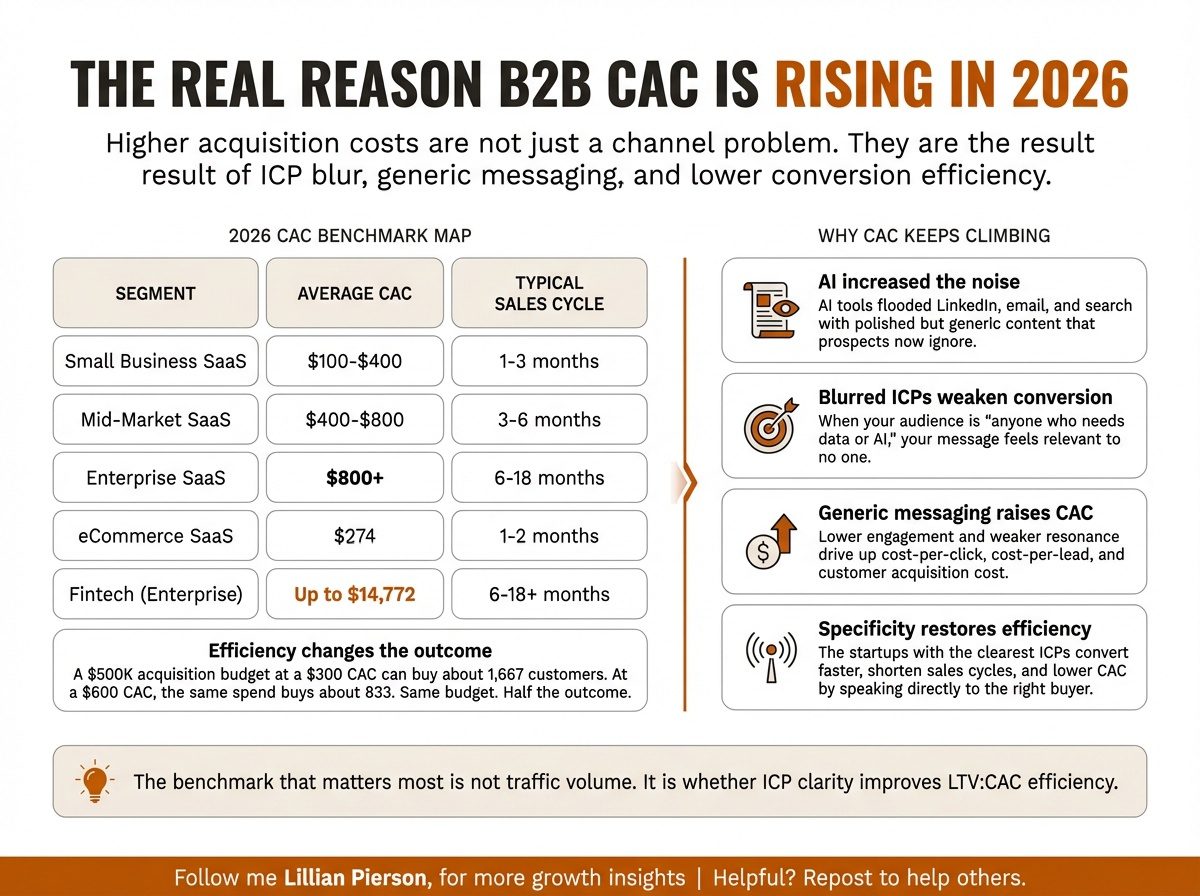
Here’s a quick benchmark map by segment:
| Segment | Average CAC | Typical Sales Cycle |
|---|---|---|
| Small Business SaaS | $100-$400 | 1-3 months |
| Mid-Market SaaS | $400-$800 | 3-6 months |
| Enterprise SaaS | $800+ | 6-18 months |
| eCommerce SaaS | $274 | 1-2 months |
| Fintech (Enterprise) | Up to $14,772 | 6-18+ months |
By channel, the picture is equally stark.
Paid search for B2B campaigns averages $802 per customer. Google Ads cost-per-lead hit $70.11 in 2025, up 5.13% year-over-year, and that trend is accelerating. Organic channels (SEO, content) run between $500 and $1,500 per customer but build compounding returns over time. Referrals, at $141-$200 per customer, remain the most efficient acquisition source by far.
That means a startup with a $500,000 acquisition budget and a $300 CAC could acquire about 1,667 customers. If each customer is worth $1,500 in lifetime value, that implies about $2.5M in LTV. At a $600 CAC, the same budget buys about 833 customers. If each is worth $1,200 in LTV, that implies about $1M in LTV.
The same budget with a CAC of $600 (LTV:CAC of 2:1) buys 833 customers and $1M in lifetime value. Same spend, but half the outcome. The difference is simply in efficiency.
And efficiency starts with knowing exactly who you’re trying to reach.
Why AI Made the ICP Problem Worse
Here’s the shift I keep watching unfold in real time.
The AI content tools that promised to help startups scale their marketing have, in aggregate, flooded every acquisition channel with well-formatted, semantically coherent, absolutely generic content. LinkedIn. Email. Organic search. They’re all drowning in it.
When every company in the data and AI space is publishing “5 Ways AI Is Transforming [Insert Industry Here],” the signal disappears. Your prospects (the ones you actually need to reach) become numb to it. They stop clicking. They stop converting. They develop what I’d call acquisition immunity: a trained response to tune out anything that sounds like it could have been written for basically anyone.
This is the compounding cost of ICP blur.
When your audience is “anyone who needs data or AI,” your content speaks to no one specifically. Generic content generates generic engagement rates. Generic engagement rates drive up your cost-per-click and cost-per-lead, because you’re paying to reach everyone and converting a small fraction of them. Your CAC climbs because your message got quieter, even as your output volume increased.
The founders I work with who have crisp, specific ICPs (“early-stage fintech compliance teams at Series A companies with 10-50 employees” or “data engineering leads at B2B SaaS companies running on Snowflake”) have a fundamentally different acquisition experience.
The founders I work with who have crisp, specific ICPs (“early-stage fintech compliance teams at Series A companies with 10-50 employees” or “data engineering leads at B2B SaaS companies running on Snowflake”) have a fundamentally different acquisition experience. Their content resonates. Their conversion rates are higher. Their CAC is lower because they’re speaking directly to someone who recognizes themselves in what they’re reading.
The ICP Clarity Framework for Data and AI Startups
Getting specific about your ICP is a unit economics exercise. Here’s the three-part framework I use with clients:
1. Identify Your Best Customers (Hint: They May Not Be Your Biggest Ones)
Pull your last 12-24 months of customer data and find the customers who: (a) converted fastest, (b) churned least, and (c) expanded most. These are not always your biggest logos. They’re your most efficient customers: the ones who understood the value quickly and stayed.
Describe those customers with specificity: role, company size, tech stack, stage of data maturity, and what problem they were solving when they found you. That profile is your real ICP.
2. Map Your ICP to the Channels Where They Actually Live
Once you know who your best customers are, ask where they go when they’re not on a buying journey. Data engineering leads hang out in dbt Slack communities and attend Coalesce. AI-curious CXOs read MIT Tech Review and follow a handful of practitioners on LinkedIn. Compliance leaders in fintech live in regulatory webinars and trade association forums.
If your acquisition channel strategy doesn’t reflect where your ICP actually spends their attention, you’re paying a premium to interrupt people who weren’t looking for you. That’s where CAC inflates fastest.
3. Build Content That Proves You Know Their World
The antidote to the AI content flood isn’t more content. It’s more specific content. A post that speaks to the exact technical pain a data engineer faces when reconciling dbt models with downstream BI tools will outperform ten generic posts about “the future of data.” A case study that shows how a Series A fintech compliance team cut audit prep time in half will convert better than a whitepaper on “AI in financial services.”
When your ICP reads your content and thinks “they wrote this for me,” your CAC starts to fall. Referrals go up. Sales cycles shorten. You’re no longer paying to shout into the void.
What to Actually Do This Quarter
If your B2B customer acquisition cost has been climbing and you’re not sure where to start, here’s the sequence I’d recommend:
- Audit your CAC by channel and by customer segment. Most founders are looking at blended CAC and missing the story underneath. You may be surprised to find that one channel or one customer segment is dragging your average up while another is super efficient.
- Talk to your five best customers. Ask them what they were trying to solve when they found you, what made them trust you enough to buy, and who else in their network has the same problem. You’ll learn more about your real ICP in those five calls than in any persona workshop.
- Narrow before you scale. It feels counterintuitive, but going narrower on your ICP (even temporarily) usually drops CAC within one to two quarters. You write better content, target more precisely, and attract customers who convert faster and stay longer.
- Protect your LTV:CAC ratio. The industry baseline is 3:1. High-performing B2B SaaS companies target 4:1 to 7:1. If your ratio is below 3:1, every acquisition dollar you spend is a bet you can’t afford to lose. Retention and expansion are the fastest ways to improve this ratio without touching your acquisition budget.
- Don’t automate a broken process. AI marketing tools are genuinely useful for personalization, lead scoring, and content distribution, once you know who you’re targeting. Using them before you have ICP clarity is like putting a turbocharger on a car with a flat tire. You’ll go faster in the wrong direction.
The Benchmark That Actually Matters
The data tells one story. The payback period (how long it takes to recover your CAC) tells another.
For organic channels, breaking even typically takes 6-9 months. After that, every dollar earned is profit. For paid channels, the math depends on monthly recurring revenue per customer and how long they stay.
Monthly churn varies widely by SaaS segment, pricing model, and ARPA, so avoid treating any single benchmark as universal. What matters is that improving retention materially improves LTV and payback efficiency.
LTV:CAC is the clearest lens you have on whether your business model is healthy.
And if the denominator (your CAC) keeps climbing while the numerator (customer lifetime value) stays flat, that’s a big problem.
If you’re staring at CAC numbers that feel unsustainable, I’d be glad to take a look at your acquisition model with you. I work with a select number of data, AI, and B2B tech startups as a fractional CMO, helping founders build acquisition systems that are specific, efficient, and built to scale.
P.S. The LinkedIn scroll that started all of this? I kept going, past the AI content, until I found a post from a data engineering leader that was describing a very specific problem with pipeline observability at scale. It had 23 likes. But every single comment was from someone who had the exact same problem and was actively searching for a solution. That is what ICP clarity looks like in the wild. The reach was small, the signal was everything.