


Running a startup with a tiny marketing team? You don’t need a big budget or a large team to compete anymore. With the right AI tools, a 2–3 person team can deliver the output of an entire marketing department. Here’s why this matters and how to make it work:
- Cost Savings: Hiring a junior marketer costs $55K–$75K/year. An AI marketing stack? Just $300–$600/month.
- Efficiency Boost: Most startups juggle 12–15 tools, but only use 33% of their features. AI simplifies workflows and saves time.
- Proven ROI: Generative AI delivers 3.7x returns on go-to-market strategies.
The key is focusing on six core building blocks to automate repetitive tasks and free up your team for high-impact work:
- Content Creation: Tools like Claude Pro and Surfer SEO replace expensive writers and streamline content production.
- Distribution: Automate social posts with Buffer and optimize paid ads with AdCreative.ai.
- Analytics: Use GA4 or Plausible for clear, actionable performance data.
- Automation: Connect workflows with Make.com or Zapier to eliminate manual handoffs.
- CRM: Start with a simple CRM like HubSpot Free to manage your pipeline.
- Search Visibility: Optimize for traditional SEO and show up in AI search results with tools like Averi and Surfer SEO.
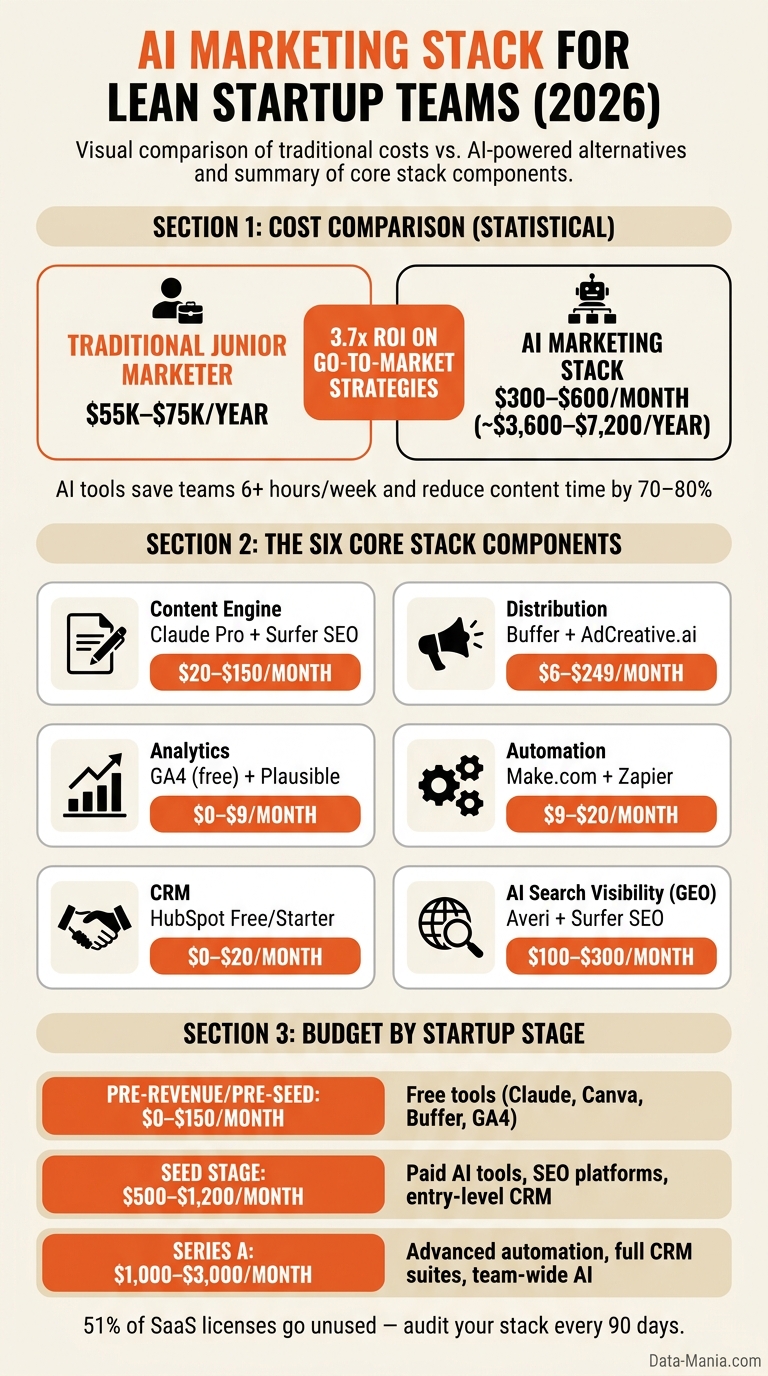
AI Marketing Stack vs. Traditional Hiring: Cost & ROI for Lean Startups (2026)
The New AI Martech Stack
sbb-itb-e8c8399
Building the AI Marketing Stack: Six Core Components
Every tool in this stack serves a key purpose, empowering small teams to function like a fully staffed department. Below, each section highlights a specific task, a recommended tool, and the workflow it supports. The aim? A stack that’s practical and ready for action – not a collection of tools chosen blindly.
Content Engine: AI Tools for Writing and Content Management
Creating content can easily eat up a full workday, but AI tools can reduce that time by 70–80% [3].
For seed-stage teams, Claude Pro ($20/month) excels at long-form writing while keeping your brand voice intact. Pair it with Surfer SEO ($89–$150/month) for keyword research and on-page optimization. Together, they handle everything from brainstorming topics to drafting SEO-friendly content and creating briefs. If you’re looking for an all-in-one solution, Averi ($100–$300/month) specializes in the SEO-to-GEO pipeline and even provides a "citation readiness" score to indicate the likelihood of your content being picked up by AI search engines.
"Personalisation at scale drives 2–3x better engagement than generic campaigns. But it only works when you have the right systems and processes in place." – Michael Torres, Chief Growth Officer, Amplitude
For growing teams, consider adding a dedicated editor and a design tool to streamline visual content creation.
Once your content is ready, the next step is ensuring it reaches the right audience.
Distribution Engine: Automating Multi-Channel Campaigns
Creating great content is just the start – it needs to find its audience. Buffer ($6 per channel/month) simplifies social scheduling and integrates seamlessly into your workflow. For paid media, AdCreative.ai ($109–$249/month) generates and tests ad creatives across platforms. The secret here is repurposing: one blog post can fuel multiple social posts across LinkedIn, X, and Instagram without the hassle of manual adjustments.
Focus on 2–3 channels where your audience is most active, rather than spreading yourself too thin.
For scaling teams, an AI-native platform that auto-generates and schedules platform-specific content can save even more time by automating the entire publishing process.
Analytics and Reporting: Building a Data-Driven Foundation
You don’t need a full-time data analyst to track your marketing performance – just a tool you’ll actually use. GA4 (free) handles website traffic and conversion tracking, while Plausible (starting at $9/month) offers a straightforward, privacy-friendly dashboard. Focus on tracking the channels that drive your pipeline, not just total traffic. For products with self-serve features, Mixpanel (free tier) lets you analyze user behavior post-signup.
"The analytics tool you use daily always beats the one you use never." – Zach Chmael, CMO, Averi
As your team grows, consider adding a business intelligence tool or revenue attribution platform to better manage multiple paid channels.
Marketing Automation: Cutting Manual Work from Daily Workflows
Manual handoffs between tools create opportunities for leads to slip through the cracks. Automation bridges these gaps. Make.com (starting at $9/month) offers a visual workflow builder for setting up multi-step automations, like routing form submissions to your CRM, triggering welcome emails, and sending Slack notifications. Zapier (starting at $20/month) is another option, known for its quick setup, though costs can rise with complex workflows.
Prioritize automating lead routing, lead qualification, and lifecycle triggers (e.g., welcome sequences, activation nudges, and re-engagement emails) to save hours of manual work each week.
"Complex stacks mean teams spend more time managing tools instead of serving users or customers." – Emmett Miller, Co-Founder, Miniloop
For scaling teams, self-hosted solutions like n8n or more advanced marketing automation platforms with built-in CRM sync can further streamline operations.
Integrated automation sets the stage for the next step: connecting sales and marketing through a unified CRM.
CRM: Connecting Sales and Marketing to Drive Revenue
At the seed stage, founder-led sales require a simple, reliable CRM. HubSpot Free covers pipeline tracking, contact management, and basic email sequences, while HubSpot Starter ($20/month) adds email automation and removes branding. For technical founders needing more flexibility, Attio ($29 per user/month) offers advanced relationship intelligence.
Stick with one CRM to avoid data fragmentation across spreadsheets and platforms. Start with free tiers until your pipeline grows beyond 50–100 active deals, then evaluate whether upgrading makes sense.
For scaling teams, AI-powered note-taking and automated data enrichment can reduce manual entry as deal volume increases.
AI Search Visibility and GEO (Generative Engine Optimization)
Organic search still accounts for 53% of all website traffic [7]. But by 2026, an added challenge is ensuring your brand gets cited in AI-generated answers – a practice known as Generative Engine Optimization (GEO). While AI search drove less than 1% of referral traffic in early 2025 [8], being cited by AI engines can quickly boost brand authority.
Tools like Averi and Surfer SEO address both traditional SEO and GEO by combining keyword tracking with citation readiness features. HubSpot Breeze offers an AEO dashboard to track mentions in AI-generated answers, while Semrush users can leverage its AI search tracking tools without adding another platform.
Start with clear headings, data-backed claims, and concise Q&A formats. These practices improve both traditional SEO rankings and your chances of being cited by AI engines.
For scaling teams, investing in a GEO monitoring tool and building topical authority through structured content clusters can further enhance visibility.
How to Choose the Right Tools for a Lean Team
With new AI marketing tools popping up constantly, picking the right ones can feel overwhelming. For a small team of 2–3 people, a bad choice doesn’t just waste money – it creates unnecessary complexity that slows down your work.
Budget and Pricing: What to Expect
Here’s a look at typical spending at different startup stages:
| Startup Stage | Monthly Budget (USD) | Primary Focus |
|---|---|---|
| Pre-Revenue / Pre-Seed | $0 – $150 | Free tools like Claude/ChatGPT, Canva, Buffer; GA4 for analytics |
| Seed Stage | $500 – $1,200 | Paid AI tools, SEO platforms, and entry-level CRMs |
| Series A | $1,000 – $3,000 | Advanced automation, full CRM suites, team-wide AI tools |
Did you know that startups with fewer than 20 employees spend around $8,000 per person annually on SaaS? Yet, 51% of those licenses go unused [5]. This isn’t about the tools themselves – it’s about staying disciplined. Regularly audit your software stack and cut anything that’s not pulling its weight.
"The best marketing stack is the one your team actually uses. A $200/month stack used daily beats a $2,000/month stack used sporadically." – Zach Chmael, CMO, Averi [4]
Once you’ve set your budget, focus on tools that integrate smoothly with your existing workflows. Efficiency is key.
Ease of Setup and Integration
For a lean team, the time it takes to set up and integrate new tools is critical. If a tool takes two weeks to configure, it’s more of a burden than a help. Look for tools that work natively with your current systems – your CRM, email platform, and automation tools and AI agents. When native integrations aren’t available, middleware like Make.com can fill the gaps without needing a developer.
Stick to one tool per function: one AI writing assistant, one analytics platform, one CRM. Using overlapping tools creates data silos, decision fatigue, and unnecessary context switching. Small teams can’t afford the productivity hit. Before committing to a new tool, map out how its data will flow into your existing stack.
And remember, it’s not just about functionality – protecting your data is just as important.
Data Privacy and Security
Data privacy often gets overlooked – until it’s too late. Start by enabling two-factor authentication (2FA) on all your marketing tools. Use a shared password manager like 1Password to keep team credentials secure [11].
Also, pay attention to how AI tools handle your data. Free or individual-tier plans for tools like Claude or ChatGPT might use your inputs to train public models. Upgrading to a Team or Business plan ensures your prompts and customer data remain private [10].
If you’re using AI to create ad visuals or branded content, make sure the tool offers commercial licensing rights. For example, Adobe Firefly provides "stock-safe" licensing, which is essential when running paid campaigns [6].
Lastly, don’t ignore email security. If your email tool is part of the stack, confirm it meets the 2026 authentication standards: SPF, DKIM, DMARC, and one-click unsubscribe features are now non-negotiable [8].
Two-Week Plan to Launch Your AI Marketing Stack
With your AI marketing stack outlined, this two-week plan gets you up and running fast. The goal? Launch a functional system that starts collecting real data right away.
Week 1: Map Workflows and Set Up Tools
Start by auditing your current tools. List everything you’re using, note how often, and cancel anything that’s not pulling its weight – if it’s used less than once a week, it’s probably not worth keeping. Next, figure out where your team spends the most time. Are they writing endless social captions, drafting emails, or reformatting content for different platforms? These repetitive tasks are the perfect place to introduce AI.
Pick 3–5 workflows that will deliver the most impact when automated. Examples include drafting SEO blogs or breaking down long-form content into bite-sized social posts. For each workflow, map it out: what goes in, the steps involved, and the final output. Before setting up any tools, gather your brand assets – logos, tone guidelines, and style rules – to make sure AI stays in line with your brand’s identity.
Next, set up your tools in this order: analytics first, content tools second, and scheduling tools last. For analytics, install Plausible or GA4 and test your tracking events to confirm they’re working before you publish anything. Stick to the one tool per function rule – overlapping tools can create chaos, especially for small teams.
"AI is great at compressing repetitive work. It’s terrible at fixing strategy problems." – Ethan Priest, Cofounder, Foxtown Marketing [10]
To keep everyone on the same page, create a shared prompt library in Notion or Google Docs. This helps your team use consistent inputs, saving time and building a rhythm without endless back-and-forth.
Once workflows are mapped and tools are in place, you’re ready to move on to Week 2.
Week 2: Connect Tools and Launch the First Campaign
Now it’s time to integrate your tools. Use Make.com to connect them and automate data flows. Clearly outline how data moves through the system, such as how enrichment data enters your CRM and triggers email sequences [5].
For your first campaign, focus on 5–10 high-intent keywords with a small paid search budget. This helps validate demand quickly while your organic content gains traction [7]. Use Make.com to pull performance data from all channels into a single shared dashboard. This way, the whole team works from the same numbers during weekly reviews.
AI-powered social scheduling can make a huge difference. Founders using these tools post 3x more consistently and see 40% higher engagement rates than those posting manually [3]. Schedule two weeks of posts in Buffer, activate a welcome email sequence in Beehiiv (free for up to 2,500 subscribers), and double-check that everything triggers as planned.
| Phase | Focus | Key Tasks |
|---|---|---|
| Week 1 | Foundation | Audit tools, map workflows, gather brand assets, set up analytics, and implement core AI tools |
| Week 2 | Execution | Connect tools via Make.com, launch a paid campaign, publish blog posts, and activate email sequences |
Governance and Risk Management
To keep your new system running smoothly, establish clear review gates tied to your workflows. Use a human-in-the-loop model, where AI handles 80–90% of tasks like drafting, scheduling, and publishing, but a team member gives the final approval [3]. This ensures consistency while maintaining speed.
Set review gates based on content risk levels. For example:
- Low-risk: Social posts can go live after a quick scan.
- Medium-risk: Web copy and email sequences need a closer review.
- High-risk: Competitive claims or regulated topics require deliberate human sign-off [13].
Document these tiers in a simple, one-page guide so the process is clear and doesn’t rely on memory.
Finally, set 90-day milestones instead of year-long goals. Startups move too fast for annual plans. Break your targets into monthly checkpoints and review progress weekly. If a tool hasn’t been used by at least half the team in the past 30 days, cut it – no exceptions [2].
Growing Beyond the Minimum Viable Marketing Stack
Your initial marketing stack might get the job done early on, but as your business grows, cracks start to show – missed follow-ups, incomplete reports, and time-consuming manual tasks. The key is to add tools that address these specific inefficiencies, rather than overloading your team with unnecessary complexity.
A good rule of thumb: if a manual task takes more than 5 hours a week, it’s time to automate or upgrade [15]. Other signs include hitting the limits of free tools for a month straight, juggling more than 50 active leads in a spreadsheet, or wasting hours on a weekly report [14][12]. When these pain points surface, it’s a signal to streamline your processes and keep your team focused on higher-value work.
When and How to Add Specialized Roles
Founder-led marketing works well until your monthly recurring revenue (MRR) hits monthly recurring revenue (MRR) hits $10,000–$50,0000,000–$50,000. Beyond this point, balancing both strategy and execution becomes too much for one person [1][5]. But hiring a full-time marketer isn’t always the first step. Instead, leverage AI tools to handle repetitive tasks like drafting, scheduling, and reporting. This allows your first hire to focus on strategic growth rather than getting bogged down in execution [3][1].
The first roles to consider adding are typically a content strategist, a paid media owner, and an email/lifecycle marketer, in that order [10]. If your ad spend is between $15,000 and $50,000 a month, a fractional specialist working 10 hours per week can be a cost-effective alternative to hiring full-time [16].
"The most expensive mistake in martech is buying enterprise-grade tools before you have enterprise-grade problems." – Deepanshu Udhwani, itsdeep.io [15]
Upgrading Tools and Processes Over Time
Instead of upgrading tools based on arbitrary timelines, let specific triggers guide your decisions. By building on the six core functions of your stack, you can maintain efficiency as your team scales. Here’s a quick guide to common upgrade triggers and the actions they justify:
| Trigger | Action |
|---|---|
| Ad spend exceeds $5K/month + need for CRO | Add Foundry ($249/month) [16] |
| Google Ads spend exceeds $5K/month + 5+ hrs/week on bid management | Add Optmyzr or Adalysis ($99–$209/month) [16] |
| Running 2+ channels with $30K+ combined spend | Add an attribution tool like Rockerbox or Triple Whale [16] |
| 5+ tools needing connected data | Add Segment CDP ($120+/month) [16] |
| Series A/B scaling | Move to HubSpot Professional, Clay Scale, or n8n self-hosted ($2,000–$5,000+/month) [5] |
To avoid tool sprawl as you grow, stick to the hub-and-spoke model. Choose one central platform – typically your CRM or email tool – and ensure all other tools integrate with it seamlessly [15]. This keeps your reporting straightforward and prevents data fragmentation, which can slow down decision-making as your team expands.
"The biggest cost of too many small apps isn’t the subscription line item; it’s the recurring cognitive load that slows execution." – 3L3C [14]
How Data-Mania Supports Scaling Teams
As your marketing stack evolves and you bring in specialized roles, external strategic guidance can help you scale faster. Moving from a basic stack to a full growth system isn’t just about adding tools – it’s about knowing what to prioritize next. That’s where Data-Mania comes in.
Data-Mania’s Fractional CMO services are tailored for tech startups navigating this growth phase. They cover everything from go-to-market (GTM) strategy and GTM engineering to marketing leadership – without the cost of hiring a full-time executive.
For teams needing quick, actionable advice, a Power Hour advisory session with founder Lillian Pierson delivers a clear plan in just 60 minutes. For more in-depth support, Data-Mania’s consulting services tackle GTM builds, channel strategies, and paid media – precisely the areas where lean teams often hit their first scaling challenges.
Conclusion: Key Takeaways for Lean Teams
What an AI-Driven Marketing Stack Makes Possible
With the right tools, a small marketing team of just 2–3 people can operate at the level of a much larger department – all without increasing headcount. Generative AI, when integrated thoughtfully into your GTM stack, can dramatically improve efficiency. In fact, AI-native tools can save teams six or more hours per week by automating tasks that would otherwise be manual and time-consuming [1]. The key is to focus on automation that replaces the need for additional hires – streamlining your tools, tightening workflows, and dedicating your energy to initiatives that drive real impact.
Murat Bock, Founder of AdLibrary, sums it up perfectly:
"The mistake is buying tools that augment work you’re already doing slowly, rather than tools that replace work you’d otherwise hire for." [6]
This approach creates the foundation for quick implementation and measurable growth.
Next Steps for Getting Started
To hit the ground running, follow the two-week plan outlined earlier to validate your stack’s performance. Here’s how to break it down:
- Week 1: Audit your current workflows and activate essential tools – prioritize content, CRM, and analytics.
- Week 2: Automate connections between these tools and launch your first campaign, focusing on one channel or customer segment.
By weeks 3–6, you should start seeing measurable results, with more noticeable performance improvements emerging between months 4–6 [9].
One critical takeaway? Integration matters more than features. A tool that works seamlessly with your stack will always outperform a "powerful" tool that slows you down with manual processes. Start small, test quickly, and let real data – not feature lists – guide your next decisions.
Working with Data-Mania for Long-Term Growth
Once you see those initial wins, it’s time to think about scaling for the future. Data-Mania offers Fractional CMO services for tech startups that provide go-to-market strategies and execution without the cost of a full-time hire. These services cover everything from channel strategy to GTM engineering and marketing leadership, all designed specifically for tech startups.
Need a quick boost? Founder Lillian Pierson’s Power Hour sessions deliver a focused, actionable plan in just 60 minutes, helping you take immediate steps toward your goals. Whether it’s short-term wins or long-term growth, the strategies outlined here align perfectly with Data-Mania’s lean, results-focused approach.
FAQs
What’s the minimum AI marketing stack I can launch in two weeks?
For a lean team, the minimum AI marketing stack should include 3-5 essential tools that streamline critical tasks like content creation, social media scheduling, and distribution. This compact setup can effectively take the place of an entire marketing team, all for under $500 per month and can be up and running in just two weeks.
Prioritize tools that simplify workflows and save time. For example:
- AI writing tools to generate content quickly and consistently
- Social media automation platforms to schedule and manage posts across channels
- SEO or distribution solutions to ensure your content reaches the right audience
This combination keeps your marketing efforts efficient and cost-effective without sacrificing quality.
How do I keep AI-generated content on-brand and accurate?
To keep AI-generated content aligned with your brand, start by setting clear guidelines for voice, tone, and messaging. These rules act as a foundation, ensuring the AI understands your brand’s personality and values. Pair these guidelines with human oversight – reviewing outputs to ensure they reflect your brand accurately. Regular audits of AI content can help fine-tune its performance, improving both consistency and accuracy over time. By combining structured rules with human input, you can maintain high-quality, on-brand content.
Which metrics should a lean team track to prove marketing ROI?
To run an efficient lean team, keeping tabs on key metrics is essential. Start with customer acquisition cost (CAC) and customer lifetime value (LTV) – these numbers reveal how much you’re spending to gain customers and how much value they bring over time. Add conversion rates to the mix to see how effectively you’re turning prospects into customers, and don’t overlook your overall marketing ROI, which ties it all together.
These metrics aren’t just numbers; they’re tools to evaluate how well your marketing efforts are working. They help you make smarter decisions about where to allocate resources and identify areas that need improvement. The goal? Focus on actionable insights that drive better performance and prove your team’s impact.