

Customer acquisition costs (CAC) vary widely depending on the channel, and understanding these differences is key to smarter budget allocation. To do this effectively, you must first calculate customer acquisition cost accurately across all your marketing expenses. Here’s the short version:
- Organic Search (SEO): Long-term play with CAC between $205–$942. Payback in 6–18 months. Best for early-stage startups to build a foundation.
- Paid Search: Quick results but costly, with CAC averaging $802. Payback takes 4–16 months. Great for testing or scaling fast.
- Paid Social: Targeted but expensive, with LinkedIn CAC reaching $982–$20,000. Payback in 1–20 months, depending on platform and audience.
- Outbound SDR: The priciest, with CAC from $1,980–$25,000. Suited for enterprise deals with 12–24 month payback.
- Partner-Led: Most cost-efficient at $150 CAC and 1–3 month payback. Works well across all stages.
- Product-Led Growth (PLG) vs Sales-Led Growth: Highly efficient with CAC at $100–$500. Payback in 6–12 months. Ideal for self-serve models and freemium.
Key Takeaway:
No single channel fits every need. Fast results come at a higher cost (e.g., Paid Search), while channels like SEO and Partner-Led deliver lower CAC but require patience. The best strategy? Diversify your acquisition mix based on your stage and goals.
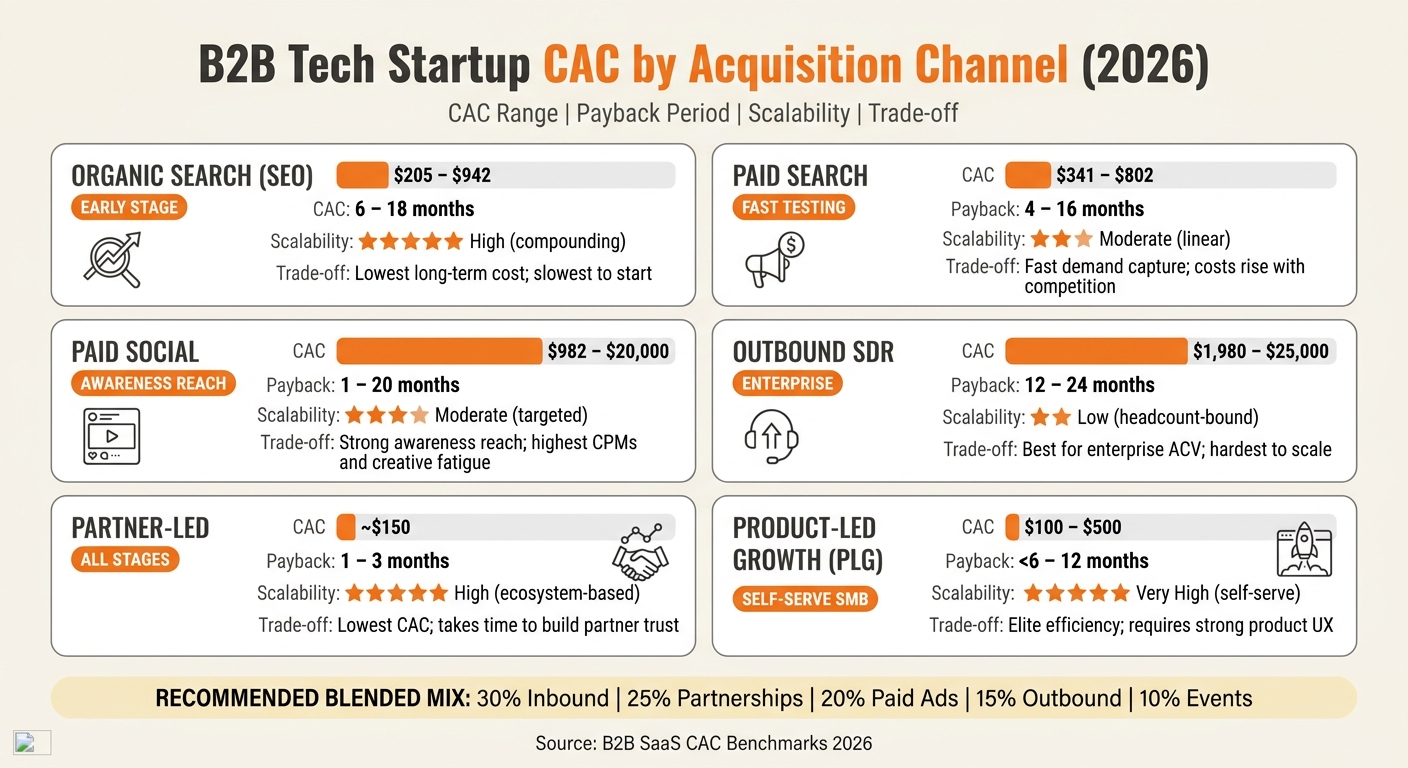
B2B Tech Startup CAC by Acquisition Channel (2026)
Episode 1 CAC Payback – The Cash Trap Behind B2B Growth
sbb-itb-e8c8399
1. Organic Search (SEO)
Organic search is often overlooked at the start, but its long-term value is undeniable. Content you create today can keep generating leads for years. Let’s break down the key factors like CAC ranges, payback periods, stage fit, and cost drivers for this channel.
CAC Range
The Customer Acquisition Cost (CAC) for organic search in SaaS averages about $205, while the broader B2B average is closer to $942 [5][7]. If you’re investing in Thought Leadership SEO – think original research or in-depth guides – it can cost around $647 per customer. On the other hand, Basic SEO, which targets generic terms, can climb to $1,786 per customer due to lower conversion rates from broad-intent traffic [7].
But remember, organic search isn’t just about ad spend. Costs include things like founder time (e.g., 10 hours/month at $100/hour adds up to $1,000 per month) [1]. Add in SEO tools, freelancer fees, and internal labor, and your amortized CAC typically falls between $480 and $942 [2][7]. These numbers highlight why understanding CAC payback timelines is so critical.
Payback Period
On average, SEO pays for itself by month 7 [2]. However, this timeline can range from 6 to 18 months, depending on factors like content quality, domain authority, and conversion rates [1]. High-intent content – like comparison pages or case studies – can speed things up dramatically. Organic leads, for instance, close at 14.6%, compared to just 1.7% for outbound leads [8]. Over time, this efficiency compounds, especially as your SEO strategy matures.
Stage Fit
SEO is a smart play early on. During the Seed stage, it helps build a foundation of organic traffic, which acts as a buffer against rising paid ad costs [2]. By Series B, the compounding benefits become clear, offering a competitive edge. For companies at Scale (with $20M+ ARR), payback periods shrink to 6–10 months as domain authority grows stronger [9]. Knowing this helps you decide how much to prioritize content and conversion optimization at each stage.
Key Drivers
The quality of your content is the biggest factor. Thought Leadership SEO draws in higher-intent readers who are closer to making a purchase. For example, improving your conversion rate by just 1.5 percentage points can cut your CAC by 33% without increasing content spend [2].
One emerging trend to watch is the rise of AI Overviews, which have led to a 61% drop in organic click-through rates for some queries [8]. To stay competitive, invest in original research and structured data like FAQ schema. Being cited in AI-generated answers can drive significant traffic – leads from tools like ChatGPT convert at 15.9%, compared to 1.76% for traditional Google organic traffic [8]. These shifts underscore why refining your organic strategy is essential before scaling with paid acquisition.
2. Paid Search
Paid search is your go-to when you need leads now. Unlike organic search, which takes time to build momentum, paid search can start driving traffic on day one. But speed has its price. While organic efforts offer long-term returns, paid search is all about quick validation of market fit – ideal for when you’re testing the waters or ramping up fast.
CAC Range
For B2B SaaS, the median customer acquisition cost (CAC) for paid search is about $802 [7]. However, this number can swing widely depending on your strategy:
- Brand search campaigns (targeting your company name): CAC typically ranges from $800 to $3,000 per customer.
- Non-brand campaigns (targeting broader keywords like "best CRM for startups"): CAC can climb to $3,000–$15,000 per customer [4].
On average, SaaS companies pay $127 per lead through Google Ads, with a conversion rate of around 4.2% [2].
Payback Period
The time it takes to recoup your ad spend varies depending on the campaign type:
- Brand campaigns: Payback periods are shorter, typically 4–8 months.
- Non-brand campaigns: These take longer, around 8–16 months [4].
Knowing these timelines can help you decide when paid search fits into your overall growth strategy.
Stage Fit
Paid search is particularly effective for early-stage companies (Seed and Series A). It builds a predictable pipeline, delivering sales-qualified leads in just 30–60 days [2][4]. Here’s how it aligns with different product types:
- SMB products (ACV of $5,000–$15,000): Payback in 6–9 months.
- Enterprise deals (ACV of $100K+): Payback in 14–22 months [4].
This makes paid search a strong option for startups looking to scale quickly while waiting for organic channels to mature.
Key Drivers
Your CAC boils down to a simple formula: CAC = CPC / CVR [2]. While cost-per-click (CPC) is largely dictated by competition, you can influence your conversion rate (CVR). Regular audits are essential – many startups waste 20–36% of their paid search budget on audiences outside their ideal customer profile [4].
"CAC = CPC / CVR. You can’t control CPC (it’s rising industry-wide). You can control CVR (conversion rate). A 1.5 percentage point CVR improvement reduces CAC by 33% without increasing ad spend." – Bradley Jones, Foundry CRO [2]
Improving your landing pages is one of the quickest ways to boost CVR. Another game-changer? Feeding offline conversion data from your CRM back into Google Ads. This helps the platform focus on quality leads instead of just chasing volume [4].
3. Paid Social
Paid social platforms offer highly targeted advertising opportunities, but the costs can vary significantly depending on the platform and your campaign goals.
CAC Range
Meta tends to deliver a cost per lead (CPL) of $94 [2] and an average customer acquisition cost (CAC) of $230 [10], making it a strong choice for campaigns focused on generating volume. LinkedIn, on the other hand, has a much higher CPL of $213 [2] and an average CAC of $982 [10]. For highly targeted enterprise campaigns, LinkedIn’s CAC can even climb to $5,000–$20,000 per customer [4]. TikTok stands out with a reported CPA of $32.74 [2], but the quality of conversions can vary widely.
| Platform | Avg. CPL | Avg. CAC | Conversion Rate |
|---|---|---|---|
| Meta (SaaS) | $94 [2] | $230 [10] | 3.1% [2] |
| LinkedIn (SaaS) | $213 [2] | $982 [10] | 2.8% [2] |
| TikTok (B2B) | $32.74 (CPA) [2] | N/A | Varies |
Understanding these cost benchmarks is essential for determining how quickly you’ll see a return on your investment.
Payback Period
Using CAC as a baseline, Meta campaigns aimed at SMB-focused products typically recover their costs within 1–4 months [1]. In contrast, LinkedIn campaigns targeting enterprise clients often require 10–20 months [4] to break even. This highlights the need to align your customer acquisition strategies with your company’s growth stage and financial goals.
Stage Fit
Paid social isn’t a universal solution – it needs to match your company’s stage and objectives. For Series A startups, it’s best used for demand capture, focusing on generating SQLs within 30–60 days rather than investing in long-term brand awareness.
"A Series A company with $2M ARR should not be running brand awareness campaigns with 18-month payback. They need demand capture campaigns that produce SQLs in 30–60 days." – Ishan Manchanda, Founder, GrowthSpree [4]
As companies progress to Series B and beyond, paid social can scale to drive both direct lead generation and broader initiatives like expanding your total addressable market (TAM). At this stage, it also helps create a "CAC shield" by building brand awareness that complements organic channels and offsets rising costs [2].
Key Drivers
Meta’s CPMs have surged by 40–60% since 2023 [2], driven by factors like privacy regulations, cookie deprecation, and AI-influenced bidding floors. To counteract these rising costs, improving conversion rates is critical. For example:
- Playvox reduced its CPL by 10x by refining its ideal customer profile (ICP) and reallocating its $50,000/month ad budget to more targeted accounts [10].
- TripMaster revamped its demo request process using CRO tactics, increasing demo requests by 35% and generating over $500,000 in new ARR [10].
These examples show how optimizing what happens after the click can make a huge difference in driving ROI, especially as ad costs continue to climb.
4. Outbound SDR
Outbound SDR is the priciest acquisition channel in B2B tech, with the median CAC hovering around $1,980 [6][10]. For enterprise deals, though, that figure can skyrocket to anywhere between $8,000 and $25,000, depending on deal complexity and the length of the sales cycle [4]. The annual cost of a single SDR, factoring in base salary, commissions, benefits, and tools, ranges from $139,000 to $150,000 [6]. This makes outbound SDR a channel best suited for high-value opportunities.
Here’s a closer look at CAC ranges, payback periods, and how costs vary by market segment.
CAC Range
The cost of outbound SDRs shifts significantly based on the deal size you’re pursuing:
| Segment | Typical Outbound CAC | Target Payback |
|---|---|---|
| SMB ($5K–$15K ACV) | $2,500–$6,000 [4] | 6–9 months [4] |
| Mid-Market ($15K–$50K ACV) | $8,000–$22,000 [4] | 9–14 months [4] |
| Enterprise ($50K+ ACV) | $25,000–$120,000 [4] | 12–18 months [4] |
One common issue: companies often underreport their outbound CAC by excluding SDR salaries and commissions.
"Excluding SDR costs from CAC is the most common accounting trick – and the reason some SaaS companies report ‘8-month payback’ when the real number is 16 months." – Ishan Manchanda, Founder, GrowthSpree [4]
Payback Period
Recovering outbound SDR acquisition costs typically takes 12–24 months [4][6]. For enterprise-focused strategies, an 18–24 month payback is considered reasonable, but anything beyond 24 months suggests deeper structural issues that need attention before scaling further [6][4].
Stage Fit
Outbound SDR isn’t the best choice for Seed or early Series A startups with limited runway. The long payback period doesn’t align with the immediate results these stages demand. However, it becomes a more viable option at Series B and later, when a company has a validated enterprise sales model and the financial flexibility to handle slower returns [4].
Key Drivers
Two factors heavily influence outbound SDR costs: data quality and AI adoption. For instance, in 2026, Meritt’s B2B team cut its outbound email bounce rate from 35% to under 4% by switching to verified contact data from Prospeo. This shift tripled their weekly pipeline from $100,000 to $300,000 without increasing overall outbound spend [10].
AI also plays a growing role in reshaping costs.
"AI SDR platforms offer a per-lead cost of approximately $39 versus $262 for a human SDR – an 85% cost reduction – while operating at 10–20x the volume." – Peter Vogel, Founder, peppereffect [6]
The takeaway? Use human SDRs for high-ACV deals, rely on AI to scale top-of-funnel outreach, and ensure your contact data is accurate before ramping up outbound efforts.
5. Partner-Led Acquisition
Compared to costlier channels like outbound SDR or paid search, partner-led acquisition stands out as the most cost-effective option in B2B tech. The median customer acquisition cost (CAC) for this channel is around $150 [2][3], significantly lower than alternatives. This efficiency comes from warm, pre-qualified leads who already trust your product before the first conversation happens. Not only does this lower CAC, but it also complements a broader acquisition strategy – a must for B2B tech startups.
Partner-sourced deals have some clear advantages: they close 25% faster than direct deals [6], and referred customers churn 18% less than those acquired through other channels [6]. As Bradley Jones, CRO at Foundry, explains:
"Referral-acquired customers have 25% higher LTV and 37% lower CAC than paid-acquired customers." [2]
These benefits are reflected in the competitive benchmarks for this channel, as outlined below.
CAC Range
| Metric | Partner/Referral Benchmark | Comparison: Paid Advertising |
|---|---|---|
| Average CAC | ~$150 [2][3] | ~57% lower than Paid Ads ($350) |
| Affiliate CAC | ~$60 [2] | – |
| SQL Win Rate | 30–50% [12] | 8–25% (cold outbound) [12] |
| LTV Impact | +25% [2] | Baseline |
SaaS affiliate programs generally offer commission rates between 25% and 40% of deal value, with rates above 30% being particularly competitive for attracting high-quality partners [2].
Payback Period
One of the standout aspects of partner-led acquisition is its quick payback period, ranging from 1 to 3 months [1]. This is possible thanks to higher conversion rates and shorter sales cycles. For comparison, paid search typically takes 8–14 months, while outbound SDR can stretch to 12–18 months or more.
Stage Fit
Partner-led acquisition works well at all stages of growth, but it’s especially valuable for early-stage companies. Seed and Series A startups can use referral programs to offset rising paid media costs, which have increased by 40–60% since 2023 [2]. Over time, the channel scales with company maturity, often contributing 10–15% of the pipeline at the Seed/Series A stage and growing to 20–30% for companies surpassing $100M in ARR [12].
Key Drivers
The trust factor is a big reason why partner-led acquisition works so well. Warm introductions eliminate much of the friction associated with cold outreach, driving down CAC. Before diving into a referral program, it’s critical to ensure your product is strong enough to inspire advocacy – aim for a Net Promoter Score (NPS) above 30 [11]. Building out a robust affiliate and partner ecosystem takes time, typically 6 to 12 months [2]. However, allocating 40–50% of your budget to inbound and partnerships can reduce overall blended CAC by 30%, compared to relying heavily on outbound strategies [3].
6. Product-Led Growth (PLG)
Product-Led Growth (PLG) takes a different approach to customer acquisition by relying on the product itself to drive conversions. Instead of traditional sales teams, PLG focuses on a self-serve model where users independently explore and find value, leading to conversions without direct human involvement. This makes PLG one of the most cost-efficient ways to acquire customers.
Today, 58% of SaaS companies are using some variation of PLG [2]. And it’s no wonder. Peter Vogel from peppereffect explains it well:
"Pure PLG companies achieve CAC of $100–$500 versus $5,000–$50,000 for pure sales-led motion – a 10–50x efficiency improvement." [6]
CAC Range
For SMBs and self-serve segments, PLG customer acquisition costs (CAC) typically range between $150 and $250 [2][3]. Pure PLG models, depending on the mix of organic and paid acquisition strategies, can range from $100 to $500 [6]. Organic-driven PLG tends to average a CAC of $205, while adding paid acquisition increases it to about $341 [5].
Here’s how PLG compares to other sales models:
| Metric | PLG / Self-Serve | SMB (Sales-Assisted) | Enterprise (Field Sales) |
|---|---|---|---|
| Typical CAC | $150–$400 [2][13] | $400–$800 [2][13] | $3,000–$10,000+ [2] |
| Payback Period | 6–12 months [13] | 12–18 months [2][13] | 18–24 months [2][13] |
| LTV:CAC Target | 3:1+ [2] | 2.5:1 to 3:1 [2] | 4:1 to 5:1 [2] |
These numbers highlight PLG’s efficiency, especially for startups relying on self-serve models in their early stages.
Payback Period
PLG typically delivers a CAC payback period of 6 to 12 months [13]. The best-performing companies recover their costs in under 6 months [2]. For early-stage businesses, this timeline can be even shorter – median payback drops to around 4.8 months in the $1K–$10K MRR range [14]. If payback stretches beyond 12 months, it’s a red flag that the self-serve economics may need adjustment.
Stage Fit
PLG shines when your ACV is under $5,000 and the economics of a no-touch model are essential for profitability [2]. It’s particularly effective at the Pre-seed and Seed stages, where resources are tight, and the focus is on proving a repeatable go-to-market strategy rather than scaling. Over time, many companies adopt a hybrid approach – leveraging PLG for initial user acquisition and layering in sales-assisted strategies to tackle larger enterprise opportunities [5].
Key Drivers
PLG success hinges on a few critical factors: freemium tiers, viral product features, and fast self-qualification [2][5][14]. Freemium models alone can cut CAC by around 50% compared to non-freemium approaches [2] because the product does the heavy lifting. Free-to-paid conversion rates typically range from 5% to 9%, but top-performing PLG companies hit as high as 15% to 25% [2]. The key to improving these rates lies in shortening the time-to-first-value and creating tailored trial experiences for different user roles [6].
One challenge with PLG is its higher monthly churn rate, which averages 3%–5%, compared to the 1%–3% seen in sales-led models [13]. This makes retention efforts just as important as acquisition strategies.
This breakdown of PLG adds to the broader conversation about CAC, illustrating when and how a self-serve model can play a pivotal role in your growth strategy.
Pros and Cons by Channel
Here’s a snapshot of how different acquisition channels stack up. The table below captures the key metrics and trade-offs for each:
| Channel | CAC Range | Payback Period | Scalability | Core Trade-off |
|---|---|---|---|---|
| Organic Search (SEO) | $205 – $942 [2][5][7] | 12 – 24+ months [6] | High (compounding) | Lowest long-term cost; slowest to start |
| Paid Search | $341 – $802 [5][6][7] | 8 – 14 months [6] | Moderate (linear) | Fast demand capture; costs rise with competition |
| Paid Social | $982 – $2,000 [6][7] | 10 – 18 months [6] | Moderate (targeted) | Strong awareness reach; highest CPMs and creative fatigue |
| Outbound SDR | $400 – $1,980 [3][6][7] | 12 – 18 months [6] | Low (headcount-bound) | Best for enterprise ACV; hardest to scale |
| Partner-Led | ~$150 [2][3][6] | 6 – 9 months [6] | High (ecosystem-based) | Lowest CAC; takes time to build partner trust |
| Product-Led (PLG) | $100 – $500 [6] | <6 – 12 months [2][6] | Very high (self-serve) | Elite efficiency; requires strong product UX |
This breakdown shows a clear pattern: speed comes at a cost. Channels like Paid Search and Paid Social deliver leads quickly, but they’re expensive and heavily reliant on constant spending. The moment you scale back, the flow of leads slows – or stops entirely.
On the flip side, slower channels like Organic Search and Partner-Led efforts are all about long-term efficiency. They take time to build momentum, but once established, they compound over time, creating a steady flow of leads at a much lower cost. The downside? They’re not ideal if you need quick results.
Product-Led Growth (PLG) stands out as a category of its own. It offers the lowest CAC and shortest payback periods for SMBs, but it hinges on having a product that practically sells itself. Think frictionless onboarding, fast time-to-value, and a freemium model that converts users effectively.
Meanwhile, Outbound SDR sits at the other extreme. It’s the most expensive channel with a heavy operational burden, but it’s also the only reliable way to break into enterprise accounts where deals often exceed $50,000. In these cases, the high cost is justified by the potential revenue.
Ultimately, no single channel is a silver bullet. The most successful B2B companies rely on a blended mix to balance these trade-offs. A common approach is allocating around 30% to inbound, 25% to partnerships, 20% to paid ads, 15% to outbound, and 10% to events [3]. By diversifying, they cover the weaknesses of individual channels while maximizing their strengths.
Conclusion
CAC doesn’t tell the whole story unless you factor in the channel behind it. The effectiveness of a channel – and how well it matches your stage and target audience – is what truly shapes smart decision-making. Here’s a breakdown of the key insights to help you refine your channel-specific CAC strategy. Tracking these metrics alongside a B2B marketing ROI scorecard ensures your pipeline remains healthy even with limited resources.
Key Takeaways:
- Organic and partner-led channels tend to yield the lowest CAC, but they demand time and consistency to develop.
- Paid channels offer speed but come at a higher cost. Relying too much on them without a solid organic base can leave you vulnerable.
- Your stage matters. As Ishan Manchanda from GrowthSpree explains:
"A Series A company with $2M ARR should not be running brand awareness campaigns with 18-month payback. They need demand capture campaigns that produce SQLs in 30–60 days." [4]
- LTV:CAC benchmarks differ by segment. Bradley Jones, CRO at Foundry, emphasizes:
"The ‘3:1 LTV:CAC’ benchmark isn’t universal. SMB SaaS operates at 2.5:1. Mid-market at 3.2:1. Enterprise at 4.5:1. The ‘right’ ratio depends on your customer segment, not a universal rule." [2]
To manage CAC effectively, focus on the performance of individual channels rather than relying on blended metrics. Use LTV:CAC ratios to rank your channels. Channels with a ratio below 1:1 should be paused, while those consistently exceeding 5:1 deserve more investment [1]. Combine this with payback period targets tailored to your ACV tier, and you’ll have a solid framework to guide your spending.
FAQs
How do I calculate CAC and payback by channel?
To figure out Customer Acquisition Cost (CAC) and the payback period for each channel, here’s how you can break it down:
- Calculate CAC per channel: Take the total spend for a specific channel (including expenses like ads, salaries, commissions, and any related software) and divide it by the number of customers that channel brought in.
- Determine the payback period: Divide the CAC by the result of multiplying the Monthly ARPU (Average Revenue Per User) by the Gross Margin. Ideally, you want this number to be less than 12 months.
What channel mix makes sense for my stage and ACV?
For early-stage startups, prioritizing organic search (with a CAC of $100–$500) and referral programs (CAC: $50–$300) can keep costs low while delivering quicker returns. Once you’re scaling toward Series A, consider splitting your budget strategically: allocate around 60% to organic channels to build sustainable growth, and the remaining 40% to paid channels like paid search or social ads, which typically have a higher CAC range of $350–$2,000. If you’re targeting high ACV deals, methods like outbound sales or account-based marketing (ABM) may be necessary, though these often come with extended payback periods.
When should I pause a channel versus scale it?
To manage your marketing channels effectively, pause any channel where the Customer Acquisition Cost (CAC) payback period stretches beyond 12–18 months. This usually indicates weak unit economics and poor efficiency. On the flip side, scale channels that keep CAC payback under 12 months, especially if they deliver high conversion rates and have room to grow.
Prioritize channels that not only meet your benchmarks but also show potential for consistent, long-term growth. This balance ensures you’re investing in strategies that deliver real value.