
I’ve worked with enough AI-native startups to recognize the pattern fast. The founder has good instincts, a technically solid product, and a team that’s excited about AI in their marketing. They’re producing content, posting on LinkedIn, and running tools across the stack.
And… their audience is quietly tuning out.
When they come to me, they usually have a sneaking suspicion that something’s off with the content itself, but they can’t name it. So I run my diagnostic. And almost every time, the root cause is the same: their AI tools are prompting against a blank slate.
There’s no positioning, no ICP, no voice, no GTM context. Just a model and a generic prompt, pointed at a topic, producing output that sounds like everyone else in their category.
 Sponsored by HubSpot
It might surprise you to hear that most content problems these days come back to context. And this lack of context problem is exactly what the best apps for marketers in 2026 are designed to fix.
What HubSpot Just Said, and Why It Matters Beyond Their Platform
HubSpot recently refreshed their 2026 Essential Apps for Marketers collection, and buried in the announcement is a line that’s worth reading twice:
“AI is only as useful as the context it can access.”
The 14-app collection they’ve assembled spans AI integration, creative production, advertising channels, and engagement intelligence. It’s essentially a 14-part answer to one question: how do you stop context from falling through the cracks between your tools?
HubSpot’s argument is a platform argument. The underlying problem it’s solving, though, is universal.
When your AI marketing stack is a collection of disconnected tools that don’t share signal with each other, you’re losing more than efficiency. You’re losing the intelligence that makes your AI output relevant, your follow-up timely, and your content credible.
Context Hemorrhaging: What It Looks Like In Practice
Context hemorrhaging happens when buying signals exist somewhere in your stack but never reach the person or system that needs to act on them. Here’s what that looks like on the ground.
Scenario 1: Your sales rep gets on a discovery call with a prospect who downloaded three resources, attended a webinar, and replied to a nurture email. The rep opens with: “So, tell me about your business.” The buying signals never made it to them.
Scenario 2: You’re running retargeting ads to people who closed last quarter because your ad platform doesn’t know who’s already a customer. You close a deal and have no idea which content touchpoints actually drove it, so you can’t replicate the sequence.
Scenario 3: Your AI tools are generating content that sounds fine but resonates with no one, because they’re drawing on general knowledge instead of what you already know about your specific buyer.
That last one is the quiet credibility killer. Generic AI content compounds over time: it erodes the trust of the audience you already have, and readers who tune out rarely come back.
Why Founders Miss the Connection
Most of the founders I work with come to me looking for an AI-native growth advisor. They’re often focused on pipeline, positioning, and GTM motion. Content is usually low-hanging fruit, so it gets addressed early.
The good news is that these founders usually have a gut sense that something’s wrong. The challenge is that they often attribute it to the wrong variable: channel selection, posting frequency, or content format. Once I name the real diagnosis out loud, the path forward gets clear fast.
The AI itself is producing credibility-eroding output. That’s the thing someone needs to say.
What a Context-First AI Marketing Stack Actually Requires
When I build a content system for a client, context requirements and structure come first. The AI is the last thing I configure. The sequence looks like this.
A messaging framework built off positioning, ICP, and offer. This isn’t a brand deck. It’s a working document that names exactly who the buyer is, what they’re afraid of, what they’re trying to prove to their investors or their board, and how this product fits into that story.
A non-negotiable brand voice style sheet. This comes from human-written pieces: the founder’s best LinkedIn posts, their clearest emails, their most compelling pitch moments. That’s the voice we train the agent on.
GTM strategy as guardrails. The AI needs to know what stage of the funnel each piece is serving, what action it’s driving, and what’s already been said to this audience. Without that, every piece is written in a vacuum.

When all three are in place, the AI executes within a system that knows who it’s talking to, what they care about, and what the business needs them to do next. That’s what separates content that compounds from content that costs you.
What the HubSpot Apps for Marketers Collection Is Actually Solving
The reason the 2026 Essential Apps for Marketers collection is worth paying attention to, even if you’re not a HubSpot shop, is that it maps the specific places where context breaks down in a modern AI marketing stack.
The Claude connector for HubSpot is a good example. It brings HubSpot’s CRM context directly into Claude, so when you’re working in your AI workflow, you’re prompting against campaign performance data, contact history, and team context, rather than a blank slate. All of my content systems are built in Claude specifically. It’s the strongest writing model available, and Claude Code’s capabilities for building these systems are in a category of their own. The HubSpot connector extends that with live CRM intelligence.
The same logic applies to Amplitude for lead scoring, Demandbase for account intelligence, and Zoom for syncing meeting and webinar context back to contact records. Every one of these apps for marketers is solving a context gap: a specific place where signal gets generated and then disappears before it can be used.
The category you’re in doesn’t matter here. The core principle is relevant to all… Every disconnected handoff in your stack is a place where context gets lost. And lost context makes your AI dumber, your sales team slower, and your content less credible.
The Stack Audit Your Team Can Do This Week
You don’t need to be on HubSpot to run this check. Pull up your current apps for marketers and ask these five questions.
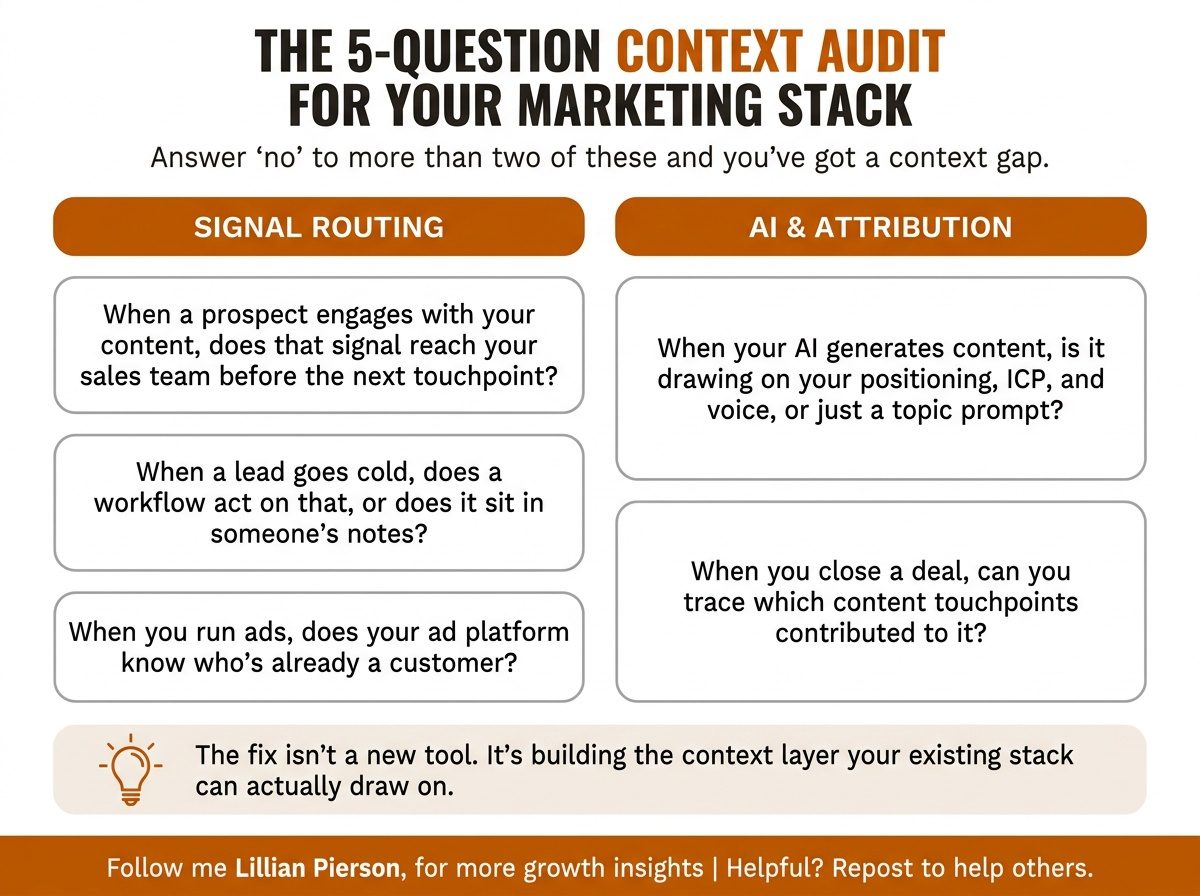
On signal routing:
- When a prospect engages with your content, does that signal reach your sales team before the next touchpoint?
- When a lead goes cold, does a workflow act on that, or does it sit in someone’s notes?
- When you run ads, does your ad platform know who’s already a customer?
On AI and attribution:
- When your AI generates content, is it drawing on your positioning, ICP, and voice, or just a topic prompt?
- When you close a deal, can you trace which content touchpoints contributed to it?
If you answered “no” or “I’m not sure” to more than two of these, you’ve got a context gap.
That gap is likely showing up in your content quality, your conversion rates, and your audience’s trust in your brand. The fix is building the context-first layer that your existing apps for marketers and your AI can actually draw on.
To see what a fully integrated context-first marketing stack looks like for a tech startup, the HubSpot 2026 collection is a useful reference point. Use it to pressure-test your own architecture, even if you never adopt it wholesale.
The Credibility Cost You Can’t See Until It’s Too Late
Here’s the thing about generic AI content… the damage is cumulative and delayed.
Your audience won’t send you a note saying your content has lost its edge. They’ll just stop clicking, stop sharing, and stop thinking of you as a credible voice in your category. By the time the metrics confirm it, you’ve already lost six months of trust-building you can’t get back.
The founders who avoid this are the ones who built the context layer first and let the tools run on top of it. It’s a move that’s available to any team that’s willing to do the positioning and voice work before they touch a prompt.
If you’re working on your GTM stack and want a second set of eyes on where the context gaps are, start here.
P.S. The most common thing I hear after a content audit is: “I knew something was off. I just didn’t know what to call it.” Now you do. And the good news is it’s fixable. You just have to treat it as a systems problem. If you’d like a second set of eyes on your stack, book a 30-minute call with me here.