
Your team is wasting time reinventing the wheel. Scattered documents and inconsistent messaging are slowing you down. An LLM Knowledge Base fixes that by turning your company’s knowledge into a dynamic AI marketing system that powers AI-driven outputs. The result? Faster execution, consistent messaging, and better results across marketing, sales, and product teams.
I’m Lillian Pierson, a fractional CMO and licensed Professional Engineer. I’ve educated 45,400 people on building AI-native growth systems with Claude, custom MCP servers and n8n. A knowledge base is the piece most teams build last and should have built first.
Key Takeaways:
- Save Time: Reduce the 25–30% of time spent searching for information and slash execution time from hours to minutes.
- Consistent Messaging: Maintain a unified brand voice across all channels, even as your team scales.
- Boost Productivity: Junior team members can deliver senior-level work within days, not weeks.
- Higher Conversions: Teams using AI-driven systems see trial-to-paid conversion rates jump from 32% to 56%.
- Smarter Decisions: Capture and apply insights from every campaign, sales call, and customer interaction.
Why it matters: Without a system like this, you’re stuck with inefficiencies, misalignment, and wasted effort. But with an LLM Knowledge Base, your team can focus on growth, not redoing work.
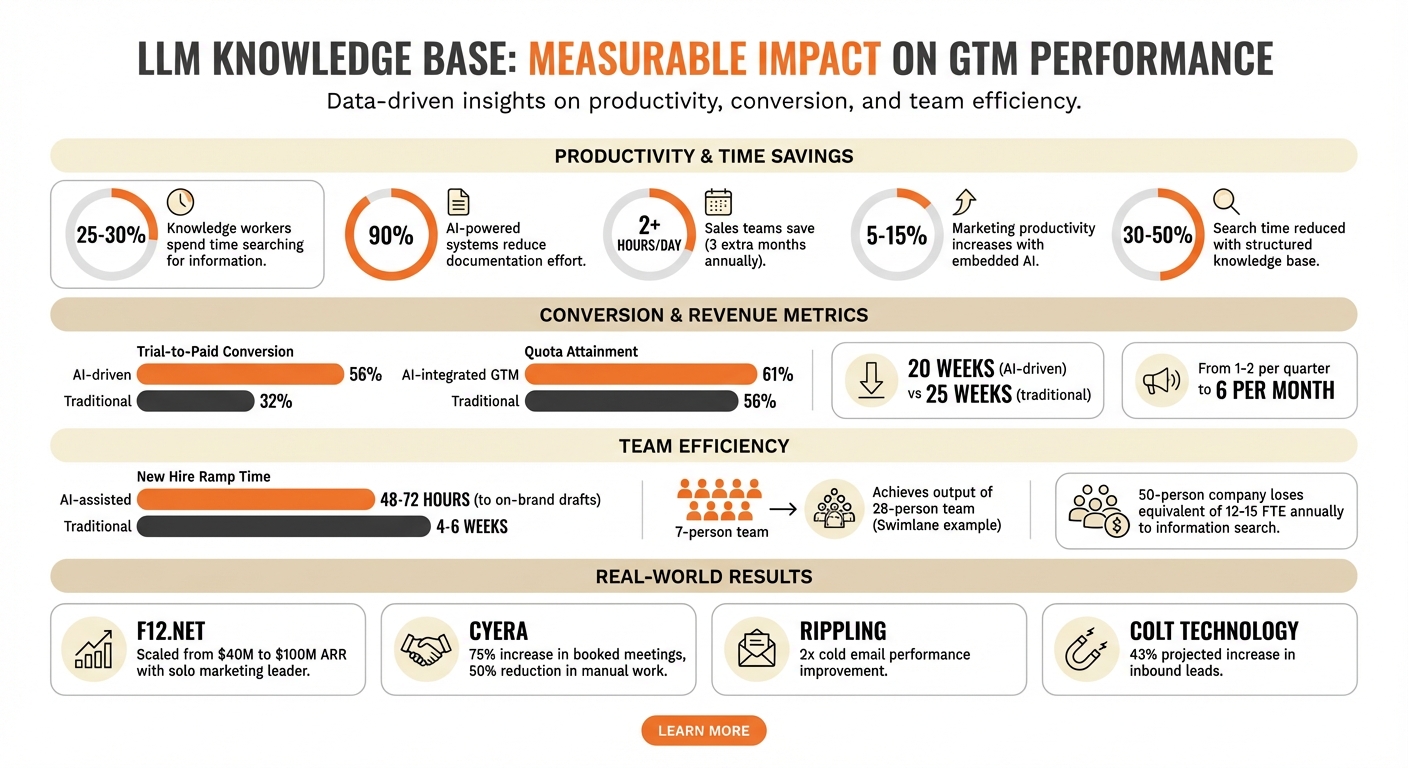
LLM Knowledge Base Impact: Key Performance Metrics and ROI
How to Build an AI-powered Lifecycle Marketing Knowledge Base in Airtable
What an LLM Knowledge Base Actually Is
An LLM Knowledge Base serves as a centralized, AI-powered hub for your company’s collective knowledge. It organizes and stores key information like brand positioning, ICP, messaging frameworks, product details, and common sales objections. Unlike a static Google Doc or Notion page that waits passively for someone to search it, this system acts as a dynamic, queryable intelligence layer that powers every AI-generated output across your GTM platform [1].
What sets it apart is its proactive nature. Traditional tools like Slack or Confluence simply store information. An LLM Knowledge Base, however, is an active system. Need to draft a sales email, write ad copy, or update competitor insights? The system pulls directly from your centralized knowledge, eliminating the need for manual searches, repetitive briefings, and the risk of inconsistent messaging [1].
Shopify CEO Tobi Lütke refers to this as "context engineering", structuring the information environment so the AI already knows what it needs to deliver accurate, aligned outputs [3].
The system also incorporates policy-as-code governance, embedding brand guidelines, pricing rules, and legal requirements directly into its infrastructure. This ensures every output remains consistent, compliant, and on-brand. Any updates, whether it’s a product feature change or a tweak to messaging, are instantly reflected across all channels, from social media posts to landing pages, without requiring manual updates [1].
This isn’t just a chatbot for FAQs; it’s a true GTM intelligence layer. It eliminates what Rick Koleta of GTM Vault calls "coordination drag", the inefficiency caused by manually transferring information between marketing, sales, and product teams. By turning scattered insights into a unified, scalable system, it transforms how teams execute their customer acquisition strategies.
1. Eliminates Starting From Scratch on Every Marketing Task
The concept of a persistent intelligence layer transforms how marketing teams operate. Without it, every campaign begins with a blank slate. Teams often find themselves recreating key assets, like ICP definitions, messaging frameworks, and brand positioning, from scratch. This inefficiency not only wastes time but also leads to "marketing amnesia", where critical documentation either becomes outdated or gets buried in silos [1].
An LLM Knowledge Base changes the game by functioning as a persistent intelligence layer. It ensures that when someone drafts emails, ad copy, or landing pages, they’re automatically pulling from pre-loaded ICP data, proven messaging structures, and brand voice guidelines. The AI integrates seamlessly with your strategic context, reducing redundant work and streamlining execution [1][3].
The impact on productivity is hard to overlook. Studies show that knowledge workers spend 25–30% of their time searching for information. For a 50-person B2B SaaS company, this inefficiency equates to losing the productive output of 12–15 full-time employees every year. By implementing a structured knowledge base, companies can slash that search time by 30–50% [9].
"Context engineering is the delicate art and science of filling the context window with just the right information for the next step," says Andrej Karpathy, Former Tesla AI Lead [3]
The ultimate test: a new hire should be able to produce an on-brand draft within 48–72 hours of joining your team [1]. That’s the difference between a static storage system and a dynamic execution engine that transfers institutional knowledge instantly.
2. Maintains Message Consistency Across All Channels
As companies grow, the informal ways teams share knowledge start to break down, and this can lead to mixed messages about your brand. In the early days of founder-led marketing, brand positioning spreads naturally, through standups, Slack chats, or quick conversations. But once your team grows past 50 people, that organic flow of information starts to fail.
What happens: your social media manager might call your product "growth marketing automation", your copywriter might describe it as "SEO software", and your sales team could still be pitching with outdated slides. These inconsistencies don’t go unnoticed by buyers, and they can chip away at trust during the decision-making process [1].
An LLM Knowledge Base (KB) solves this issue by centralizing and automating your brand’s messaging. When you update your positioning in the KB, the changes ripple out instantly, whether it’s a social media post, a landing page, or an email. Unlike traditional setups where context lives in scattered documents or one-off prompts, the KB serves as a single source of truth. It acts as a "brand constitution", ensuring every AI-generated output aligns with your core message [1][4].
| Feature | Traditional Setup | LLM Setup |
|---|---|---|
| Positioning Updates | Manual updates to documents, briefs, and agency meetings | Update once in the KB; changes propagate instantly |
| Real-time Update Propagation | Requires manual coordination across teams and channels | Automatic synchronization across all communications |
| Brand Consistency | Depends on individual creators | Unified voice across all channels and teams |
This unified system becomes even more valuable as you scale beyond founder-led marketing. Research shows that companies hiring an AI GTM engineer to embed AI across their teams hit 61% quota attainment, compared to 56% for teams using traditional approaches. A key factor? Reduced coordination delays, those frustrating lags between marketing insights and sales execution that can slow down performance [4][5].
3. Turns Content Into a Reusable Asset
Too often, B2B teams create content, use it once, and then let it sit forgotten in a folder. This habit of "marketing amnesia" wastes the time and money spent on crafting positioning and messaging, as these efforts gradually fade away [1].
An LLM Knowledge Base changes the game. Instead of letting content gather dust, it transforms it into a reusable resource. Every blog post, case study, sales call transcript, and product update becomes part of a searchable system. Launching a new campaign? The AI taps into your entire library, drawing on customer language and past successes. That webinar from six months ago? It can shape today’s email sequence. A case study from Q2? It might inspire Q4’s ad copy.
"The companies that treat content as a campaign will rent attention. The companies that treat it as knowledge architecture will own discovery."
This shift, from single-use content to a reusable framework, creates lasting value. For example, when your product team releases a new feature, updating the Knowledge Base once ensures that every AI-generated asset reflects the change. Social media posts, landing pages, sales materials, and support docs all stay aligned without the headache of manual updates. This prevents outdated messaging from slipping through the cracks and streamlines execution across GTM campaigns [1].
On top of that, the time savings are huge. While manual documentation can take three to six hours per article, an AI-powered Knowledge Base can cut that by as much as 90% [7]. Your content library effectively becomes "indexing infrastructure", a critical foundation for AI-powered answer engines. These engines help surface your brand when potential buyers are researching solutions, long before they even reach out to your sales team [5][6].
4. Reduces Execution Time From Hours to Minutes
Speed is everything when you’re scaling. The gap between a marketing team that moves fast and one that lags often boils down to wasted time recreating context. Without a clear system, inefficiencies snowball, imagine a marketer spending 30 minutes in back-and-forth discussions just to craft a usable cold email from a generic AI tool [3]. Now multiply that across sales emails, landing pages, and ad copy variants, and you’re looking at hours of lost productivity every day.
Enter the LLM Knowledge Base. With your ICP, messaging, and brand guidelines pre-loaded, it generates polished, on-brand drafts instantly. Tasks that used to take hours, like refining a sales email or drafting a landing page, can now be completed in minutes. Need ad copy variants? The system can not only create entire test matrices but also push them directly to your project management tool [8].
The productivity boost is undeniable. AI-driven systems can cut documentation effort by up to 90% [7]. Sales teams using AI save over 2 hours a day, which translates to three extra months of productivity annually [4]. Marketing teams report a 5–15% increase in productivity when generative AI is embedded into their workflows rather than used for isolated tasks [8]. This isn’t just about speeding up individual tasks. It’s about scaling your entire campaign output.
These time savings have a ripple effect. Teams can go from launching 1–2 campaigns per quarter to managing several campaigns each month [4][8]. For example, in early 2026, SPINS ramped up its campaign output from 1–2 per quarter to 6 per month by automating nurture sequences and content creation [4]. Similarly, Swimlane, with just seven marketers, achieved the output of a 28-person team by leveraging intent data and customized AI workflows [4].
5. Boosts Junior Team Members to Senior-Level Performance
Scaling a GTM team isn’t just about adding headcount. It’s about reducing the time it takes for new hires to deliver work that doesn’t need constant revision. Without a clear system in place, junior team members often spend 4–6 weeks just getting a handle on positioning, brand voice, and ICP nuances before they can produce anything useful [1]. During this ramp-up period, senior leaders are often stuck in endless review cycles, rewriting drafts and re-explaining strategy.
An LLM Knowledge Base changes this dynamic by embedding senior-level strategy into every deliverable. When a junior marketer queries the system, for something like a campaign brief or a sales email, they instantly access pre-loaded ICP definitions, proven messaging frameworks, and brand voice guidelines. This acts as a shortcut for knowledge transfer, allowing new hires to create on-brand drafts in days rather than weeks [1].
The productivity gains are striking. Take F12.net, for instance: a single marketing leader scaled the company from $40M to $100M ARR between 2024 and 2026 by using Claude AI to generate content directly from Gong transcripts, achieving the output of a much larger team [4]. Similarly, Swimlane‘s 7-person GTM team delivers the equivalent of 28 people’s work by leveraging intent data and automated workflows tailored to specific segments [4]. These examples highlight how AI-enabled GTM teams achieve 61% quota attainment compared to 56% for traditional setups [4].
"A 3–4 person GTM team with clear ICP conviction, strong positioning, instrumented systems, and AI-native loops will outperform a 20-person org on quarterly resets," says Emre Tok, Chief Growth Officer at Disrupt.com [4]
This approach also reshapes hiring economics. Instead of overloading senior strategists with execution tasks, companies can focus on hiring for refinement and interpretation roles, even if the marketing team is inexperienced. Junior team members, backed by AI, can produce work that’s already 80% aligned with senior-level strategy [4]. They spend their time fine-tuning outputs instead of hunting for the right positioning or guessing at brand voice. The result? Faster onboarding, higher-quality work, and less reliance on expensive senior hires. Plus, this streamlined process ensures that GTM intelligence is captured and reused effectively as the company grows.
6. Captures and Applies GTM Intelligence
In many B2B companies, valuable insights often vanish as quickly as they appear. A sales rep might handle a tricky objection to close a deal, a campaign could unexpectedly resonate with a new audience, or a product demo might expose a competitor’s weakness. But instead of these insights being preserved, they get lost in Slack messages or fleeting standup conversations. Months later, teams find themselves re-solving the same issues from scratch.
This loss of insights slows down teams, creating what’s called coordination drag, the delay between when marketing discovers something and when sales acts on it. Rick Koleta explains it clearly:
"If your marketing team learns something on Monday and your sales team responds three weeks later, you do not have a talent problem. You have coordination drag" [5].
An LLM Knowledge Base helps eliminate this drag. It automatically collects intelligence from customer calls, support tickets, and campaign results, making it instantly searchable for the entire team. Take F12.net as an example: when they scaled from $40M to $100M ARR in 2026, a solo marketing leader used Gong transcripts and Claude AI to capture and reuse GTM insights. This meant they didn’t have to rebuild their positioning every quarter [4].
The system works through automated ingestion and semantic structuring. Tools like Gong, Fireflies, or Whisper transcribe customer conversations, while the LLM Knowledge Base tags objections, categorizes win/loss trends, and links features to pain points. Instead of digging through outdated documents or relying on employees’ memories (which often leave with them), teams gain access to a live, up-to-date intelligence layer that reflects current market conditions [1]. For instance, in early 2026, Cyera automated lead routing based on real-time intent data. This cut manual work by 50% and increased booked meetings by 75% [4].
Without a system like this, companies risk losing their edge. Messaging drifts, positioning gets muddled, and successful strategies are forgotten. With an LLM Knowledge Base, insights from closed-won deals feed directly into targeting strategies and content creation [4][5]. For example, SPINS implemented intent triggers and automated nurture sequences in 2025. By continuously applying buyer signals, they increased their campaign output from 1–2 per quarter to 6 per month [4]. This system doesn’t just store data, it closes the feedback loop, enabling GTM strategies to adapt daily instead of quarterly.
This approach transforms content from a static calendar into what Koleta calls "knowledge architecture", a structured system that machines can reference and reuse [5]. Companies with AI deeply integrated into their GTM teams have seen tangible results: 61% quota attainment compared to 56% for traditional setups, and sales cycles reduced from 25 to 20 weeks [4]. By turning scattered insights into actionable intelligence, the LLM Knowledge Base fuels faster, smarter decisions. It’s a key element of an AI-driven GTM system, helping teams preserve hard-earned insights and act on them in real time.
7. Delivers Personalization at Scale Without Manual Work
B2B teams often find themselves stuck between sending generic messages or spending hours on personalization. A LLM Knowledge Base changes the game by automating tailored outreach, turning insights into actionable, consistent messaging without the manual effort.
This system is built to store specific ICP variants, including firmographics, key pain points, and buying triggers for each segment [1]. When crafting outreach, the LLM pulls from a structured intelligence layer to create messaging that reflects how each buyer segment talks about their challenges. Instead of starting from scratch or manually tweaking multiple email versions, it generates tailored outputs instantly. That’s because it already incorporates your positioning, anticipated objections, and the language that resonates most with your audience [1].
The personalization doesn’t stop there. The system refines each message in real time using behavioral signals, like which content a prospect interacted with, how recently they engaged, and which features caught their attention. These insights allow the Knowledge Base to create micro-segments on the fly. For instance, in February 2026, Rippling saw its cold email performance double by replacing static quarterly campaigns with continuous AI-driven experimentation powered by Clay’s data enrichment [4]. Messaging was automatically adjusted based on which variants worked best for specific segments, eliminating the need for manual A/B testing.
This targeted approach delivers measurable results. Companies that fully integrate AI into their GTM teams report trial-to-paid conversion rates of 56%, compared to just 32% for teams relying on traditional methods [4]. Every interaction, whether it’s the first email or a demo follow-up, is informed by buyer-specific language pulled from CRM notes, call transcripts, and win/loss data [5]. Instead of guessing what might work, the system leans on proven messaging hierarchies and real objections stored in the Knowledge Base [1].
This scales because the system updates instantly. When you roll out a new product feature or adjust your ICP, you only need to update the Knowledge Base once. Every future message across all channels reflects those changes automatically [1]. This ensures consistency across your strategy and eliminates the risk of misalignment or outdated messaging.
8. Improves Conversion Rates Through Data-Backed Inputs
Many marketing teams rely on guesswork to create hooks, offers, and CTAs. A LLM Knowledge Base changes the game by rooting these efforts in real data, drawn from sales conversations, win/loss insights, and buyer behavior patterns. This shift turns every marketing interaction into a conversion-driving opportunity.
The results speak for themselves: teams leveraging AI-driven inputs see 56% trial-to-paid conversions, compared to just 32% for traditional methods [4]. Why? When your hooks directly address objections pulled from sales call transcripts and your CTAs mirror the language buyers actually use to describe their challenges, response rates naturally improve [5]. Rick Koleta from GTM Vault calls this "signal synchronization", aligning messaging with buyer behavior to replace generic, high-volume outreach with precise, context-aware communication [5].
The system also evolves over time. It draws on objection clusters identified by conversation intelligence tools, pricing sensitivity trends from closed deals, and feature usage data that pinpoints what problems your product solves [5]. For example, if your win/loss analysis reveals buyers are concerned about integration complexity, your Knowledge Base ensures every offer tackles that issue head-on, using phrasing that resonates [1][4].
This approach doesn’t just boost conversions. It also speeds up sales. AI-driven GTM teams report average sales cycles of 20 weeks, compared to 25 weeks for traditional teams [4]. Quota attainment improves too, rising from 56% to 61% when teams use AI to guide their messaging [4]. By aligning every touchpoint with buyer behavior, the LLM Knowledge Base ensures prospects move closer to a decision at every step. It’s a clear example of how raw data becomes a powerful GTM advantage.
"Execution is abundant. Clarity is scarce. The advantage shifts from ‘Who can do more?’ to ‘Who understands the buyer better?’", emre tok, Chief Growth Officer, Disrupt.com [4]
9. Builds a System That Learns and Improves Over Time
Traditional marketing often faces the challenge of losing institutional knowledge with staff changes or strategy shifts. An LLM Knowledge Base changes the game by creating a system that learns and improves with every interaction.
Instead of relying on periodic updates, like annual persona revisions or quarterly competitive analyses, an LLM Knowledge Base thrives on real-time analytics feedback loops. For instance, objections raised during sales calls are logged immediately, while successful email variations help refine future campaigns on the spot. When there’s a shift in positioning, one update seamlessly adjusts messaging across all channels [4].
This dynamic system doesn’t just maintain consistency in messaging or reuse GTM insights. It actively compounds intelligence over time. Emre Tok, Chief Growth Officer at Disrupt.com, refers to this as "learning velocity", the speed at which a system absorbs and applies new information [4]. Companies embracing this approach consistently outperform those sticking to traditional methods, showing measurable boosts in speed, quality, and conversion rates. The real advantage lies not just in faster execution but in compounding intelligence that enhances every future output.
How it evolves:
- Week 1: No more repetitive re-briefing.
- Month 1: The system starts identifying patterns that work.
- Month 3: Accumulated insights raise the baseline quality.
- Month 6: The Knowledge Base fully captures and leverages your institutional memory [3].
Unlike static documentation that becomes outdated, this system continuously evolves. Every win, loss, or experiment feeds back into the system, refining it further.
"If your system doesn’t improve itself, it decays. If your messaging isn’t tested continuously, it drifts," says Emre Tok, Chief Growth Officer, Disrupt.com [4]
This ongoing refinement not only strengthens every piece of marketing but also sets the stage for AI-driven GTM automation. It’s a system designed to grow smarter with time.
10. Powers AI-Native GTM Systems and Automation
AI’s role in improving efficiency, ensuring consistent messaging, and enabling scalable personalization leads to its evolution into a core growth engine. At the heart of this transformation is the LLM Knowledge Base, which goes beyond being a simple productivity tool. It serves as the backbone for AI-driven GTM automation.
Without a well-structured Knowledge Base, AI agents lack the strategic depth to produce outputs that align with your AI business context, positioning, and brand voice. The result? Generic, uninspired content that requires time-consuming manual revisions.
The introduction of a Knowledge Base takes AI from being a tool requiring supervision to an autonomous layer of execution. With this foundation, AI agents can access live CRM data, interpret buyer behavior in real time, and craft personalized outreach that seamlessly fits your GTM strategy. This concept is part of what Shopify CEO Tobi Lütke refers to as context engineering, designing the information environment around AI so it understands your business before being tasked with any specific action [3].
"Context engineering is the delicate art and science of filling the context window with just the right information for the next step."
– Andrej Karpathy, Former Tesla AI Lead [3]
What Happens Without an LLM Knowledge Base
Without the structure and efficiency of an LLM Knowledge Base, organizations often face misalignment and wasted effort. Scaling becomes a challenge as coordination slows down. For example, marketing might update positioning, but sales teams could continue using outdated messaging for weeks simply because the updates don’t reach them in time [5]. Often, messaging documents are over a year old, 14 months on average, leading to repetitive positioning workshops that consume days of valuable time [1].
"If your marketing team learns something on Monday and your sales team acts on it three weeks later, you do not have a talent problem. You have coordination drag."
– Rick Koleta, Author, GTM Vault [5]
The numbers highlight the scale of the issue: knowledge workers spend 25–30% of their time just searching for information. This inefficiency grows without a centralized system to streamline access. Additionally, 53% of GTM leaders report minimal impact from AI tools, not because the technology itself is flawed but because their workflows are broken [3]. Generic AI tools, which lack specific brand context, force marketers to repeatedly re-educate the system on company details, audience needs, and tone for every task [3].
The consequences of these inefficiencies go beyond wasted time. Without a unified knowledge base, brands risk sounding inconsistent across channels, as if they represent multiple companies instead of one [1]. When experienced employees leave, their institutional knowledge often disappears with them if it hasn’t been captured in a centralized system [1]. This leaves new hires struggling to adapt, often taking 4–6 weeks to produce content that doesn’t require major revisions. Instead of leveraging structured resources, they’re left to learn through trial and error [1].
There’s also a strategic cost in the AI-driven world. Brands without a machine-readable knowledge base are effectively invisible in AI-powered searches. Buyers using tools like ChatGPT or Perplexity won’t encounter companies that lack structured, accessible knowledge [6]. With marketing budgets holding steady at just 7.7% of revenue [8], teams can’t afford to waste time recreating information they already have.
These challenges make it clear: a centralized, machine-readable LLM Knowledge Base isn’t just a nice-to-have. It’s essential for scalable and effective GTM execution.
How to Implement an LLM Knowledge Base
Creating an LLM Knowledge Base involves three main components: inputs, system elements, and outputs.
Start with the right inputs. A strong foundation is key. Your knowledge base should include strategic elements like brand positioning, ICP (Ideal Customer Profile) definitions that consider firmographics and pain points, detailed product information (features, use cases, and differentiators), messaging hierarchies, and tone guidelines [1]. Pair these with behavioral data, such as meeting transcripts, customer conversations, win-loss analyses, webinar recordings, and real-time product telemetry. This combination of static documents and dynamic feedback ensures your knowledge base reflects both your strategic goals and real-world market insights [5].
Build your system architecture in layers. A layered approach is essential for scalability and efficiency. Use automated capture pipelines to reduce manual documentation efforts, manual processes often fail at scale, as one implementation guide noted. Organize the captured data semantically with auto-tagging and relationship maps that link concepts, features, and market signals. This layered design ensures the system delivers the right information at the right time, whether it’s sales battlecards, synthesized customer feedback for product teams, or content briefs for marketing. By following this structure, you can transform raw data into a functional, AI-powered resource.
Follow a 60-day implementation sprint. Break the process into manageable phases:
- Days 1–15: Audit existing knowledge sources and set up automated capture pipelines.
- Days 16–35: Process and organize the knowledge base, piloting semantic search with one team (often sales or customer success).
- Days 36–50: Expand data capture to all sources and integrate the system with tools like CRM and Slack.
- Days 51–60: Finalize governance by implementing role-based access controls, audit logging, and training team leads.
This timeline ensures a focused and efficient rollout.
Connect your knowledge base to execution tools. Integration is the final step in turning your knowledge base into a dynamic, AI-driven engine. Use Model Context Protocol (MCP) to allow AI to pull live data from platforms like your CRM and analytics tools [3]. Automated quality gates can enforce standards for formatting, style, and compliance before outputs are finalized [3]. With these integrations, your knowledge base evolves from a static repository to a tool that generates actionable outputs, such as on-brand articles, social media posts, competitor battlecards, and sales assets [1]. For example, Colt Technology Services used this approach with the Growth Method’s GrowthOS system in 2026, achieving a projected 43% increase in inbound leads for the year [3].
Conclusion
Many companies use AI to generate outputs, but the real game-changer lies in embedding strategic intelligence into every aspect of your operations. When your ICP definitions, messaging frameworks, and market insights are stored in a structured, queryable system, your outputs are no longer starting from scratch. They’re built on a foundation of institutional knowledge. As Tobi Lütke, CEO of Shopify, puts it:
"I really like the term ‘context engineering’ over prompt engineering. It describes the core skill better: the art of providing all the context for the task to be plausibly solvable by the LLM" [3].
This approach doesn’t just improve efficiency; it creates a compounding advantage. Companies that fully integrate AI across their GTM teams report 61% quota attainment, compared to 56% for those using traditional methods. They also see sales cycles shrink from 25 weeks to 20 weeks [4]. The difference isn’t about working harder. It’s about removing the friction caused by disjointed coordination.
An LLM Knowledge Base is the key to this transformation. It turns AI from a simple assistant into a GTM intelligence layer, capturing and applying team insights across every channel. This system safeguards institutional knowledge, avoids the pitfalls of "marketing amnesia", and empowers new hires to deliver senior-level results in just days [1].
The real question isn’t whether you’ll implement this system. It’s whether you’ll do it before your competitors. By 2026, architecture will determine success [5]. Teams that treat knowledge as infrastructure rather than static documentation will define the next decade of growth. Start building your LLM Knowledge Base now to stay ahead.
FAQs
How is an LLM Knowledge Base different from a wiki?
An LLM Knowledge Base functions as a living, evolving system built for real-time intelligence and action. Unlike a static wiki, which merely stores information like a manual, this system actively organizes essential business knowledge, such as ICP, messaging, and content. It enables LLMs to access and apply this information effectively, ensuring outputs remain consistent and aligned with strategic goals. Think of it as an intelligence layer that adapts and improves over time, rather than a simple repository of facts.
What data should we add to an LLM Knowledge Base first?
Start with the basics: ICP definitions, messaging frameworks, a well-organized content library, sales conversation guides, and compelling case studies. These elements create a strong foundation for GTM strategies, ensuring your team has structured, aligned resources to execute consistently and effectively.
How do we keep an LLM Knowledge Base accurate over time?
To ensure an LLM Knowledge Base stays accurate, it’s crucial to set up a system for regular updates and checks. Regularly revisit and update core components like ICP definitions, messaging, and differentiators to keep them aligned with changing strategies. Implement automated quality checks and integrate with live tools to validate and add new data smoothly. This method helps incorporate insights from successes, setbacks, and campaigns, ensuring the system remains relevant and consistent over time.