
Landing pages in 2026 are no longer static – they’re dynamic, AI-powered systems designed to adjust in real time for every visitor. Here’s what’s changed:
- AI-driven personalization: Pages now rewrite headlines, CTAs, and testimonials instantly based on user behavior, intent, or traffic source.
- Faster testing cycles: AI eliminates manual A/B testing, reducing weeks of work to hours while continuously optimizing.
- Better performance metrics: Tools monitor page speed, user friction points, and AI crawlability for improved conversions.
- Higher efficiency: Generative AI creates tailored page variants in 1–2 hours instead of 12–18, boosting conversion rates by 15–30% for warm traffic.
- Mobile-first focus: With 75% of traffic from mobile, fast load times (LCP under 2.5s) and clean designs are critical.
The takeaway? Static pages are outdated. AI-powered systems deliver tailored, faster, and more effective results in today’s competitive landscape.
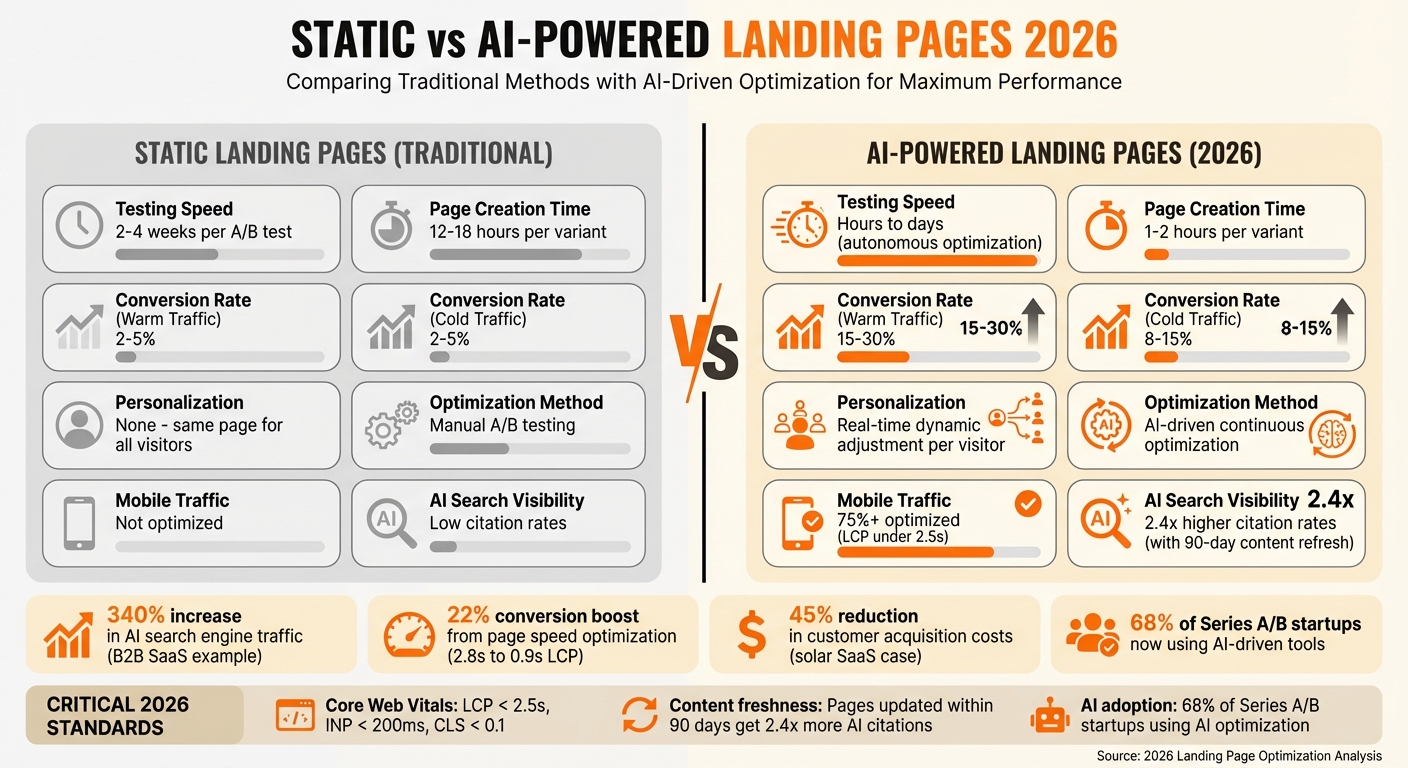
Static vs AI-Powered Landing Pages: 2026 Performance Comparison
Build an AI Agent with me! Ep. 30: Landing Page Optimizer
The Shift from Static Pages to Dynamic Conversion Systems
The big change in landing page optimization isn’t about tweaking headlines or rearranging visuals. It’s about leaving behind static pages in favor of dynamic conversion systems that adjust on the fly. Traditional landing pages were stagnant, often unchanged for weeks or months. Modern systems, however, adapt in real time, leveraging visitor behavior, intent signals, and live data to make updates instantly [3].
The Infinite Landing Page model, powered by AI, eliminates the need for manual A/B testing by dynamically altering page elements based on who’s visiting. For instance, someone coming from LinkedIn might see different proof points than a visitor arriving via Google search. These changes happen in milliseconds, exposing the limitations of older, static approaches [3].
Why Old-School Optimization Methods Don’t Work Anymore
Relying on traditional A/B testing – changing a button color or headline and waiting weeks for results – is outdated in today’s fast-paced environment. With rising customer acquisition costs and aggressive competition, businesses need strategies that can adapt almost immediately [3].
Modern audiences have also become resistant to repetitive tactics. Researchers call this "reflexive pattern resistance", where people instinctively ignore generic elements like testimonials, countdown timers, or intrusive popups [5][9]. Far from building trust, these tactics now trigger skepticism. Additionally, AI search engines like ChatGPT and Perplexity favor clean, information-rich pages over cluttered designs filled with CTAs [8].
The data backs this up: single-topic, information-dense pages are three times more likely to perform better with AI models [8]. And with 68% of Series A/B startups already using AI-driven tools instead of traditional methods, sticking with old approaches puts companies at a disadvantage [3]. The need for tailored, high-performing landing pages that adapt in real time is now unavoidable.
How AI Drives Dynamic Landing Pages
AI has opened the door to a new level of personalization, enabling what’s known as "Edge Personalization." This technology allows page elements to rewrite themselves instantly based on user data [3]. For example, if someone searches for a specific product, the page can adjust the headline to match their query, showcase testimonials from their industry, or highlight features relevant to their role.
This is made possible through the Model Context Protocol (MCP), which connects landing pages to live data from platforms like Shopify or Salesforce [3]. A B2B visitor already in your CRM might be greeted with a personalized "Welcome back" message and custom pricing, while a first-time visitor sees educational content. In 2026, the brand Tushy achieved a 15% conversion rate by using AI agents to handle detailed pre-sale questions directly on their landing page – something static templates could never achieve [3].
"The landing pages converting at 20% in 2026 are not doing anything mysterious. They are doing the fundamentals… but they are doing them dynamically, for every visitor, in real time." – Rob Palmer, Direct-Response Copywriter [9]
The technical side has evolved too. Instead of relying on multi-armed bandit algorithms to shift traffic between pre-built variants, modern systems use autonomous optimization, which compresses testing cycles from weeks to just days [9]. One fintech startup in 2026 used this approach to cut page load time from 2.8 seconds to 0.9 seconds, boosting conversions by 22% in just 30 days [3]. This kind of rapid progress isn’t achievable with manual workflows, proving that adaptive systems consistently outperform static methods.
What’s Changed in Landing Page Optimization in 2026
Landing page optimization has shifted dramatically, moving away from static updates toward real-time, AI-driven adjustments. Today, AI-powered systems handle everything from generating page variants to diagnosing technical issues on the fly. These advancements have turned landing pages into adaptive conversion systems that respond dynamically to each visitor’s behavior and intent. This evolution has taken optimization to levels that were hard to imagine just a few years ago.
AI-Generated Page Variants in Minutes
The days of manually creating and testing landing page variants over 12–18 hours are behind us. AI now generates multiple tailored versions in just 1–2 hours, making the process faster and more efficient [6]. Generative AI can craft pages personalized for specific personas, traffic sources, or campaign goals in mere minutes.
Take the example of a B2B SaaS company in late 2025: they shifted from 12 generalized product pages to 45 highly focused guides. While their traditional search traffic stayed flat, their AI citation rate in tools like ChatGPT and Perplexity jumped from 3% to 18% in just 90 days. This change also drove a 340% increase in traffic from AI search engines [8].
Modern systems go beyond creation – they continuously test these variants and automatically promote the best-performing ones [2][6]. This approach eliminates the long wait times associated with traditional A/B testing, allowing teams to make data-driven updates in days rather than weeks [9].
Real-Time Personalization by Audience Segment
AI-generated variants are just one piece of the puzzle. Real-time personalization ensures that every visitor sees a version of the page tailored to their specific needs. AI determines which variant to display based on factors like persona, intent, lifecycle stage, and traffic source [6]. This level of customization drives impressive results: 15–30% conversion rates for warm traffic and 8–15% for cold traffic, compared to the 2–5% typically seen with static landing pages [9].
This personalization feels seamless and avoids heavy-handed targeting [5]. For example, a healthcare professional landing on the page might see HIPAA compliance highlighted, while a retail visitor is shown integrations with e-commerce platforms. Key elements like clear headlines, compelling proof, and a single call to action remain consistent but are dynamically adjusted for relevance [9].
Automated Detection of Performance and UX Problems
AI has also taken over the technical audits that used to require manual effort, making continuous optimization a reality. Automated tools now monitor Core Web Vitals – ensuring LCP stays under 2.5 seconds, INP under 200ms, and CLS under 0.1 – to meet 2026 performance standards [7]. With more than 75% of landing page traffic coming from mobile devices (and over 85% for social media ads), hitting these benchmarks is critical [9].
Beyond speed, AI uses behavioral analytics to identify friction points. By analyzing heatmaps and session recordings, it flags areas where users hesitate, scroll back, or abandon the page [9]. These tools also ensure pages are optimized for AI crawlability, with clean HTML and server-side rendering to help large language models parse content effectively [8].
For visibility in AI-driven search engines, automated platforms now track Answer Engine Optimization (AEO) signals. These tools identify which sections of a landing page are featured in AI-generated summaries for high-intent queries [10][8]. Regular content updates are key: pages refreshed within the last 90 days are cited 2.4x more often by AI tools compared to older, static content [8]. This highlights the ongoing need for consistent updates and improvements to stay competitive.
AI-Powered Methods for Better Landing Page Performance
The adoption of AI-driven techniques is no longer just a concept – it’s actively transforming how teams design, test, and refine landing pages. By 2026, the use of generative AI for content creation, streamlined design approaches, and mobile-first strategies ensures landing pages load faster, convert better, and adapt to individual user needs. Data-Mania is already helping B2B SaaS companies modernize their landing pages with these advancements.
Using Generative AI for Content Creation
Generative AI simplifies the content creation process, allowing teams to produce multiple audience-specific landing pages while staying true to brand guidelines. Advanced tools with large context windows can process entire brand handbooks, ensuring every generated page aligns with the company’s voice and style [3].
Dynamic copy injection is another game-changer, personalizing page elements to address specific audience pain points. For example, in 2026, a solar SaaS company used this approach to create 50 tailored subdirectories, slashing customer acquisition costs by 45% compared to their older, generic pages [3].
Real-time sentiment monitoring on platforms like TikTok or LinkedIn keeps content fresh by enabling instant headline updates [3]. Structuring content using the inverted pyramid – delivering key answers in the first 100 words – also ensures AI search engines can easily identify and cite your content [11].
Data-driven content strategies prove their worth: landing pages with quantitative claims see 40% higher citation rates than those with qualitative statements [11]. Additionally, using FAQ and Page schema boosts citation rates to 41%, while presenting data in tables instead of paragraphs increases citations by about 2.5x [11].
Once content is efficiently generated, the focus shifts to creating a seamless design and user experience.
Simplified Navigation and Clean Design
In 2026, effective design prioritizes simplicity, removing unnecessary elements to maximize conversions. The Bento grid layout has become a go-to choice because it balances high information density with readability, aligning perfectly with how AI engines process content [7].
Sticky CTAs (Call-to-Actions) are essential for keeping conversion opportunities visible. On mobile devices, placing CTAs in the lower third of the screen – the "thumb zone" – makes them easy to access. A scrolling CTA bar ensures users always have a clear path to take action.
Micro-commitments, such as AI-powered quizzes or calculators, encourage users to engage before committing to a primary action [9]. Short video clips, ranging from 15 to 45 seconds, can further boost conversion rates by 20–40% when used wisely. However, these videos must load quickly to avoid slowing down the page [9].
A clean, intuitive design naturally complements the mobile-first approach, which is critical for driving conversions today.
Mobile-First Design and Page Speed
Mobile performance has a direct impact on revenue. Meeting Core Web Vitals standards is non-negotiable – this includes achieving an LCP (Largest Contentful Paint) under 2.5 seconds and a CLS (Cumulative Layout Shift) under 0.1 [7][11]. For instance, in early 2026, a fintech startup optimized their JavaScript and reduced bundle sizes, cutting their LCP from 2.8 seconds to 0.9 seconds. This led to a 22% increase in conversions within 30 days [3].
Beyond speed, mobile-first pages must also cater to AI crawlability. Server-side rendering and clean HTML ensure large language models can easily interpret your content [8]. Introducing an LLMs.txt file provides AI bots with a clear roadmap to your most important schema and documentation [11]. Moreover, regularly refreshing content – at least every 90 days – makes your pages 2.4x more likely to be cited by AI tools compared to static, outdated content [8].
Platforms Driving AI-Powered Optimization
Adobe and Optimizely are reshaping the way businesses approach optimization by embedding AI into their platforms. These advancements eliminate the need for manual testing, enabling automated, real-time adjustments. The shift marks a move from static page tweaks to adaptive systems that personalize user experiences on the fly. Both platforms now offer tools that handle everything from generating test ideas to creating page variants – without requiring developers.
Adobe‘s AI Personalization Tools
Adobe has introduced several powerful tools, including the Journey Optimizer Experimentation Accelerator, which leverages generative AI to automate experiment analysis. This tool doesn’t just track outcomes but digs into behavioral patterns to explain why certain variants perform better. Its AI Experiment Insights feature uncovers patterns and provides actionable explanations for test results, helping teams refine their strategies more effectively [12][14].
Another standout feature, AI Adaptive Experiments, takes optimization a step further by making real-time adjustments during active tests. This approach maximizes results without needing larger sample sizes. Adobe’s internal use of this tool on Adobe.com in September 2025 led to a 24% boost in win rates and a 212% average ROI per test. Paul Aleman, Principal Product Manager at Adobe, highlighted how this tool shifted their process from manual analysis to AI-driven insights that directly informed future tests [12].
"We saw 24% relative increase to our win rate (i.e. success rate) and 212% average ROI per test using Adobe Journey Optimizer Experimentation Accelerator."
- Paul Aleman, Principal Product Manager, Adobe [12]
Additionally, Adobe’s Experience Manager Sites Optimizer uses an "Identify, Suggest, and Fix" framework to tackle issues like traffic, engagement, SEO, page speed, and accessibility. In March 2025, The Hershey Company used this tool to optimize content performance, achieving measurable improvements within weeks [15].
Optimizely‘s Automated Testing Platform
Optimizely has also stepped up with its Opal Agents, a suite of AI tools designed to manage the entire experimentation process. From brainstorming ideas to delivering post-test summaries, these agents streamline workflows and reduce the need for technical expertise [13].
One key feature is the Variation Development Agent, which allows you to create landing page variations using plain-language prompts in a Visual Editor – no coding required. Teams using Optimizely’s AI tools report running 78.7% more experiments and launching 24.1% more personalization campaigns [13].
Optimizely’s AI also speeds up the testing process. Its Ideation and Planning Agents boost test creation by 18%, cut run times by 33%, and help teams reach statistical significance 25% faster. Experiments managed by AI see a 9.3% increase in win rates, and the Experiment Summary Agent drives nearly 20% of follow-up tests, creating a compounding effect where each test builds on previous results [13].
Comparing Adobe and Optimizely
Both Adobe and Optimizely offer compelling AI-driven solutions, but their strengths lie in different areas. Here’s a quick breakdown:
| Feature | Adobe Experimentation Accelerator | Optimizely Opal Agents |
|---|---|---|
| AI Type | Generative and Agentic AI | AI Workflow Agents |
| Key Capability | AI Adaptive Experiments (real-time adjustments) | Variation Development (no-code creation) |
| Focus | Predicting lift and uncovering growth drivers using predictive analytics | Eliminating operational bottlenecks |
| Integration | Adobe Target & Journey Optimizer | Optimizely Visual Editor & Experimentation Platform |
These platforms are paving the way for B2B tech startups to implement adaptive landing page systems, making optimization faster and more effective than ever.
How B2B Tech Startups Can Adopt Adaptive Landing Page Systems
B2B tech startups now have the tools to transition from static landing pages to systems that adapt dynamically, tailoring content to specific audiences in real-time. This shift, powered by AI, can significantly improve conversions without requiring a complete overhaul upfront.
Startups can begin by leveraging their existing data – CRM records, behavioral analytics, and sales call transcripts – to train AI models for predictive personalization. A modular architecture is key here, allowing quick updates to elements like headlines, CTAs, and social proof based on user behavior. This approach not only enables faster updates but also introduces new metrics to measure the effectiveness of these adaptive systems.
Practical Steps for Implementation
One way to prepare for adaptive landing pages is by optimizing content for AI readability. This includes using structured hierarchies (H1–H3 tags), Schema markup, and an LLMs.txt file to highlight critical documentation for AI systems. As traditional search traffic declines by 25% and AI-sourced traffic converts 25 times better, ensuring your content is machine-readable is no longer optional [7][11].
Another step is to replace outdated rule-based targeting with machine learning models. These models can adjust key page elements – like headlines and CTAs – on the fly to better match user intent. Coca-Cola’s digital campaigns in March 2026 showcased this strategy, combining CRM data with AI-driven multivariate testing. The result? A 15% drop in bounce rates and a 25% boost in lead capture [1].
New Metrics to Evaluate Landing Pages
While traditional metrics like conversion rates and bounce rates still matter, adaptive landing pages demand new ways of measuring success. Metrics like message match (how well the page aligns with ads or queries), trust signals (logos, testimonials, security badges), and personalization quality are now critical [9][16].
A rising metric to watch is response-to-conversion velocity, which tracks how quickly visitors take action after landing. This is particularly relevant as Copilot-assisted journeys are 33% shorter and deliver 76% higher intent conversions compared to traditional search [11]. Another useful metric is AI citation rates, measuring how often your brand appears in AI-generated answers. This directly impacts the quality and intent of incoming traffic [7][11].
Additionally, you should focus on micro-commitment architecture. By offering low-friction interactions – like ROI calculators or interactive quizzes – before asking for a primary conversion, you can build trust and engagement. For example, developers often respond better to "Start Free Trial" CTAs, while enterprise leaders prefer "Book a Demo" [16].
Partnering with Data-Mania for Adaptive Landing Pages
Expert guidance can make the transition to adaptive landing pages smoother and more effective. Data-Mania, founded by Lillian Pierson, specializes in helping AI startups and B2B SaaS companies modernize their strategies. With a blend of marketing expertise and engineering know-how, the firm is well-equipped to handle the technical and strategic challenges of adaptive systems.
Through its GTM Engineering Services and Fractional CMO Leadership, Data-Mania supports startups in integrating Voice of Customer (VoC) data, building modular page architectures, and implementing AI-driven multivariate testing workflows. These workflows can cut the time needed to create page variants from 12–18 hours to just 1–2 hours [6][16]. They also ensure consistency across product descriptions, improving AI citation rates and overall search visibility [16].
For startups on tight budgets, Data-Mania offers 60-minute Power Hour sessions packed with actionable strategies. For those ready to scale, their Fractional CMO service provides ongoing leadership and execution support, helping companies build landing page systems that cater to both AI agents and human buyers effectively.
Conclusion
Landing page optimization in 2026 has evolved far beyond minor adjustments or lengthy testing cycles. The game has changed: static pages are giving way to self-optimizing decision engines. These engines adapt in real time, tailoring content based on visitor intent, behavior, and context. As LaunchInTen aptly describes:
"In 2026, a landing page is not just a web page. It is a decision engine" [4].
Companies clinging to outdated optimization methods are falling behind. As we’ve seen, adaptive pages consistently deliver stronger results than static ones. This isn’t some mysterious force at work – AI is continuously refining, personalizing, and optimizing content for speed and relevance. At the same time, it structures pages to align with AI-mediated discovery, ensuring brands are referenced in tools like ChatGPT, Perplexity, and Google’s AI-driven summaries.
The real edge in 2026 isn’t just having AI tools; it’s about how quickly you can implement them. Speed is the name of the game. For example, Coca-Cola cut bounce rates by 15% and boosted lead capture by 25% by integrating machine learning with their CRM to deliver localized, dynamic messaging [1]. Meanwhile, businesses stuck in endless setup phases are losing to competitors who test and iterate in minutes rather than months. This ability to adapt quickly is a direct path to market leadership, especially for B2B tech startups.
For these startups and AI-driven companies, the roadmap is clear: embrace adaptive landing page systems that integrate modular design, real-time personalization, and AI-friendly content structures. While fundamentals like clear headlines, message alignment, and strong evidence remain critical, they must now be dynamically tailored to each visitor in real time. Partnering with experts like Data-Mania can accelerate this shift. As Rob Palmer puts it:
"AI is the best optimization tool landing page marketers have ever had. But optimization without strategy is just rearranging deck chairs more efficiently" [9].
The shift from static pages to dynamic systems is no longer optional. Rapid adaptation is the key to staying competitive. Companies that modernize their approach today will gain a significant edge tomorrow, while those who delay will find themselves struggling to keep up in a market that has already moved on.
FAQs
What is an adaptive landing page system?
An AI-powered landing page system is designed to adjust a page’s content, layout, and messaging on the fly, tailoring the experience to each visitor. By analyzing factors like user behavior, intent, and device type in real time, it shifts away from the rigidity of static pages. Instead, it dynamically adapts to optimize for conversions, ensuring every visitor encounters a relevant and engaging experience. This approach not only streamlines scalability but also builds stronger connections with users by increasing relevance and boosting performance – all without constant manual updates.
How do I personalize a landing page without being creepy?
In 2026, ethical landing page personalization is all about balancing relevance with respect for privacy. By leveraging AI, you can craft experiences that feel tailored to specific audiences without crossing boundaries. The key lies in relying on first-party data, ensuring clear opt-ins, and maintaining transparency to build trust with your visitors.
Rather than overloading users with hyper-personalized or intrusive tactics, focus on subtle adjustments. For example, dynamically updating headlines or CTAs based on visitor segments and intent can make the experience feel more helpful. Your goal is to create a connection that feels thoughtful and relevant, not invasive.
What should I track besides conversion rate in 2026?
In 2026, it’s time to expand beyond just tracking conversion rates. Pay attention to audience engagement, how well your personalization efforts resonate, and crucial page performance metrics like load speed and Core Web Vitals. Dive deeper into understanding how your content aligns with AI-driven readability standards, analyze visitor behavior, and leverage segmentation data. These insights will help ensure your landing pages align with current expectations and deliver results.