


Here’s the bottom line: Publishing random content doesn’t build trust or drive revenue. Founders need a system that positions their brand as a trusted solution provider while directly impacting growth. Lillian Pierson specializes in creating content strategies tailored for tech startups, bridging the gap between visibility and revenue.
Key Takeaways:
- Activity ≠ Authority: Posting frequently without a clear message or system won’t make your brand stand out.
- Content Systems Drive Revenue: Data-backed insights, original studies, and targeted strategies convert visibility into measurable growth.
- Proven Results: Clients have seen up to 10x traffic boosts, six-figure contracts from a single post, and $310K in closed deals within months.
- Why Lillian?: With nearly 20 years of experience, she combines technical expertise and marketing strategy to deliver results that matter – qualified leads, shorter sales cycles, and scalable growth.
Want to stop churning out content and start driving demand? Let’s dive into how Lillian Pierson’s approach turns content into a revenue engine.
Lillian Pierson Content Marketing Strategy Results and Client Success Metrics
Publishing Content vs. Building a Content System
Why Random Publishing Doesn’t Build Authority
Many tech founders approach content creation as a box to check – writing a blog post every week, sharing updates on LinkedIn, or crafting an occasional case study. But simply staying busy doesn’t mean you’re building authority. Without a clear niche, a fresh perspective, or a consistent way to distribute your content, all that effort can easily get lost in the sea of noise online[1].
Random publishing often prioritizes activity over impact, leading to generic advice that fails to stand out or earn trust. This scattershot approach misses the bigger picture: creating a content strategy that not only builds credibility but also ties directly to revenue. As content strategist Habeeb Adetunji aptly puts it:
"Traffic is nice, but without conversion, it’s just a vanity number."[1]
What Makes a Content System Work
A content system flips the script. Instead of chasing clicks, it focuses on capturing attention and building trust. It positions you as an industry leader by leaning on original data, fresh insights, and in-depth case studies. The key is targeting the right audience, showcasing real expertise, and improving AI brand visibility – even in a landscape where AI-driven summaries are causing a 34.5% drop in traditional click-through rates[1].
Take Ahrefs, for example. In 2024, they published a report titled Insights from 55.8M AI Overviews Across 590M Searches. This study revealed that AI Overviews appear for 9.46% of desktop keywords and lead to a 34.5% decline in click-through rates. By providing original, data-backed insights, Ahrefs became the go-to source for the SEO industry on this topic[1].
Similarly, PaidHR conducted a survey of 1,500 individuals in Nigeria and released The State of The Employed report. They uncovered that 70% of employees lacked access to financial support. This data-driven report earned them citations in Forbes Africa and positioned them as a trusted authority in their field[1].
These examples highlight how a content system built on actionable insights and unique data can establish authority and drive business growth.
How Content Systems Connect to Revenue
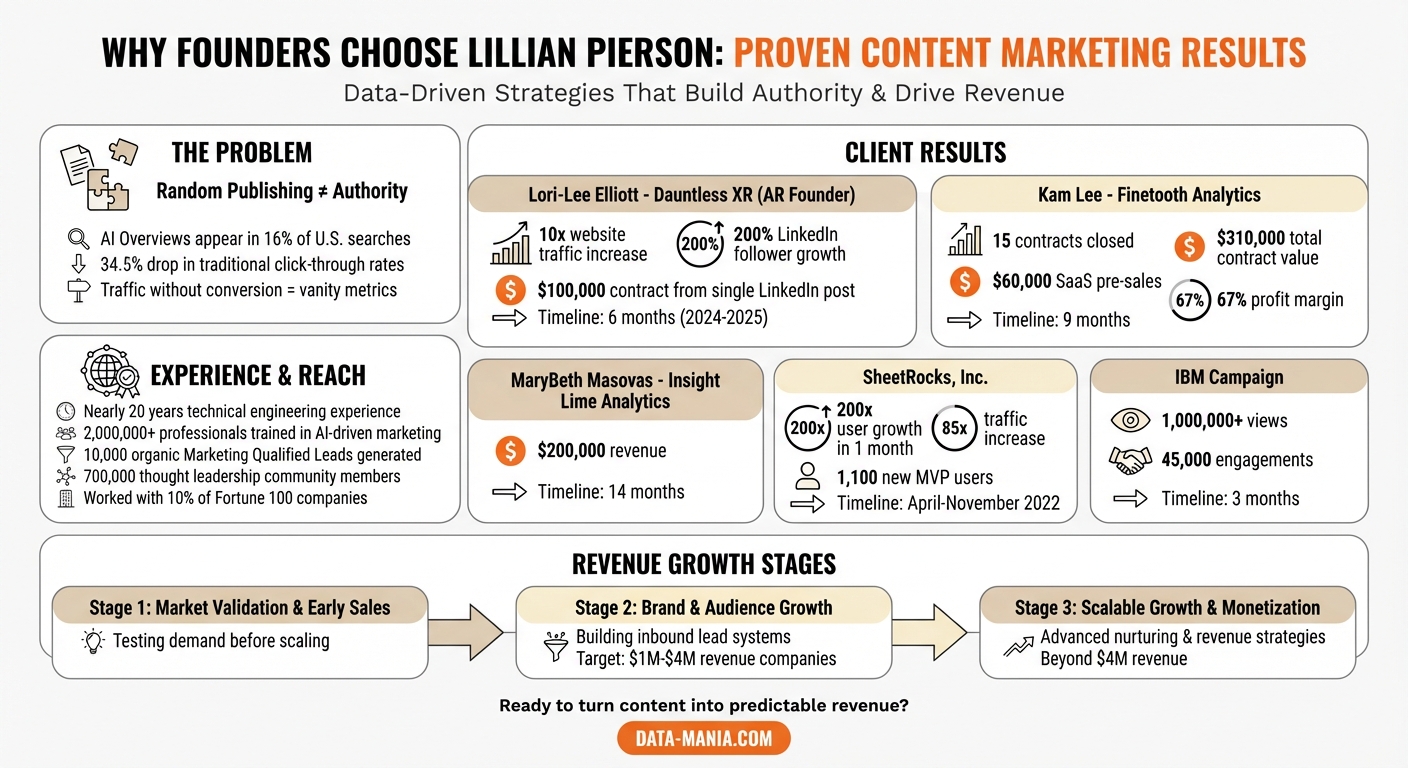
A strong content system doesn’t just boost your visibility – it delivers concrete business results. Between 2024 and 2025, Lori-Lee Elliott, founder of Dauntless XR, adopted a structured content strategy under the guidance of Lillian Pierson. Within six months, she saw a 10x increase in website traffic and a 200% growth in LinkedIn followers. Even more impressively, a single LinkedIn post from this strategy landed her a $100,000 contract[4].
Another example comes from Kam Lee, founder of Finetooth Analytics. By using a systematic approach to content, he closed 15 contracts worth $310,000 in about nine months. His strategy also helped pre-sell $60,000 in annual contracts for a SaaS company, with 67% of that revenue being pure profit[4].
These results underscore a critical point: a well-planned content system isn’t just about better engagement or visibility – it’s a direct driver of revenue for tech startups.
sbb-itb-e8c8399
What to Look for in a Content Marketing Strategist
Data Expertise and Fractional CMO Background
The best content strategists rely on data to guide every decision. They go beyond surface-level metrics like page views, focusing instead on bounce rates, session duration, conversion rates, and how content impacts revenue within a larger marketing strategy [5][6].
Lillian Pierson exemplifies this approach, blending engineering precision, data science expertise, and Fractional CMO experience. With over 2 million professionals trained in AI-driven marketing and growth, her track record speaks volumes [7]. Jaleh Rezaei, CEO and Co-founder of Mutiny, sums it up perfectly:
"Marketing has shifted to a point where, without technology and engineering, it’s almost useless." [6]
Aligning Content with Customer Needs and Revenue Goals
Exceptional content strategists collaborate with sales and product teams to identify customer pain points. They transform technical updates into engaging stories that address real issues while driving pipeline growth [6]. This cross-functional approach ensures content is both relevant and impactful.
From April to November 2022, as Fractional CMO for SheetRocks, Inc., Lillian spearheaded efforts that led to 200x user growth and tripled the email list by implementing a systematic funnel [7]. She explains:
"When your growth is systematic, you gain more than revenue → you regain control of your time, your focus, and your runway." [7]
This kind of data-driven success showcases how well-aligned content can fuel strategic growth.
Proven Ability to Build Authority and Drive Demand
Hiring mistakes or weak execution can be costly for tech founders. A strategist with a proven track record offers the confidence to transition from scrappy efforts to scalable growth [2]. Look for someone who delivers measurable results, such as qualified leads, closed deals, and shorter sales cycles.
Lillian’s work with IBM provides a clear example of her impact, generating over 1 million views and 45,000 engagements in just three months. Her ability to simplify complex topics into engaging content is unparalleled. Matt Carter, IBM‘s Global Program Director for Content Marketing, praised her work:
"Lillian’s gift for turning incredibly complex and high-technical information into engaging, approachable and highly-consumable content is paired with an innate understanding of trending or soon-to-be trending technology topics." [2]
Taylor Cromwell from HubSpot adds another layer of insight:
"If you’re selling in your discovery calls, your content isn’t strong enough." [3]
These examples highlight the importance of measurable authority and how it sets the stage for scalable growth – a topic we’ll dive into further when evaluating content marketing results.
Is Your Startup Falling Behind Its AI-Native Competitors?
The 2026 B2B Content Strategy Most Marketers Miss
How to Measure Content Marketing Results
A clear approach to measuring both authority and revenue impact is essential for any content strategy to succeed.
Measuring Authority and AI Search Performance
Building authority takes time, but the right metrics can show progress. Focus on indicators like backlinks, domain authority, and brand mentions instead of vanity metrics [8][10]. These elements reveal whether your content is resonating with human audiences and earning trust from AI-driven search engines.
AI search visibility is becoming increasingly important. With AI Overviews now appearing in about 16% of U.S. searches [1], tracking your brand’s citation rate and frequency in AI search results is crucial [11]. For example, in 2024, Lori-Lee Elliott saw a 10x jump in website traffic and a 200% increase in LinkedIn followers within just six months by applying Lillian Pierson’s content strategy. This demonstrates how a structured approach to authority-building can yield measurable outcomes [4].
Once authority metrics are in place, it becomes easier to assess how content impacts revenue.
Tracking Pipeline and Revenue Impact
For revenue-focused metrics, prioritize those that matter most: Sales Qualified Leads, pipeline value, and the percentage of leads that fit your Ideal Customer Profile. These metrics go beyond surface-level data like clicks and give insight into whether your content is attracting the right audience [11][13].
Campaign attribution can provide a clearer picture of your content’s financial impact. In 2024, New Breed’s marketing team used HubSpot’s attribution tools to show a 79.8% increase in revenue from blog posts and an 88.4% boost from marketing emails. This success led to a 33.3% increase in marketing staff and a 71.2% budget increase the following year [12]. Similarly, between March 2024 and early 2025, Kam Lee closed 15 contracts worth $310,000 and pre-sold $60,000 in SaaS contracts using targeted content strategies, achieving a 67% profit margin [4].
These metrics underline the importance of connecting content efforts to tangible business results.
Using Data to Improve Content Performance
Engagement metrics like scroll depth and time-on-page can help evaluate the quality of your content [9][13]. Regularly review older content – especially pieces over 6–12 months old – to determine when updates are needed to maintain or improve rankings [11]. Use tools like Google Analytics 4 to measure assisted conversions, which track how blog posts or webinars contribute to a sale, instead of relying solely on last-click attribution [8][11].
To determine which content formats are most effective, calculate tactic-specific ROI: (Net Profit / Total Costs) × 100. This formula can help you decide whether to allocate more resources to formats like podcasts or blog posts [11]. For instance, MaryBeth Masovas, founder of Insight Lime Analytics, reached $200,000 in revenue within 14 months by focusing on strategic priorities and audience growth through Lillian’s methods [4]. These results highlight the power of a data-driven content system.
Todd Morris, CEO of InMarket, sums up the importance of aligning marketing metrics with financial goals:
"CFOs have all these measures that matter [to them], and unfortunately, marketers don’t always have an aligned sense of what those same metrics are for them…. CFOs [will] want to know, ‘for every dollar I invested, what did I get back?’" [12]
Why Tech Founders Work with Lillian Pierson
Tech founders often grapple with a familiar problem: creating a content system that drives revenue instead of just churning out random posts. With almost two decades of technical engineering expertise, Lillian Pierson turns this guessing game into a reliable growth strategy [7]. By combining tailored plans with fractional CMO support, she transforms scattered efforts into a structured, revenue-focused engine.
Tailored Content Strategies for Tech Startups
Lillian uses a Marketing Maturity Model to align her strategies with where a startup stands in its growth journey. This model includes three key stages:
- Market Validation & Early Sales: Testing demand before scaling.
- Brand & Audience Growth: Building inbound lead systems.
- Scalable Growth & Monetization: Implementing advanced nurturing and revenue strategies [7].
She enhances these strategies with her STAR Framework, which is designed to deliver measurable growth for B2B SaaS, data, and AI startups [7].
Take her work with SheetRocks, Inc., a spreadsheet SaaS, as an example. From April to November 2022, Lillian served as their CMO. She created an "Acquisition, Activation, Retention, Revenue & Referral" funnel, which led to 200x user growth in just one month and brought in 1,100 new users for their MVP launch [7]. Additionally, she developed a 55-page, conversion-optimized website that increased traffic by 85x over seven months [2].
Tony Garvan, Founder & CEO of SheetRocks, shared:
"As a technical founder, I was pretty naive around what it really would take to get a big product to market. Working with Lillian was really, really, a critical part of us getting to the next level in our business." [2]
Fractional CMO Services for Rapid Growth
In addition to custom content strategies, Lillian offers fractional CMO services designed for scalable growth. These services are tailored for companies generating $1 million to $4 million in annual revenue and involve 6–12 months of strategy and execution oversight [2]. Acting as an AI-native GTM engineer, she integrates AI-driven solutions to streamline processes and reduce manual workload, helping startups shift from founder-driven sales to repeatable systems [7].
Her results speak for themselves. For IBM’s Developer Content Acquisition team, she led a 3-month integrated marketing campaign that delivered over 1 million views and 45,000 engagements [2].
Kevin Allen, Manager at IBM Developer Content Acquisition, remarked:
"Through Lillian’s service, we got incredible value. More specifically, her outreach delivered over 1 million views and 45,000 engagements in 3 months." [2]
This hands-on leadership ensures the creation of content that builds trust and drives conversions.
Driving Visibility, Trust, and Leads
Lillian’s data-driven methods are all about building authority that translates into qualified leads. She has trained over 2 million professionals in AI-driven marketing, generated 10,000 organic Marketing Qualified Leads for a VC-backed venture, and grown thought leadership communities to 700,000 members using analytics and customer journey mapping [7].
Her strategies have delivered impressive results for clients. For example, AR founder Lori-Lee saw a 10x increase in website traffic and secured a $100,000 contract from a single LinkedIn post within six months [2]. Similarly, Kam Lee closed $310,000 in contracts and pre-sold $60,000 in SaaS annual contracts with a 67% profit margin [2].
Matt Brown, Head of Global Growth at SingleStore, summed it up:
"Her approach is characterized by a genuine curiosity and a commitment to understanding every facet of our brand. This has enabled her to craft strategies that are not only effective in bringing our product to market, but also in ensuring that it resonates with our target audience." [2]
Conclusion
Publishing content randomly creates noise, but a well-thought-out content strategy builds measurable authority. This kind of approach doesn’t just boost trust – it directly impacts pipeline and revenue, as outlined earlier. The contrast is stark: one approach chases short-term clicks, while the other earns trust, drives consistent growth, and delivers lasting results. In a competitive market increasingly filled with AI-generated overviews, creating authoritative content is no longer optional – it’s essential.
Founders turn to Lillian Pierson because she delivers measurable outcomes, not just website traffic. With nearly 20 years of technical engineering experience and a history of working with 10% of Fortune 100 companies [4], she transforms scattered content efforts into scalable systems that consistently generate revenue.
This is the reason founders rely on Lillian Pierson. Whether you’re validating market fit, scaling from $1 million to $4 million in revenue, or breaking into new channels beyond $4 million, Data-Mania offers solutions tailored to each stage of growth. From Power Hour sessions designed to quickly address key priorities to Fractional CMO leadership for ongoing strategy and execution, the focus remains the same: building visibility, trust, and qualified demand.
Ready to shift from simply publishing content to building true authority? Check out Data-Mania‘s services and see how a strategic content system can reshape your startup’s growth. Book a discovery call today and start turning your content into predictable, scalable revenue.
FAQs
What is a content marketing strategy system?
A content marketing strategy system offers a clear, organized way to produce and share content that ties directly to your business goals. These goals might include establishing credibility, generating demand, or driving revenue. Unlike sporadic posting, this approach ensures your content addresses your audience’s challenges while aligning with measurable outcomes like engagement and lead generation. By following this system, you can strengthen trust, increase visibility, and create a foundation for sustainable growth.
How does content turn into qualified pipeline and revenue?
Content fuels a strong pipeline and boosts revenue when it directly connects with your audience’s challenges, revenue objectives, and position in the buyer’s journey. A well-thought-out strategy not only builds credibility but also fosters trust by delivering solutions to customer problems, nurturing prospects, and guiding them toward making a purchase. By monitoring key performance indicators (KPIs) and pipeline metrics, you can evaluate effectiveness, attract qualified leads, and drive consistent sales growth.
How do I measure authority and AI search visibility?
To get a sense of authority, look at SEO metrics such as organic traffic, keyword rankings, and backlinks from trusted sources. These indicators show how credible and knowledgeable your content appears to both users and search engines.
AI search visibility, on the other hand, revolves around how prominently your content appears in search results. This can be tracked through keyword rankings, impressions, and click-through rates (CTR).
Make sure your content directly addresses the challenges and needs of your ideal customer profile. Regularly reviewing these metrics will help you understand how well your strategy is working and where adjustments might be needed.