
In 2026, AI companies are rethinking how they charge customers. Why? AI products come with real costs tied to usage, unlike traditional software. Pricing models like seat-based subscriptions often fail because heavy users can drive up costs while paying the same flat fee. To stay profitable, companies are shifting to various AI pricing models:
I’m Lillian Pierson, a fractional CMO and licensed Professional Engineer who runs go-to-market for AI-native startups, and pricing is the decision I see founders revisit most often after launch.
- Token-based pricing: Charges based on usage (e.g., per million tokens processed). It aligns revenue with costs but can make revenue unpredictable.
- Hybrid models: Combines a base subscription fee with usage-based charges. This balances predictable income with flexibility for scaling.
- Outcome-based pricing: Customers pay only for results (e.g., leads generated or contracts processed). It’s clear and ROI-focused but hard to track and implement.
The trend? By 2025, 85% of SaaS leaders had adopted usage-based or hybrid models. Hybrid pricing is now the most popular, offering stability while capturing extra revenue from heavy users. Token-based pricing works best for developers, while outcome-based pricing fits measurable, high-value use cases like sales automation or legal AI. Picking the right model is key to matching costs, maintaining margins, and growing revenue.
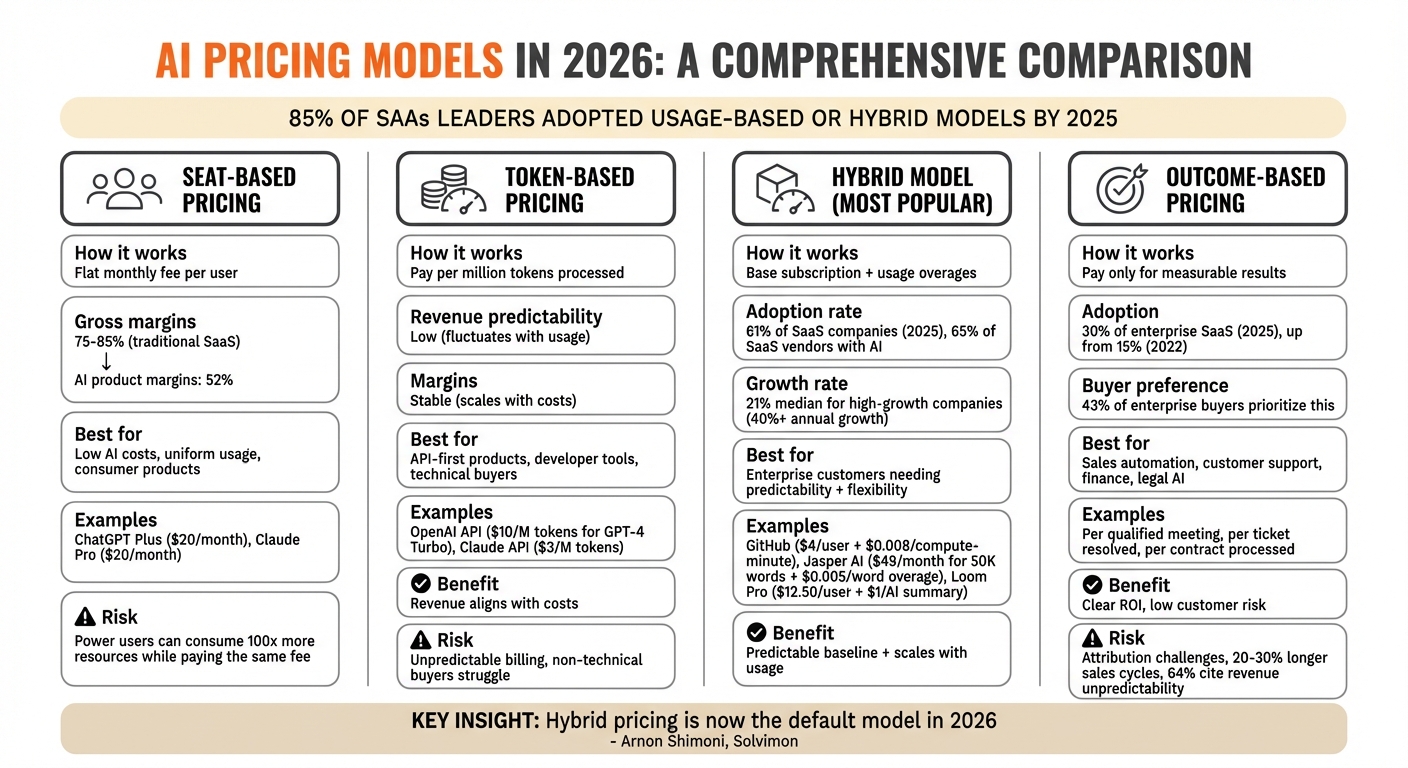
AI Pricing Models Comparison: Seat-Based vs Token-Based vs Hybrid vs Outcome-Based
Why Seat-Based Pricing Breaks Down for AI Products
What Seat-Based Pricing Assumes
Seat-based pricing relies on two key assumptions: uniform resource usage across users and negligible incremental costs for adding new ones. This approach worked well for traditional SaaS products like Slack or GitHub Teams. Adding a new user in these cases typically meant a small increase in database entries and a minor uptick in server load. Infrastructure costs stayed relatively stable as revenue grew.
AI products, however, challenge these assumptions. Unlike traditional SaaS, where serving an additional user costs mere pennies, AI products carry steep variable costs for every interaction. These include expenses tied to GPU compute, model inference, and third-party API fees [3][7]. Furthermore, while traditional SaaS assumes consistent user activity, AI products face disproportionate costs from heavy usage. A single automated workflow, for instance, might generate hundreds of API calls in an hour, leading to situations where one user could cost up to 100 times more to serve than another, despite paying the same flat fee.
Margins also tell a compelling story. AI products often operate at gross margins of about 52% [11], significantly lower than the 75% to 85% margins typical of traditional SaaS [11][7]. This disparity arises because AI infrastructure costs scale with usage intensity rather than just user count. These financial dynamics create operational hurdles, which we’ll explore next.
Problems with Scaling Seat-Based Models
The flaws in seat-based pricing become glaring as usage scales unevenly. One of the biggest challenges is margin compression caused by power users. Under a flat pricing structure, power users can consume 100 to 1,000 times more resources than light users [3][7]. This imbalance doesn’t just leave potential revenue untapped. It can lead to actual losses on the most active customers.
"A single power user can consume 100x more resources than a light user, while paying the same flat subscription fee. That’s a recipe for margin disaster," says Monetizely [7]
Another issue is the misalignment between costs and revenue growth. As customers automate workflows and ramp up their AI usage, costs can skyrocket while revenue remains static. This disconnect means that helping customers succeed might inadvertently erode profitability.
AI also exposes a value mismatch. For instance, when an AI product replaces ten analysts with a single AI agent, charging per seat doesn’t reflect the true value delivered by the automation [9]. Compounding this, 70% of software providers offering AI-driven capabilities report struggles with delivery costs, particularly cloud-related expenses [12].
When Seat-Based Pricing Still Makes Sense
Despite its limitations, seat-based pricing can still work in specific scenarios. It’s effective when AI plays a minor role, costs are driven more by support and infrastructure than by usage, and user activity remains relatively uniform [5][7].
This model also works well for consumer-focused products that prioritize simplicity. Flat-rate subscriptions like ChatGPT Plus ($20/month) [3] and Claude Pro ($20/month) [3] avoid complexities around tokens and unexpected charges, making them more appealing to users and boosting conversion rates.
A newer approach involves licensing AI agents as "agent seats." Here, companies charge a premium flat fee for autonomous agents rather than billing per human user [9][10]. This method ties pricing to the value of labor replacement rather than resource consumption. Additionally, as AI infrastructure costs drop, some models are projected to cost as little as $30 in compute by 2025, down from millions [9], simpler pricing structures become more feasible, as the marginal cost of serving users diminishes.
For most AI-first products, however, where inference costs remain significant and resource usage varies widely, pure seat-based pricing falls short. The companies thriving in 2026 are those that have embraced pricing models aligned with actual delivery costs and customer growth potential [4].
Model 1: Pure Token or Consumption Pricing
How Pure Token Pricing Works
Pure token pricing charges customers based entirely on how much they use the service. Unlike seat-based pricing, which involves a flat monthly fee regardless of usage, this model tracks every interaction. For example, when you send a prompt to an AI model, you’re charged for input tokens (the text you provide) and output tokens (the AI’s response). A short word like "the" counts as one token, while longer words may be broken into multiple tokens [13].
This approach requires complex infrastructure. Companies must implement real-time systems to track API calls, tally usage, and manage tiered pricing structures [2]. For instance, OpenAI charges $10 per million input tokens for GPT-4 Turbo [8], while Anthropic‘s Claude 3.5 Sonnet starts at $3 per million input tokens, with discounts for customers exceeding 50 million tokens per month [8]. The key feature of this model is its direct alignment between customer payments and the actual cost of providing the service.
Benefits of Token-Based Pricing
One major advantage of token-based pricing is how it avoids the margin issues often seen with seat-based models. Since revenue scales directly with usage, gross margins remain stable even as infrastructure costs increase [8][7]. For example, if a customer processes 10 million tokens, they are billed accordingly, ensuring that GPU costs align with revenue. This eliminates scenarios where heavy users consume far more resources than light users but pay the same flat fee.
Additionally, this model lowers the barrier to entry. Customers can start small, paying only for what they use during testing or prototyping. By March 2024, OpenAI’s API revenue, which is entirely usage-based, had surpassed its subscription revenue [3]. This demonstrates that developers favor pay-as-you-go pricing for projects with variable workloads. For technical audiences that can estimate their own costs, this level of transparency fosters trust [5][3].
Downsides of Token-Based Pricing
The biggest drawback is the lack of revenue predictability. Monthly income can swing wildly due to factors like customer seasonality, experimental projects, or sudden traffic spikes [5][8]. This unpredictability complicates financial planning and makes metrics like Customer Acquisition Cost (CAC) and Lifetime Value (LTV) harder to calculate.
Another issue is that non-technical buyers often struggle with the concept. Unexpectedly high charges can arise when customers don’t fully understand token consumption, leading to budget overruns [3][8]. Even with tools like real-time dashboards and alerts, the uncertainty can deter enterprise clients. As pricing expert Armin Kakas points out:
"LLM inference costs have declined roughly 10× annually since 2022… The pricing set today will be misaligned within 12 months unless your governance process accounts for this deflationary rate," says Armin Kakas [6]
This rapid cost deflation adds another layer of complexity, requiring constant repricing to remain competitive.
Who Should Use Token-Based Pricing
Pure token pricing is ideal for API-first products, developer tools, and LLM infrastructure platforms where usage varies significantly across customers [5][3]. Technical buyers, such as engineers, often prefer this model because they understand metered usage and can estimate their own costs. OpenAI’s API and Anthropic’s Claude API cater to these developer audiences, who value detailed control over expenses [8][3].
This pricing model also works well when your costs closely align with token usage. For example, if you’re reselling inference from foundation models or running GPU clusters where compute costs scale with token volume, charging per token helps maintain margins [5][3]. However, for products targeting non-technical buyers or enterprise clients who need predictable budgets, pure token pricing can create significant challenges. In such cases, many companies adopt hybrid models to strike a balance between predictable revenue and cost alignment.
Model 2: Platform + Tokens (The Hybrid Model)
How the Hybrid Model Works
The hybrid model blends predictability with flexibility, offering a mix of fixed and variable pricing. Customers pay a set platform fee, usually monthly or annually, that provides access to the product, support, essential infrastructure, and core features. On top of this, they pay additional fees based on their usage, such as token consumption, credits, or other AI-specific actions that go beyond their included allowance.
Common structures include the "Flat + Limit + Overage" model, where the base fee covers a defined amount of usage and extra units are billed separately, and the "Flat + Credits" model, where the platform fee includes a set number of credits for advanced features. For instance, Jasper AI charges $49 per month for up to 50,000 words, with an added cost of $0.005 per word beyond that. Similarly, Loom’s Pro plan costs $12.50 per user per month, including 25 AI-generated summaries, with each additional summary priced at $1.00. This fixed fee ensures steady, high-margin recurring revenue while the variable component scales with customer usage. This structure explains the growing popularity of hybrid pricing.
Why Hybrid Pricing Works
By 2026, hybrid pricing has become the standard. Arnon Shimoni from Solvimon puts it plainly: "Hybrid is no longer experimental. It’s the default." Data supports this trend: 61% of SaaS companies were using hybrid models by 2025 [1], and 65% of established SaaS vendors incorporating AI adopted seats-plus-usage pricing structures [4]. The model bridges the gaps between traditional seat-based pricing and pure usage-based models. It offers a predictable baseline through the fixed fee while capturing additional revenue as customers scale their usage. High-growth SaaS companies, those growing over 40% annually, have achieved a median growth rate of 21% with this approach.
This model also appeals to enterprise customers by balancing budget predictability with the flexibility to scale. It minimizes the risk of unexpected billing increases while protecting profit margins from high compute costs.
Companies Using Hybrid Pricing
Real-world examples highlight the success of this model. GitHub charges $4 per user per month for Teams, with an additional $0.008 per compute-minute for Actions usage [2]. Vercel’s pricing starts at $20 per user per month, with extra charges for bandwidth and function invocations [2]. Companies like Clay and PostHog use credit-based hybrid systems, bundling credits for AI features into the platform fee. ElevenLabs offers tiered pricing, starting at $5 per month for 30,000 characters and scaling up to $330 per month for 2,000,000 characters [3].
Model 3: Outcome-Based Pricing
What Is Outcome-Based Pricing?
Outcome-based pricing flips the script by charging customers based on measurable results, like the number of qualified meetings booked or documents reviewed at a specific accuracy level, instead of billing for access or usage. In this setup, the AI doesn’t just assist with tasks; it delivers a tangible outcome, and payment is tied directly to that result.
This approach aligns pricing directly with customer value. For instance, if a sales automation AI secures 50 qualified meetings, the vendor charges per meeting. Similarly, a legal AI that processes 1,000 contracts with 95% accuracy would be paid based on the number of contracts reviewed at that standard. It’s a “we succeed when you succeed” model, making return on investment (ROI) clear from the start.
Benefits and Challenges of Outcome-Based Pricing
This model has a major upside: customers only pay when they see real results. For businesses making high-stakes decisions, this significantly reduces the risk of adopting new technology. In fact, Gartner predicted that by 2025, more than 30% of enterprise SaaS solutions would include outcome-based components, up from around 15% in 2022 [9]. Additionally, 43% of enterprise buyers now factor outcome-based or "risk-share" pricing heavily into their purchasing decisions [9].
However, pulling this off isn’t easy. The biggest hurdle? Attribution. Proving that a 5% revenue boost came from your AI rather than external factors, like market trends or the customer’s own team, requires access to detailed data and reliable metrics. As of 2022, only about 17% of enterprise SaaS vendors had managed to implement true outcome-based pricing [9]. The process also extends sales cycles by 20–30%, as legal, finance, and procurement teams must hash out baselines, agree on measurement methods, and create safeguards in case targets aren’t met [9]. Plus, 64% of SaaS finance executives list revenue unpredictability as their top concern with this pricing model [9].
Most companies aren’t fully committing to outcome-based pricing yet. Instead, many are adopting hybrid models that combine a base platform fee with outcome bonuses or success fees. For example, a customer might pay $5,000 per month for access, plus an additional 20% of verified cost savings or $100 per qualified lead generated beyond a set baseline.
Where Outcome-Based Pricing Works Today
Outcome-based pricing shines in clear, high-value scenarios where results can be measured and verified. Here are some examples:
- Sales automation: Vendors charge per qualified meeting booked or for each percentage-point improvement in win rates.
- Customer support: Pricing is tied to the percentage of support tickets resolved without human intervention.
- Finance: Companies pay based on reductions in Days Sales Outstanding (DSO) or the number of invoices reconciled without errors.
- Legal and compliance: Fees are based on the number of documents processed at a specific accuracy level, such as 95% extraction accuracy [6][10].
The common thread? These outcomes are system-driven, measurable, and directly tied to ROI. Achieving this requires integrations with systems like CRMs, ticketing platforms, or financial tools that can track results in real time. For AI companies exploring this model, the advice is clear: establish baselines early, set caps and minimums to protect both parties, and introduce outcome-based pricing gradually once metrics are stable [10].
This shift also disrupts traditional SaaS metrics, rendering them less useful. As a result, companies adopting this model must develop new ways to measure and communicate value, an issue explored in the next section.
How Your Pricing Model Changes What You Should Measure
Your pricing model isn’t just about how you bill customers. It also dictates which metrics are most relevant to your business. A dashboard tailored for traditional seat-based SaaS might not work if you’ve transitioned to token-based or hybrid pricing. Adjusting your metrics is critical to avoid being misled by outdated frameworks.
Metrics for Seat-Based Pricing
If your pricing is still based on the number of seats, the traditional SaaS metrics remain key. Focus on ARR (Annual Recurring Revenue), NRR (Net Revenue Retention), and LTV:CAC (Lifetime Value to Customer Acquisition Cost) [2,5]. These indicators help measure growth and scalability. Top SaaS companies often boast NRR between 120–140% [2].
However, for AI products, seat-based pricing can obscure margin challenges. It’s important to monitor per-seat usage and cost-to-serve metrics. For example, if 5% of your users account for 75% of compute costs [4], flat-rate pricing might erode margins. To understand profitability, calculate break-even usage by dividing your monthly subscription price by your cost per inference. For instance, a $20/month plan with a $0.05 cost per query breaks even at 400 queries [8].
Metrics for Token-Based Pricing
Switching to token-based pricing shifts the focus entirely. Metrics like ARR lose relevance since revenue now fluctuates with usage rather than contract stability [5]. Instead, concentrate on unit economics. Track metrics such as gross profit per million tokens, inference costs per request, and burn multiple (how much you’re spending to generate token revenue) [7,8]. Keeping an eye on revenue per dollar of compute cost is vital to maintaining healthy margins [8].
"The marginal cost of serving one more user approaches zero [in traditional SaaS]. In AI, it does not," says Kyle Kelly, Line of Sight [14]
Don’t overlook the "token iceberg", internal consumption from system prompts, reasoning loops, and agent workflows can account for 50–90% of total usage in agentic products [14]. If you’re only tracking billable tokens, you could miss a significant chunk of your cost structure.
Metrics for Hybrid Models
Hybrid pricing, which combines fixed and variable components, requires tracking both streams. Monitor predictable subscription revenue (platform fees) alongside variable usage revenue (tokens or overages) [5,8]. Key metrics include:
- Overage conversion rate: Percentage of customers exceeding their base allowance.
- Base vs. variable revenue split: To understand where your margins are strongest.
- Revenue per unit: For example, per million tokens consumed above the baseline [5,8].
It’s also essential to calculate gross margins separately for each revenue stream. Platform fees typically have high margins, while token-based revenue margins can vary with infrastructure costs. This dual approach explains why 65% of SaaS vendors incorporating AI have adopted hybrid models [4]. It balances predictable revenue with the flexibility to capture more from heavy users without sacrificing profitability.
Metrics for Outcome-Based Pricing
Outcome-based pricing requires a completely different mindset. Instead of tracking seats or logins, you measure completed work and the value delivered. Metrics like success rates, cost per resolution, shared-savings percentages, and first-year value replace traditional ARR [9,10]. For example, if you charge per resolved support ticket, track resolution rates, average resolution times, and gross margin per ticket resolved.
Revenue recognition also changes. Unlike seat-based revenue, which is recognized evenly over the contract period, outcome-based revenue is recognized as usage occurs or when results are delivered [5]. This shift adds complexity to forecasting, 64% of SaaS finance executives cite unpredictability as their biggest concern with this model [9].
Because outcome-based pricing is so different, many companies start with hybrid models that include outcome bonuses on top of base fees. Once you’ve settled on a pricing model, the key is determining which metrics truly matter for your AI business. A clear metrics framework can help you focus without getting lost in data. Check out our Metrics Pillar post to dive deeper into optimizing these measures for your business.
Conclusion
The move from seat-based to usage-based pricing reflects the economic realities of AI-driven businesses. When costs are tied to token consumption rather than fixed infrastructure, pricing strategies must adjust accordingly. While seat-based pricing might work for products with low AI costs and consistent usage patterns, it often leads to shrinking margins for most AI companies by 2026.
Token-based pricing directly ties revenue to costs, helping maintain gross margins, but it can lead to unpredictable revenue and unexpected bills for customers. This is why many companies have embraced hybrid models, combining a base subscription with usage-based overages. These models strike a balance, offering revenue stability while capturing extra value from heavy users. By 2025, 85% of SaaS leaders had adopted usage-based or hybrid pricing models [1], and this trend shows no signs of slowing. On the cutting edge, outcome-based pricing aligns tightly with customer value but demands advanced measurement tools that many businesses aren’t yet equipped to handle.
"You can have a strong AI product and still end up with weak economics if your pricing model fights your cost structure," says Afternoon [5]
This highlights the importance of aligning pricing models with cost structures. The metrics you track are shaped by your pricing approach, seat-based models rely on traditional dashboards, while token-based and hybrid models require updated instrumentation. Pricing is one of the most powerful tools for SaaS revenue growth; even a 1% improvement can boost profits by 11% on average [2]. However, this potential can only be realized if you’re tracking the right metrics.
Once you’ve chosen your pricing model, ensure your metrics framework aligns with your revenue structure to avoid relying on outdated tools. For a more detailed exploration of aligning KPIs with your pricing strategy, check out our Metrics Pillar post.
FAQs
How do I choose between seats, tokens, and hybrid pricing?
Choose your pricing model by aligning it with your product’s costs, how customers use it, and the value it provides. Seat-based pricing is a good choice if usage is steady and predictable. For services with fluctuating or heavy usage, token-based pricing ties charges to actual consumption, making it a better fit. Hybrid models, which mix a flat base fee with usage-based charges, offer a balance between steady revenue and cost alignment. The key is to match your pricing approach to your cost structure and how your customers interact with your product.
How can I prevent surprise bills with token or usage pricing?
To help your customers steer clear of unexpected charges with token or usage-based pricing, it’s crucial to provide real-time cost visibility and enforce usage limits. Implement tools like quotas, soft warnings, and hard stops to keep overages in check. Allow users to set budgets and alerts at the project or tenant level, so they’re notified before any unexpected costs arise. On top of that, reduce expenses by using routing policies that automatically choose the most efficient models for specific features.
What metrics should I track if I switch to a hybrid model?
When shifting to a hybrid model, it’s important to monitor both standard SaaS metrics, like ARR (Annual Recurring Revenue), NRR (Net Revenue Retention), and LTV:CAC (Customer Lifetime Value to Customer Acquisition Cost), and consumption-driven metrics such as gross profit per million tokens and burn multiple. By combining these data points, you can get a clearer picture of how subscription income and usage-based elements impact your overall margins.