
Last month, a founder sent me his cold outreach numbers with a note that said “Finally making progress.” His reply rate was 1.2%. He had spent three months building the infrastructure: connecting APIs, configuring sequences, setting up the enrichment pipeline. The system ran beautifully. And it was producing almost no results.
This is what I see across the B2B startup world right now: technically competent teams running well-built systems that generate almost no traction.
A few years ago, a well-crafted cold sequence would get 7 to 10% reply rates. Today, the average for B2B tech companies is under 3%, and many teams are grinding at 1 to 2%. The gap between what a well-built AI GTM strategy can produce and what most teams are actually getting comes down to one thing.
The GTM Engineer Problem (And What’s Actually Missing)
There’s a new job title spreading across the B2B startup world: GTM engineer. These are operators who can build outbound sequences, connect APIs, set up enrichment pipelines, and automate CRM workflows. They’re technically sharp and increasingly in demand.
The thing most of them are missing is marketing taste.
What I see, in client after client, is well-architected systems producing content no one engages with. They’ve optimized for output. They have not optimized for relevance. The volume is high. The quality of targeting is low. And the two problems compound each other: the more content the system produces, the more noise it adds to already-saturated channels, and the lower the response rates fall for everyone.
An AI GTM strategy built on signal detection changes this entirely. Rather than asking how to reach more people, the question becomes how to reach the right people at the exact moment they’re ready to hear from you.
That single reframe changes the architecture of everything downstream, including the targeting logic, the content triggers, the outreach timing, and the measurement.
What an AI GTM Strategy Actually Is (Most Founders Get This Wrong)

Most founders come to me believing GTM is about getting people to know about their product. After 90 days of working together, they understand something different… GTM is about meeting people at their most relevant pain point and offering them genuine value for free.
When your AI GTM strategy is built around awareness, you push content at scale and measure reach. When it is built around pain-point relevance, you monitor signals: a job posting for a RevOps Manager, a funding announcement, a tech stack change. You move when someone shows intent, rather than when you have something to say. The outreach arrives at the right moment, addresses a real and current problem, and delivers something useful before asking for anything in return.
That’s what AI GTM strategy enables at scale. The targeting gets sharper. The timing gets better. And the conversion rates go up because the relevance went up, which is the only lever that produces durable results.
The Results Are Astonishing
Companies that have adopted AI-native GTM are reporting 5X revenue growth and 89% higher profits compared to companies running conventional GTM methods.
And here’s what strikes me every time I look at these numbers: in my experience working across B2B tech startups, vanishingly few are actually running a true AI go-to-market strategy. Most are still using AI for isolated tasks, a LinkedIn post here, a CRM update there, while leaving the full system unbuilt. The gap between what’s possible and what most teams are actually doing is enormous. The tools exist. The case studies are documented. And still, almost no one has built the full picture.
The leverage shows up in three specific areas in AI GTM strategy.

Sales enablement. Instead of relying on static playbooks and post-call memory, AI analyzes every interaction, surfaces coaching insights in real time, auto-updates CRM records, and adapts messaging based on what’s actually working. CallHippo applied AI-driven conversation intelligence and cut customer churn by 20% while growing new revenue by 13%. The reps didn’t get smarter. The system did, and it made them more effective with every call.
Marketing tech stack. Firmographic targeting tells you who a company is. Behavioral signals tell you what they’re actively doing right now. Jedox used HubSpot’s targeting and segmentation tools to increase marketing-qualified leads by 54% and reduce sales cycles by up to 20%. Same audience. Completely different targeting logic. The difference was moving from demographic filters to behavioral ones.
Outbound prospecting. The spray-and-pray approach is over. The companies winning at outbound now run signal-based selling: outreach triggers when a specific behavioral event happens. A company posts a RevOps role. They adopt a new tool. They announce a funding round. AI monitors these events at scale and deploys personalized, timely outreach in response. Ivanti used this approach and generated 71% more pipeline opportunities, $18.4M in new revenue, and a 94% increase in won deals. The volume of outreach didn’t change. The precision did.
Steal This: A 90-Day Framework to Start Your AI GTM Strategy
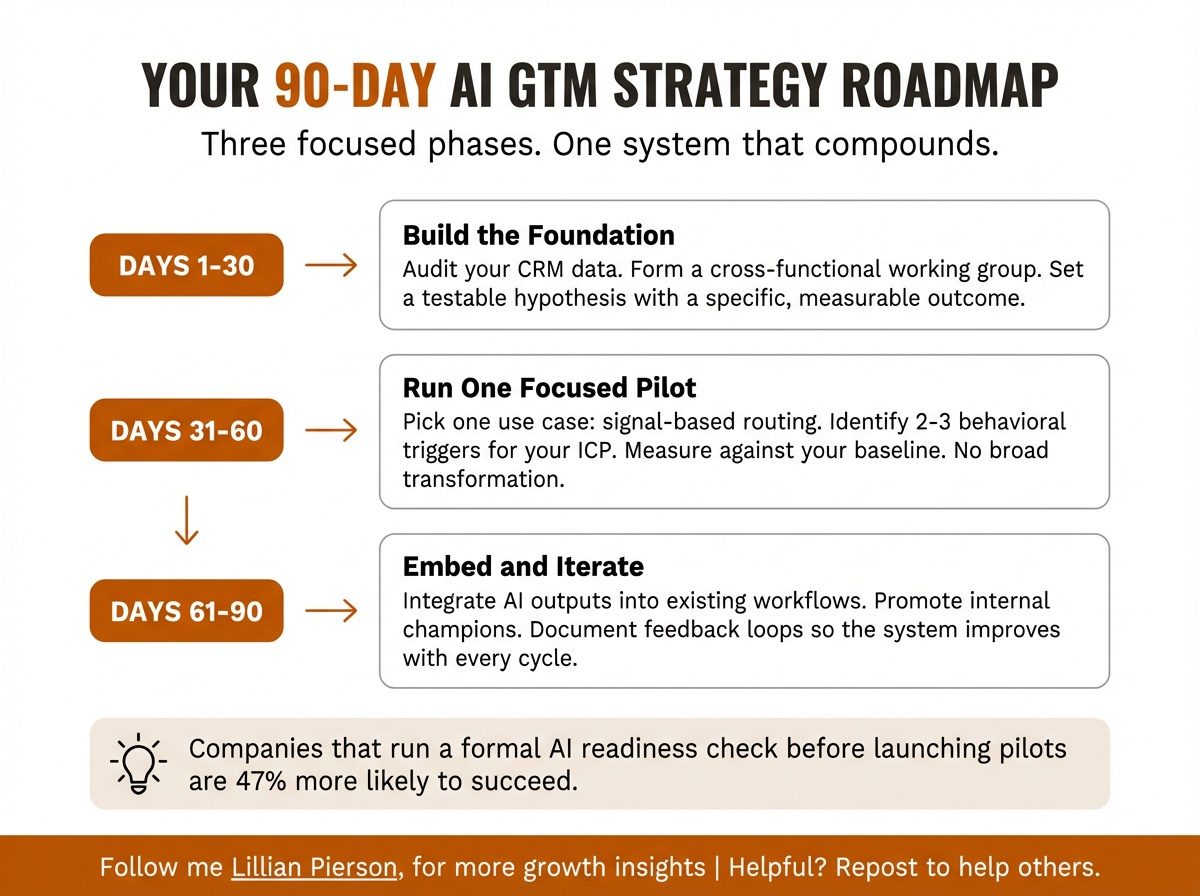
If you want to move on this, here’s how to approach the first 90 days without trying to boil the ocean.
Days 1 to 30: Build the foundation. Audit your CRM data quality before touching any AI tools. Bad data produces bad AI outputs, and that problem compounds fast. Form a small working group across sales, marketing, and RevOps. Set a specific, measurable hypothesis: something like “AI-triggered routing will cut our speed-to-lead to under five minutes and increase booked meetings by 15%.” Vague goals produce vague results. The clearer the hypothesis, the cleaner the learning.
Days 31 to 60: Run one focused pilot. Signal-based routing is a strong starting point for most B2B teams. Identify two or three behavioral triggers that are relevant to your ICP, automate outreach when those triggers fire, and measure response rates against your baseline. Limit the pilot to one or two use cases per role and resist the pull toward broad transformation. Small scope, clean measurement, clear learning.
Days 61 to 90: Embed and iterate. Integrate AI outputs into existing review processes, not as separate tools, but as part of how your team already operates. Promote internal champions who can share results and build momentum. Adjust based on what the data shows, and document the feedback loops so the system improves with every cycle. Leaders who model AI usage in meetings and forecasting reviews accelerate adoption by the rest of the team.
Companies that conduct a formal AI readiness check before launching pilots are 47% more likely to succeed. Skipping the foundation phase is the most common and costly mistake I see founders make in the first 30 days.
Why You Don’t Need a $400K CMO to Build an AI GTM Strategy
Building an AI-native GTM architecture requires someone who understands both marketing strategy and the technical infrastructure underneath it. That’s a specialized skillset, and a full-time CMO who can do this well typically costs $350K to $450K per year in total compensation. For an early-stage startup, that’s often not viable. And frequently, it’s not necessary.
On a project basis or a monthly retainer, you can get the architecture built, the pilots launched, and the governance frameworks in place at a small fraction of the cost of a full-time hire, and get to market considerably faster. The fractional model gives you access to someone who has built these systems across multiple companies and can move directly to what works, without the ramp-up time or overhead.
The goal is a system that gets smarter over time, so your team’s hours go toward work that actually requires human judgment, rather than tasks a well-designed agent could handle in the background. That’s GTM engineering. And it compounds.
The Real Before and After
The founders who come out the other side of this shift don’t just have better metrics, though they usually do. They have a different mental model of what AI GTM strategy actually is. It stops being a broadcast function and becomes a listening function. You’re monitoring, detecting, responding. You’re deploying genuine value at the moment someone is actively looking for it.
That’s what an AI GTM strategy actually produces at 90 days. A system that gets smarter with every signal it processes, a team that understands how to use it, and a pipeline that reflects real buyer intent rather than volume-based guesswork.
If you want to start building the measurement infrastructure that supports this shift, I put together a free email course called the Growth Metrics OS, specifically for startup founders and GTM leads. It covers the core metrics framework you need before, during, and after AI adoption.
And if you’re further along and looking for fractional CMO support to architect the full system, you can learn more about working with me at Data-Mania.
P.S. The stat I keep returning to is this: 90% of B2B startups fail within three years, and 70% of those failures are GTM execution failures, not product failures. Which means most of what kills startups isn’t what gets fixed in product sprints. It’s what gets ignored until the runway is short and the options are few. If you’re reading this before you’re in that position, you’re already ahead.