
Attribution is where most marketing arguments start, because everyone is looking at a different number and no one trusts the dashboard. The tools below give your sales and marketing teams one shared view of what is actually driving pipeline. I’ve built attribution into growth systems for companies from SingleStore to IBM, and in this post I’ll show you which tool fits your stack and your stage.
Quick Overview of Each Tool
- Dreamdata: Best for B2B teams needing precise multi-touch attribution. Stands out with Markov chain modeling and seamless CRM integrations.
- HockeyStack: No-code platform capturing 4-6x more touchpoints than CRMs. Ideal for teams handling complex buyer journeys.
- Adobe Analytics: Enterprise-grade solution with AI-powered insights and deep integration across Adobe tools.
- HubSpot Analytics: Perfect for teams already in the HubSpot ecosystem, offering revenue attribution at a lower entry price.
- Factors.ai: Focused on account-level attribution with a 75% account identification rate, outperforming many competitors.
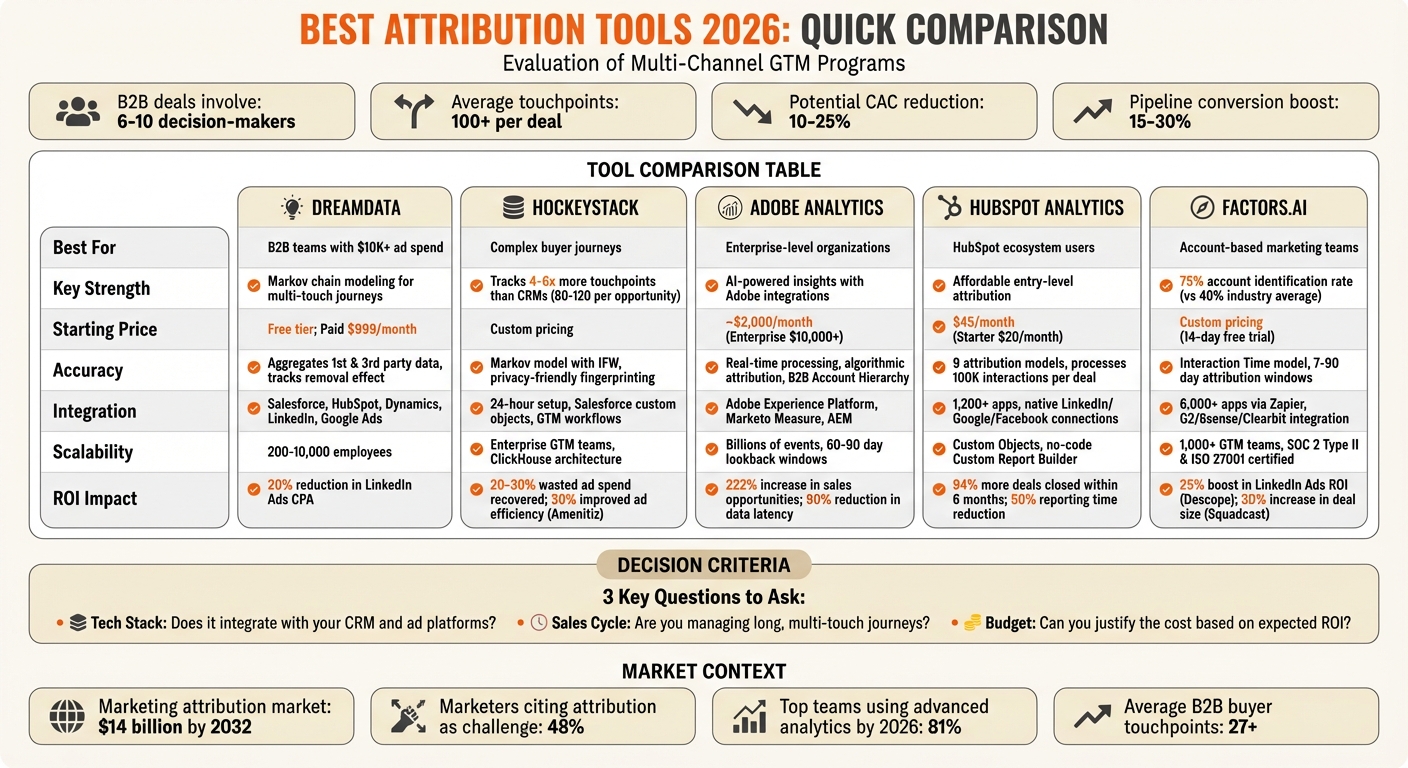
Quick Comparison
| Tool | Best For | Key Strength | Starting Price |
|---|---|---|---|
| Dreamdata | B2B teams with $10K+ ad spend | Markov chain modeling for multi-touch journeys | Free; Paid starts at $999/month |
| HockeyStack | Complex buyer journeys | Tracks 4-6x more touchpoints than CRMs | Custom pricing |
| Adobe Analytics | Enterprise-level organizations | AI-powered insights with Adobe integrations | ~$2,000/month |
| HubSpot Analytics | HubSpot users | Affordable entry-level attribution | $45/month |
| Factors.ai | Account-based marketing teams | High account identification rate (75%) | Custom pricing |
For my client, SingleStore, the tracking and attribution I built produced 1,100 organic MQLs at a $50 cost per lead, every one of them measured, with no paid ads.
Quick tip: I’d have you fix the definitions before you buy a tool. Most attribution problems are really disagreements about what counts as a lead, when an opportunity is real, and which touch gets the credit. Get your sales and marketing teams to agree on those answers first, and write them down. Then the tool has something true to measure, and your reports finally tell the same story to everyone in the room.
Without further ado, let’s dive deeper into what makes each of these tools stand out.
B2B Attribution Tools Comparison 2026: Features, Pricing & ROI Impact
Cracking the Code: Mastering Attribution Reporting | Hubspot User Group ’25
1. Dreamdata
Dreamdata is a B2B revenue attribution platform designed to connect every touchpoint, from anonymous website visits to sales meetings, into a cohesive view. Unlike B2C analytics tools that focus on individual users, Dreamdata aligns all interactions with a company account, offering a comprehensive understanding of how deals come together [6][7].
Accuracy
Dreamdata prioritizes precision in attribution. Its proprietary tracking script enriches data from anonymous visitors by linking behavioral insights with information from your CRM, marketing automation, sales, and support tools. It then cleans and accurately connects each touchpoint [6][7].
The platform uses a Markov chain model to analyze the "removal effect" of each interaction – measuring how conversion rates drop if a specific touchpoint is removed. Additionally, its Attribution Exclusions feature filters out non-causal interactions, defaulting to a Linear model for journeys with fewer than 50 touchpoints [5].
Integration Capabilities
Dreamdata seamlessly integrates with major platforms like Salesforce, HubSpot, Microsoft Dynamics, Pipedrive, Marketo, Pardot, and Oracle Eloqua [10][8]. For sales engagement, it connects with tools such as Outreach, Salesloft, Apollo.io, and Chili Piper, ensuring activities like meetings or LinkedIn Sales Navigator interactions are directly tied to revenue outcomes [10].
The Audience Hub and Offline Conversions features enable daily syncing of pipeline data back to LinkedIn and Google Ads. This allows AI bidding algorithms to focus on actual deals rather than just leads, with Dreamdata reporting that offline conversion syncing can reduce LinkedIn Ads CPA by 20% [11][12]. Data can also be exported to business intelligence tools like Tableau, PowerBI, and Looker, or to data warehouses such as Snowflake, BigQuery, and Redshift [10].
Scalability
Dreamdata is best suited for B2B companies with 200 to 10,000 employees and a monthly ad spend of $10,000 or more [8]. Its Markov chain models improve in accuracy as more customer journeys are added, making it ideal for growing businesses with increasingly complex go-to-market strategies. The platform also supports historical data from CRMs or CDPs, enabling immediate insights [5][7].
"[B2B] attribution … isn’t a marketing problem to solve… This is a company problem and we’re trying to figure out where the company is driving growth, and we want to double down on those things." – Phil Gamache, Humans of Martech [7]
ROI Impact
Dreamdata provides 10 attribution models, including multi-touch options that are especially valuable for businesses managing more than five channels or dealing with sales cycles longer than a month. For companies spending over $10,000 monthly on ads, the platform often delivers a strong return on investment [6][9].
Pricing Model
Dreamdata offers a free tier for B2B companies, alongside paid plans for those meeting the employee and ad spend criteria. Pricing is straightforward, with no hidden fees or consultancy costs. All data is stored in EU-based cloud databases to ensure GDPR compliance [6][7][8].
2. HockeyStack
HockeyStack is a no-code platform designed for B2B marketing and RevOps teams, focusing on attribution and pipeline analytics. Its Atlas Data Foundation pulls raw data from CRMs, marketing automation tools, ad systems, and website activity, creating a unified view of the customer journey – no SQL or data engineering required [15][18][19].
Accuracy
HockeyStack captures 80 to 120 touchpoints per opportunity, which is 4 to 6 times more data than typical CRM-only models. This is achieved through privacy-friendly fingerprinting that tracks device types, screen dimensions, and browser settings to identify returning visitors across sessions and devices – even before they self-identify [13][15][18].
The platform uses a Markov model with Inverse Frequency Weighting (IFW) to balance common touchpoints while giving more weight to rare but impactful interactions [16]. Unlike platforms that rely on sampled data, HockeyStack analyzes the full dataset for more precise insights [14]. Its AI analyst, Odin, ensures accuracy by using deterministic code execution – meaning all numbers are derived from actual data, avoiding the pitfalls of LLM-generated reasoning [18].
"HockeyStack is helping us track what was previously considered the dark funnel. We have insights into activities I previously thought were immeasurable and unable to be tracked." – Rachel Wallace, Performance Marketing Manager, Outreach [3]
This level of precision ensures data flows smoothly across integrated systems.
Integration Capabilities
HockeyStack connects to a company’s website and data sources in under 24 hours, giving teams immediate access to AI-driven insights and dashboards [19]. It automatically cleans CRM data, resolving duplicates at both the individual (email) and account (domain) levels [15][18]. For enterprise needs, it fully supports Salesforce custom objects, capturing data that standard integrations often overlook [18].
With GTM Workflows, users can sync audiences, enrich account data, and push actions directly into third-party tools like ad platforms or sales systems [17][19]. The AI agent, Nova, ties together CRM data, calls, emails, and web activity to deliver real-time account insights, helping sales reps prepare for meetings [19].
"HockeyStack Account Intelligence, combined with n8n’s workflows, brings together structured and unstructured data to surface user journey insights – all in one place. This makes it simple to integrate these insights into our processes and recommend the best next steps for our sales team." – Anne-Charlotte Chauvet, Head of Revenue Operations [17]
Scalability
HockeyStack is built to handle the demands of growing businesses. It supports all attribution models, custom weighting, and flexible lookback windows [17]. Unlike warehouse-first solutions that charge based on query volume, HockeyStack’s ClickHouse architecture ensures costs remain predictable, even as data scales [18].
The platform has delivered impressive results for its clients. For example, Amenitiz improved ad spend efficiency by 30% in just 30 days. ActiveCampaign hit revenue targets while cutting ad spend in half, and Coro reduced manual reporting time from hours to just five minutes [17].
"What used to take hours in Excel now takes five minutes – and the insights are 10x better." – Justin Brock, VP of Demand Generation [17]
ROI Impact
HockeyStack’s detailed insights help teams reallocate 20 – 30% of wasted ad spend [15]. The platform validates channel performance using incremental lift testing with hold-out groups. Over 60% of customers use Odin AI, with 90% of their questions answered instantly [14][17][18].
"Any platform that doesn’t pair attribution with incremental lift testing is missing a big piece of the measurement pie. And I haven’t seen this capability in the wild until recently with HockeyStack." – Jason Widup, SVP of Marketing [17]
Pricing Model
HockeyStack offers stable pricing that doesn’t fluctuate with data volume [17]. For teams with specialized needs, the Enterprise Team option provides tailored quotes and support [17].
3. Adobe Analytics
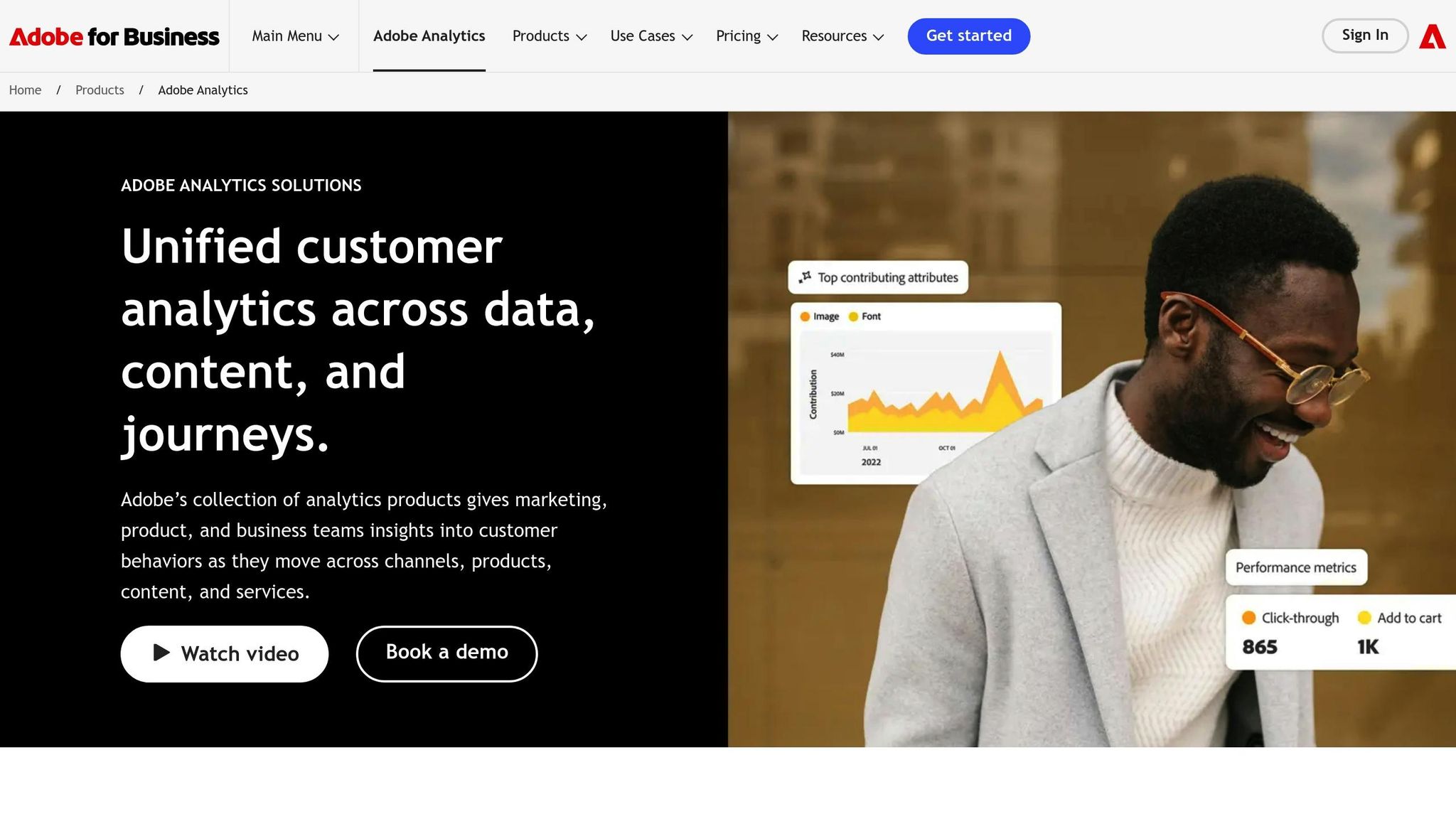
Adobe Analytics offers a powerful solution for enterprise-level attribution through its Customer Journey Analytics (CJA) platform. This tool brings together online and offline data from sources like CRM systems, call centers, and point-of-sale systems into a single, comprehensive customer view [22]. What sets Adobe Analytics apart is its integration with Adobe Experience Platform (AEP) and its ability to provide deep insights tailored for B2B environments. This is especially crucial in B2B sales, where closing a deal often involves more than 100 touchpoints and buying groups typically include 6 to 13 decision-makers [1][25].
Accuracy
Adobe Analytics excels in precision by using persistent identifiers – unique markers that consistently track interactions – and a B2B Account Hierarchy to link long sales cycles to specific buying groups. This approach enables attribution at the opportunity level rather than stopping at individual leads [22][24].
Its real-time processing ensures accuracy by allowing analysts to switch between attribution models, like last-touch or algorithmic, without needing to reprocess data or adjust tracking setups [23][24]. The platform’s algorithmic attribution uses machine learning to determine the statistical influence of each touchpoint, avoiding the biases often found in rule-based systems [22][23]. Companies leveraging Adobe’s B2B tools have reported a 222% increase in sales opportunities and three times higher engagement within buying groups [25].
Integration Capabilities
The strength of Adobe Analytics lies in its ability to integrate seamlessly with various data sources, including CRM systems, call center logs, and POS data, all through CJA [22]. At the core of this setup is the Adobe Experience Platform (AEP), which consolidates data from multiple channels into unified customer profiles [22]. Additionally, Marketo Measure aggregates touchpoints across marketing and sales platforms, enabling a holistic view of the customer journey [1][29].
Major enterprise clients have benefited from a 90% reduction in data latency, thanks to these integrations [27]. The platform also links with Adobe Experience Manager (AEM), allowing teams to attribute the performance of specific content – like whitepapers or videos – to conversions and journey progression [22]. For extended reporting, data can be exported to third-party business intelligence tools [29].
"I’ve always had a vision of looking at marketing data more holistically from an account perspective – not an easy task when dealing with global clients and organizations. Adobe solutions work together to help us connect teams and find more proactive ways to work with clients." – Karen Hopkins, Global CMO, EY [27]
These integrations make Adobe Analytics an excellent choice for unifying customer data across systems.
Scalability
Adobe Analytics is designed to grow alongside businesses, offering solutions that range from basic digital tracking to complex cross-channel analysis [22][30]. Its CJA platform consolidates lengthy, fragmented B2B journeys into a single, cohesive view [22][30]. The platform supports a variety of attribution models, including Linear, U-Shaped, and Time Decay, as well as algorithmic options for more intricate journeys where manual weighting may fall short [28][26].
For businesses with extended sales cycles, the platform allows teams to expand the lookback window to 60 or 90 days, capturing the full scope of the customer journey instead of the standard 30-day view [26]. Companies using Adobe Analytics for account-based orchestration have seen a 25% increase in lead-to-opportunity conversion rates [25].
Pricing Model
Adobe Analytics offers flexibility through its tiered pricing structure, which includes Select, Prime, Ultimate, and Foundation tiers [23]. Pricing is tailored based on factors like the size of the organization and data volume. To get a specific quote, businesses need to consult with an Adobe Account Team [23].
4. HubSpot Analytics
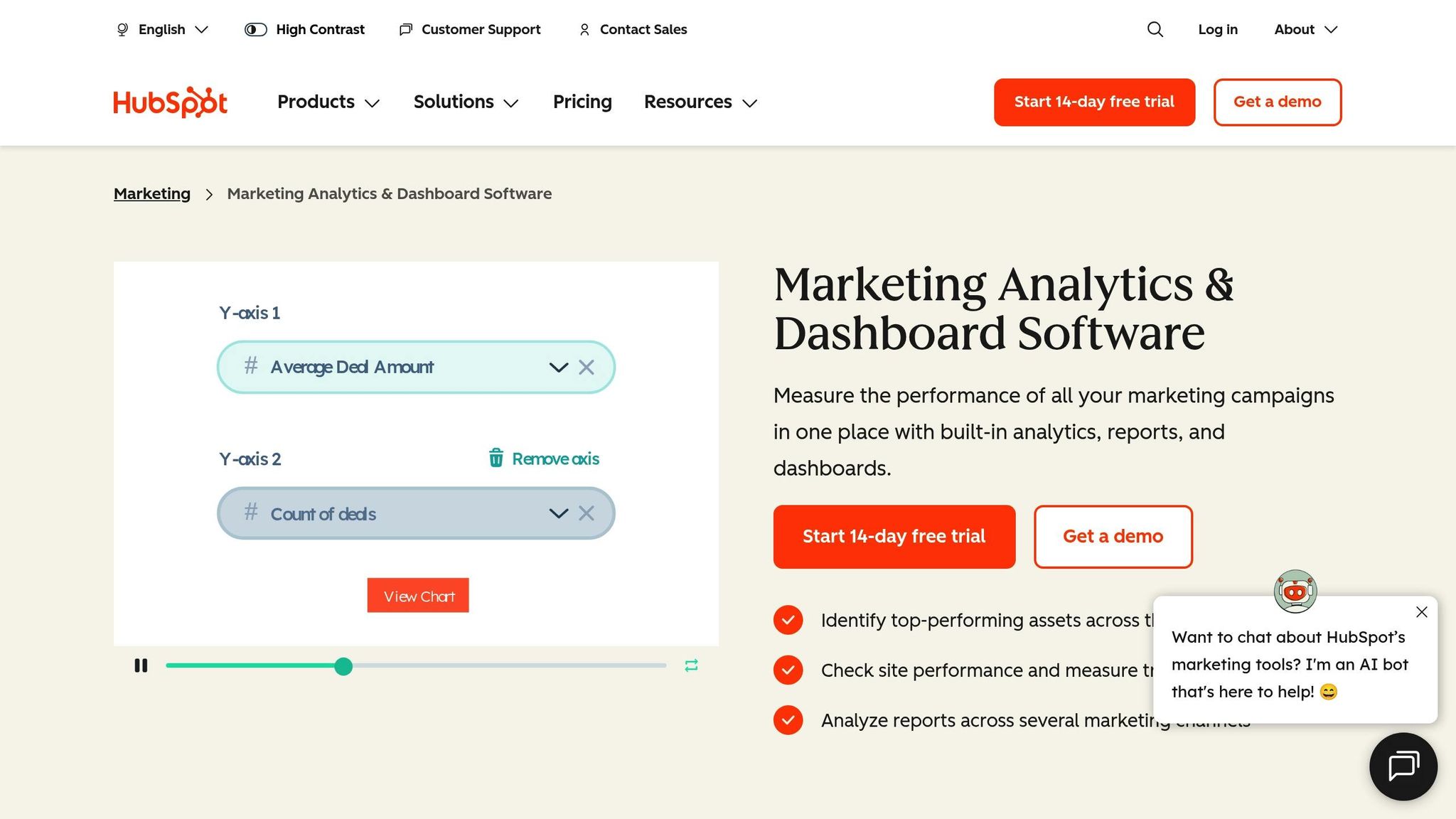
HubSpot Analytics combines CRM data with marketing touchpoints in one platform, offering an all-in-one attribution system that removes the need for multiple tools. For B2B teams looking for cross-channel attribution tools, it processes up to 100,000 interactions per deal – such as page views, calls, and meetings – using sampling to keep results accurate and free from outliers [33]. The platform supports nine attribution models, ranging from simple First/Last Interaction to more advanced options like Full Path and W-shaped models , which often leverage data science in attribution models to optimize credit distribution, which allocate credit across significant milestones [33].
Accuracy
HubSpot boosts attribution accuracy by automating UTM parameter creation for marketing emails and click tracking, reducing the chances of manual tagging errors [31]. To ensure revenue attribution works correctly, deals need to include values for "Amount", "Create date", and "Close date", and must be in a "closed-won" stage with at least one associated contact [33]. In the W-shaped model, credit is distributed as follows: 30% each to first interaction, lead creation, and deal creation, with the remaining 10% spread across intermediate steps [33]. The Time Decay model gives more weight to recent interactions, using a seven-day half-life to calculate credit. However, HubSpot cannot attribute revenue from interactions outside its ecosystem unless tracking URLs with the HubSpot tracking code are used [33]. These attribution models integrate seamlessly with HubSpot’s broader ecosystem of tools and integrations.
Integration Capabilities
HubSpot connects with over 1,200 apps through its marketplace [36] and offers native integrations with major platforms like LinkedIn, Google Ads, Facebook, and Instagram. It also supports event marketing tools such as Zoom, Eventbrite, and GoToWebinar, enabling teams to track ad clicks, spending, registrations, and attendance [33][34]. For example, EXOS, a health company, saved over 1,200 hours by leveraging the HubSpot-Eventbrite integration [34]. Meanwhile, Imagine Business Development improved email open and click rates and doubled conversions using the Seventh Sense integration [34].
HubSpot’s Media Bridge and custom APIs make it possible to bring in external media and custom event data for attribution reports. Additionally, specialized B2B data – like G2 Buyer Intent signals – can be synced to align account activity with the buyer journey [35].
"The visual attribution tools make it easy to understand how marketing actions translate into results."
- Danielle W., HubSpot Marketing Hub User [31]
This level of connectivity ensures HubSpot grows with your data and campaign complexity.
Scalability
For B2B teams managing multi-channel campaigns, HubSpot scales effectively with features like Custom Objects. These objects store business-specific data, allowing users to create tailored segments, reports, and workflows [36]. HubSpot offers three types of attribution reports – Contact Create, Deal Create, and Revenue Attribution – providing a full view of the B2B funnel, from initial contact to revenue generation [32]. Its Custom Report Builder consolidates data from contacts, companies, deals, and content assets into one view, all without requiring SQL or coding knowledge [36]. Additionally, the Breeze AI feature simplifies report creation by using natural language prompts, saving time as data grows [32]. For example, Revenue River, an inbound agency, cut its reporting time in half by integrating HubSpot with Databox [34].
Pricing Model
HubSpot’s Marketing Hub starts at $45/month, making it an affordable option for smaller teams [31]. However, advanced attribution features – like Deal Create and Revenue Attribution reports – are only available on the Professional or Enterprise tiers. The most sophisticated tools are exclusive to Marketing Hub Enterprise [32][33].
5. Factors.ai
Factors.ai stands out among attribution tools for its ability to tackle the intricate customer journeys common in B2B marketing. By offering account-level attribution, it’s tailored for teams managing multi-channel go-to-market (GTM) programs. Using reverse IP lookup, the platform identifies anonymous website visitors and reports an impressive 75% account identification rate, far exceeding the industry average of around 40% [39]. It brings together scattered data from ad platforms, CRMs, and intent providers like G2 into a single, cohesive view. This integration connects marketing efforts directly to sales activities, such as calls and meetings, enabling more precise attribution analysis [35][37].
Accuracy
To address the complexities of long B2B sales cycles, Factors.ai employs its Interaction Time attribution model, which ties revenue to the month when marketing touchpoints occur [38]. The platform supports attribution windows ranging from 7 to 90 days and allows side-by-side comparisons of models like Last Touch and Linear. This flexibility helps teams determine which model best aligns with their buyer journey [38]. Additionally, Factors.ai tracks view-through attribution for LinkedIn Ads, capturing the influence of ads even when they don’t result in clicks [35].
"We were able to identify and close a $45,000 deal in just 15 days. This was a big win we would’ve missed if it weren’t for Factors." – Saurabh Wahegaonkar, Demand Gen Lead, AudienceView [35]
Integration Capabilities
Factors.ai integrates seamlessly with a variety of platforms to create a comprehensive data ecosystem. It connects with HubSpot and Salesforce for CRM data, LinkedIn, Google, Meta, and Bing for ad attribution, and tools like 6sense, Clearbit Reveal, Snitcher, and Demandbase for account identification [37]. The platform also pulls data from sources like Segment, LeadSquared, and Rudderstack to build unified user profiles [37]. Real-time alerts can notify teams via Slack or Microsoft Teams when high-intent accounts visit your site, and users can leverage 6,000+ custom workflows through Zapier or link to 1,500+ apps via Make.com [37]. Descope, for example, achieved a 25% boost in LinkedIn Ads ROI by using Factors.ai to refine ad impressions at the account level [39].
Scalability
With over 1,000 GTM teams relying on its solutions, Factors.ai caters to startups, growth-stage businesses, and enterprises alike [35]. The platform is GDPR compliant and holds top-tier certifications like SOC 2 Type II and ISO 27001 [35]. For expanding teams, Factors.ai offers GTM Engineering Services that customize workflows for specific ICPs and SDR processes [41]. Success stories include Squadcast, which saw a 30% increase in average deal size, and Upflow, where 35% of their pipeline was influenced by combining G2 data with Factors.ai [39].
Pricing Model
Factors.ai’s pricing is designed to adapt to different needs. It offers a 14-day free trial with a self-serve onboarding process that takes about 30 minutes [35]. Pricing is customized based on factors like data volume, tracked accounts, and intent data add-ons [40]. The platform has earned a 4.5 out of 5-star rating on G2 from over 12,000 users, though some have mentioned that the wide range of features can present a learning curve [35][39][40].
Comparison Table: Strengths and Weaknesses
Below is a comparison of Dreamdata, HockeyStack, Adobe Analytics, HubSpot Analytics, and Factors.ai, evaluated on key criteria: accuracy, integration capabilities, scalability, ROI impact, and pricing. These factors are essential when assessing B2B tech attribution tools, helping you identify the best fit for your needs.
| Tool | Accuracy | Integration Capabilities | Scalability | ROI Impact | Pricing Model |
|---|---|---|---|---|---|
| Dreamdata | Aggregates 1st and 3rd party data to map B2B journeys and link revenue to activities [42] | Seamlessly integrates with HubSpot CRM and B2B marketing automation tools [21] | Designed for mid-market to enterprise-level businesses with complex sales processes [21] | Links revenue directly to AI-powered attribution insights [21] | Free tier available; Team: $999/month; Business: $2,499/month [42] |
| HockeyStack | Combines sales, marketing, website, and product data into a unified "Atlas" foundation [42] | Effortlessly connects with Salesforce, HubSpot, and major ad platforms [42] | Tailored for enterprise-level go-to-market (GTM) teams [42] | Uncovers hidden revenue drivers across the full buyer journey [42] | Custom pricing based on GTM needs [42] |
| Adobe Analytics | Uses AI-powered "Adobe Sensei" for real-time anomaly detection and predictive modeling [42] | Offers native integration across Adobe Experience Cloud solutions [20] | Scales to handle billions of events with data freshness within 4 hours [42] | Enables real-time optimization for large-scale campaigns [42] | Starts at ~$2,000/month; enterprise plans often exceed $10,000/month [4] |
| HubSpot Analytics | Delivers high accuracy within the HubSpot ecosystem but faces challenges syncing with external systems [42] [20] | Provides native connections to CRM and marketing automation tools [20] [21] | Accessible for startups, though costs rise with contact volume [21] [44] | Tracks lead-to-deal progress; users report closing 94% more deals within 6 months [44] | Starter: $20/month; Professional: $890/month; Enterprise: $3,600/month [42] |
| Factors.ai | Features an Interaction Time model with a 75% account identification rate, outperforming the 40% industry average [39] | Integrates with platforms like HubSpot, Salesforce, LinkedIn, Google, Meta, and more (6,000+ apps via Zapier) [37] | Supports over 1,000 GTM teams, from startups to enterprises, with SOC 2 Type II and ISO 27001 certifications [35] | Case studies: Descope achieved a 25% boost in LinkedIn Ads ROI; Squadcast saw a 30% increase in deal size [39] | 14-day free trial; custom pricing based on data volume and tracked accounts [35] [40] |
This table highlights the unique strengths of each tool, offering a clear snapshot to inform your decision-making process.
With the marketing attribution market expected to reach $14 billion by 2032, it’s worth noting that 48% of marketers still identify attribution as a major data challenge [4]. Choosing the right tool depends on your ecosystem, sales cycle complexity, and budget. HubSpot works well for teams centered around its ecosystem, Adobe Analytics suits large enterprises, while Dreamdata, HockeyStack, and Factors.ai shine in managing long, multi-touch attribution journeys.
Conclusion
Selecting the right attribution tool depends on your technology stack, the complexity of your sales cycle, and your budget. These factors encapsulate the trade-offs discussed earlier.
For HubSpot users, HubSpot Analytics provides built-in attribution capabilities with no integration hassle [2][43]. If you’re handling enterprise-scale data and need advanced predictive modeling, Adobe Analytics is a leading choice. However, be prepared for a 3 – 6 month implementation period and costs that can exceed $10,000 per month for more sophisticated setups [4].
Mid-sized teams might find value in Dreamdata’s free tier or HockeyStack’s rapid 24-hour go-to-market insights [3][11]. For those seeking detailed account-level insights, Factors.ai stands out with its ability to integrate LinkedIn and G2 intent signals [35].
By 2026, 81% of top-performing marketing teams are expected to leverage advanced analytics, yet nearly half (48%) still struggle with attribution challenges [45][4]. To navigate this, consider running a 30-day pilot with two different attribution models to identify which one delivers the most actionable insights for your sales cycle [2]. Start small by tracking 2 – 3 key metrics, such as conversion rates and ROAS, before diving into more complex multi-touch models. With B2B buyers engaging with 27 or more touchpoints before making a purchase, your tool must support comprehensive account-level tracking across the entire buyer journey [45].
"Most B2B organizations are not short on marketing data. They are short on shared conviction." April Robb, B2B Marketing Leader [46]
To maximize results, align your attribution strategy with these insights. Standardize UTM parameters and campaign naming conventions from the beginning [2]. This foundation ensures that every critical touchpoint in the buyer’s journey is accounted for.
FAQs
What should I consider when choosing the best attribution tool for my business?
To pick the best attribution tool for your needs, start by pinpointing your business objectives. Are you aiming to map out multi-touch customer journeys, gain deeper insights for account-based marketing (ABM), or sharpen your forecasting? Defining your goals upfront will help you focus on tools that align with your priorities.
Make sure the tool works smoothly with your current tech stack, including your CRM (like Salesforce or HubSpot) and marketing platforms. Opt for tools that support multi-touch attribution models, as these offer a more comprehensive view of longer sales cycles compared to single-touch models. Scalability matters too – select a tool that can adapt as your business grows. Look for features like real-time dashboards, data-quality controls, and pricing that aligns with your budget.
Before fully committing, consider running a pilot with a few high-value accounts. This allows you to test how effectively the tool tracks performance, integrates into your workflows, and delivers actionable insights. If it enables you to quickly shift resources to the best-performing channels and provides accurate metrics, it’s likely a strong choice for your business.
What should I look for in a pipeline analytics tool for multi-channel GTM programs?
When selecting a pipeline analytics tool for a multi-channel go-to-market (GTM) program, it’s essential to start with its accuracy and attribution features. The tool should accommodate various attribution models – like first-touch, last-touch, and multi-touch – and effectively manage account-based marketing (ABM) cycles. This ensures that credit is assigned correctly across the entire buyer journey.
Equally important is integration and data quality. The tool must integrate smoothly with your existing CRM systems (such as Salesforce or HubSpot) and marketing platforms while maintaining clean, reliable data to generate actionable insights. Don’t overlook scalability – the solution should handle increasing data volumes, process information in real time, and adapt to the changing needs of your campaigns.
Lastly, consider the tool’s potential for delivering a strong ROI impact. Look for solutions that can boost pipeline conversion rates, generate high-quality marketing-qualified leads (MQLs), and demonstrate cost-effectiveness. Platforms with clear pricing, measurable outcomes, and robust support can make your investment worthwhile and drive better business results.
How do attribution and pipeline analytics tools help lower Customer Acquisition Costs (CAC)?
Attribution and pipeline analytics tools offer a clear, data-focused perspective on every interaction within a multi-channel buyer journey. By examining both online and offline engagements and applying multi-touch attribution models, these tools pinpoint which campaigns, channels, or content deliver the greatest impact. This insight empowers marketing teams to cut down on unnecessary spending by shifting budgets toward strategies that perform well, effectively reducing Customer Acquisition Costs (CAC).
Businesses that tap into these insights often report tangible results, such as a 10% – 25% drop in CAC within just 3 – 6 months. By addressing inefficiencies, refining media strategies, and enabling quicker optimization cycles, these tools ensure acquisition costs align with real-time performance metrics. Moreover, when integrated with CRM and marketing automation platforms, they provide a unified view of ROI. This integration supports smarter spending decisions, better vendor negotiations, and faster lead-to-customer conversions.
Related Blog Posts
- How to Choose Cross-Channel Attribution Tools for B2B
- Ultimate Guide to Marketing Channel Benchmarking
- How to Choose Cross-Channel Attribution Tools for Maximum Impact
- Best GTM Engineering Tools 2026: How to Choose (Orchestration, Data Quality, Attribution, and Integration Depth)