
AI pricing is a whole different beast compared to regular software. Why? Every action, like an API call or processing tokens, comes with real costs tied to compute power. Traditional per-seat pricing doesn’t always work here. Instead, AI companies use four main models:
I’m Lillian Pierson, a fractional CMO and licensed Professional Engineer who’s spent more than 20 years driving growth for tech companies, and I price my own work across three models. I’ve solved this from both sides of the table.
- Usage-based: Pay for what you use (e.g., API calls, tokens).
- Seat-based: Fixed fees per user, but often paired with usage limits.
- Credit-based: Prepay for credits that cover various actions.
- Outcome-based: Pay based on results (e.g., leads generated, hours saved).
Each model has its upsides and challenges. Usage-based is flexible but unpredictable. Seat-based is simple but doesn’t always match AI’s costs. Credit-based blends flexibility with upfront clarity, while outcome-based ties pricing directly to delivered value but can be tricky to measure.
The key? Choose a model that matches how your customers see value, and be ready to adjust as you grow.
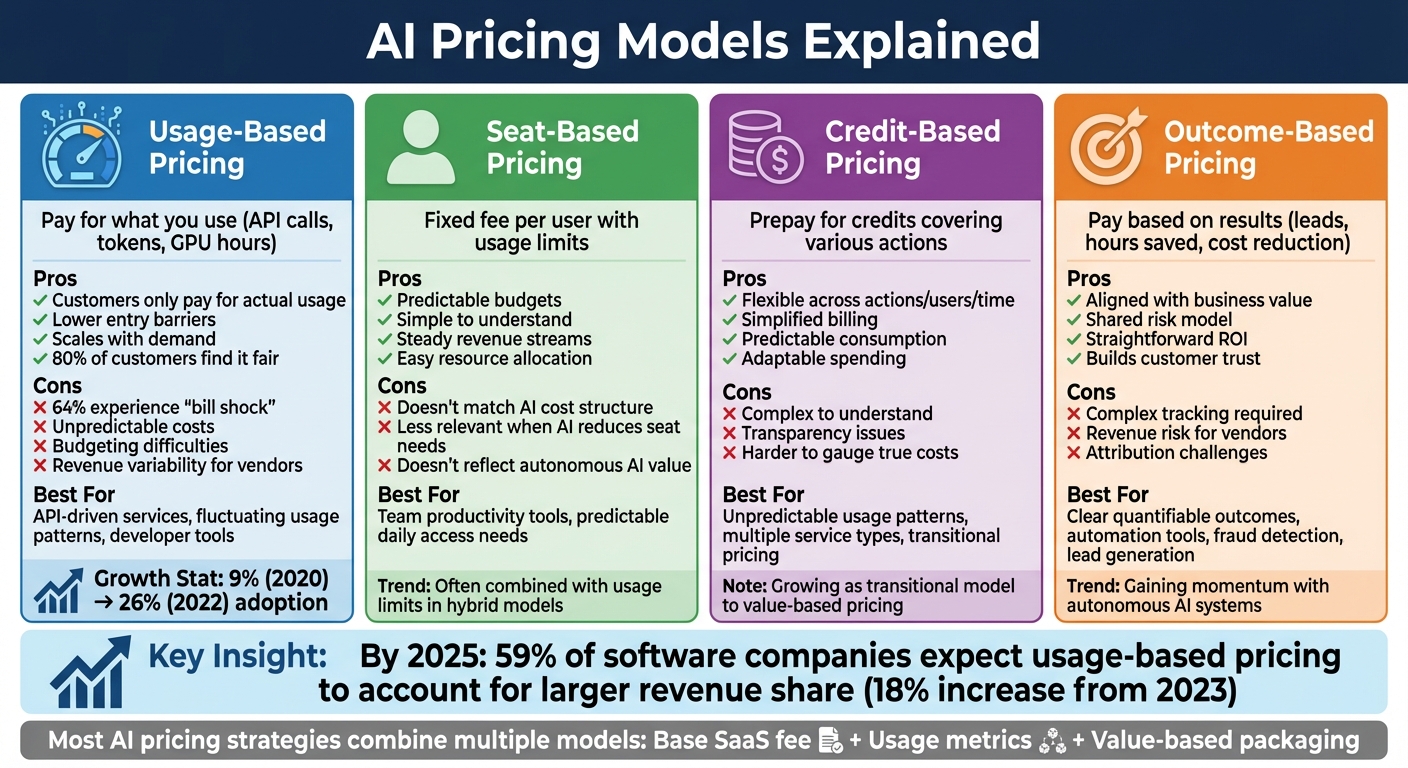
AI Pricing Models Comparison: Usage, Seat, Credit, and Outcome-Based
Usage-Based AI Pricing
How Usage-Based Pricing Works
Usage-based pricing operates on the principle of charging customers based on their actual consumption. Metrics like tokens processed, API calls, or GPU hours serve as the foundation for determining costs [3][5].
Most teams run this as a credit system, and you can too. Customers prepay for credits, which are then deducted as they perform specific AI actions [3]. Simpler tasks might use only a few credits, while more complex operations consume significantly more. This system offers transparency in spending and ensures billing remains simple.
The success of this model depends on selecting usage metrics that align with the value customers derive. For example, if your AI software analyzes legal documents, charging per document makes sense. Similarly, for API services, pricing based on API calls or per thousand tokens processed ties costs directly to consumption [6].
Pros and Cons of Usage-Based Pricing
| Advantages | Challenges |
|---|---|
| Customers only pay for what they use, making it easier to demonstrate ROI | Unpredictable costs: 64% of organizations have reported experiencing "bill shock" with consumption-based AI services [7] |
| Lower entry barriers: New customers can start with minimal investment | Budgeting difficulties: Fluctuating usage can complicate monthly expense forecasts for CFOs |
| Scales effortlessly with demand: Pricing grows alongside customer usage | Requires advanced infrastructure: Robust billing systems and real-time usage tracking are essential |
| Perceived fairness: 80% of customers believe usage-based pricing better reflects the value they receive | Revenue variability: Vendors may face challenges forecasting income due to inconsistent usage patterns |
The popularity of usage-based pricing has surged in recent years. Between 2020 and 2022, the percentage of companies adopting this model grew from 9% to 26%. Your peers have already moved: by 2025, 59% of software companies expected usage-based pricing to take a bigger share of their revenue, an 18% increase from 2023.
When to Use Usage-Based Pricing
This pricing model is particularly effective for API-driven AI services, infrastructure platforms, and tools aimed at developers, especially when customer usage patterns are unpredictable [3]. It’s an ideal choice for businesses where consumption fluctuates, such as marketing teams that ramp up usage during campaign periods but scale back afterward.
Usage-based pricing works best when operational costs scale directly with usage. For instance, higher GPU inference costs can be passed to the customer seamlessly. If your customers budget monthly or need the product every day, a subscription suits you better. Your key is to tailor your pricing strategy to match how customers naturally interact with your product and perceive its value.
Unlike fixed or seat-based fees, this flexible approach adapts to varying consumption levels. In the next section, we’ll delve into how seat-based pricing modifies traditional subscription models to accommodate the specific cost structures of AI solutions.
Seat-Based and Subscription AI Pricing Models
How Seat-Based Pricing Works
Seat-based pricing is a simple model where customers pay a fixed fee for each individual user accessing the software. This method, widely used in traditional SaaS, allows you to plan budgets easily while clearly communicating the value of the service [1].
Seat-Based Pricing for AI Products
AI introduces complexities to the seat-based pricing model. Unlike conventional software designed to enhance human productivity directly, AI systems often operate autonomously, improving team efficiency as a whole rather than individual performance [1]. This creates challenges because AI’s operational costs, driven by processing tokens and varying user demands, don’t always align neatly with a per-seat structure [9]. Seats give you predictable revenue and manageable resourcing [9], it can lose relevance when AI systems reduce the need for multiple user seats. These limitations have encouraged the adoption of more flexible pricing strategies.
Hybrid Models: Subscription Plus Usage
To address the shortcomings of traditional pricing, many AI providers are turning to hybrid models that combine seat-based and usage-based pricing. Studies suggest that tiered pricing structures, often involving two-part tariffs, work well for AI products. These models include a fixed subscription fee covering standard usage and additional usage-based charges for higher consumption levels [9]. Your customers get a predictable baseline cost, and you still get to charge for what they actually consume. The result is a balanced approach that ensures steady revenue for the provider while fairly reflecting the costs associated with fluctuating AI consumption.
Credit-Based AI Pricing Models
How Credit-Based Pricing Works
Credit-based pricing operates on a prepaid currency model, where customers purchase credits in advance and use them for various AI services or actions. Each credit corresponds to a specific unit of value, like an API call, a gigabyte of data, 1,000 tokens, or 10 minutes of transcription, and is deducted in real time as the product is used [10]. This method simplifies billing by creating a layer of abstraction between backend infrastructure costs and the customer experience, making the process more simple and flexible [11].
Your customers buy a pool of credits and draw them down as they use the product. Unlike purely usage-based pricing, which directly reflects raw consumption metrics, credits translate technical usage into a unified, easy-to-understand currency. This approach blends the flexibility of pay-as-you-go models with the predictability of prepaid plans, making it particularly appealing for AI products with fluctuating usage patterns [10]. Next, let’s examine the benefits and drawbacks of this pricing model.
Pros and Cons of Credit-Based Pricing
| Advantages | Disadvantages |
|---|---|
| Flexibility: Credits can be reallocated across actions, users, or time periods, allowing for adaptable spending. | Complexity: Understanding how credits map to actual product features can be confusing, making it harder to gauge true costs. |
| Simplified Billing: A unified credit system consolidates diverse usage metrics into one streamlined billing process. | Transparency Issues: The abstraction layer may obscure direct cost comparisons, complicating ROI evaluations. |
Credit-based pricing is gaining traction as a transitional model for companies exploring more value-driven pricing strategies [12]. This approach is particularly useful when infrastructure costs are well understood, but the value of AI features remains uncertain, or when usage patterns are unpredictable. It also saves you where direct metering is operationally awkward [11].
How to Design a Credit System
The success of a credit-based system hinges on its design. To create an effective system, focus on pricing transparency, predictable consumption, and flexibility. Transparency means giving customers clear insights into how credits are consumed, the remaining balance, and the cost of specific actions before they commit [13]. It’s also important to ensure customers understand how credits are distributed across teams and whether unused credits can roll over to future periods.
Price your credits against the economic value you deliver, so a customer can commit without precise knowledge of their future usage [13]. Flexibility, or fungibility, is key, customers should be able to transfer credits between actions, users, or time periods as needed [13]. Additionally, establishing fair and transparent expiration policies is essential for maintaining customer trust and achieving a balanced pricing approach.
AI Pricing Models with Paddle

Outcome-Based and Performance-Based AI Pricing
Unlike usage-, seat-, or credit-based models that charge based on consumption or access, outcome-based pricing links costs directly to business results.
What is Outcome-Based Pricing?
Outcome-based pricing flips the usual billing model on its head. Rather than charging for access or usage, you charge for specific, measurable results [16]. This means the vendor’s revenue depends on delivering tangible business outcomes, such as boosting revenue, cutting costs, or improving operational processes [14][15][17].
This model creates a risk-sharing dynamic where payment is contingent on achieving agreed-upon results. For AI products, this might involve charging per qualified lead type, per hour saved through automation, or as a percentage of cost reductions.
To make this work, both parties must define success upfront using clear and measurable metrics [18][14]. You will need logs, events or sensors inside your product to track those outcomes as they happen [18]. Seamless data sharing through APIs or integrations is critical, allowing both sides to monitor and verify results [18]. Attribution rules also play a key role in determining how credit is assigned when multiple factors influence an outcome [18].
By focusing on results, this pricing model helps assess when it’s the best fit for driving meaningful business impact.
Pros and Cons of Outcome-Based Pricing
| Advantages | Disadvantages |
|---|---|
| Aligned Value: Pricing reflects the actual business value delivered, making ROI simple to justify. | Complex Tracking: Measuring and attributing outcomes accurately requires advanced data systems and tools. |
| Shared Risk: Customers only pay when results are delivered, reducing their upfront financial exposure. | Revenue Risk: Vendors face financial uncertainty if outcomes fall short, which can impact revenue stability. |
| Builds Trust: Shows confidence in the product’s ability to deliver real, measurable results. | Attribution Issues: Determining how much credit the AI solution deserves versus external factors can lead to disagreements. |
As AI systems become more self-sufficient, outcome-based pricing is gaining momentum [19][20]. A hybrid model lets you keep some outcome-based pricing alongside other strategies, which balances your risk and flexibility [19].
When to Use Outcome-Based Pricing
To decide if outcome-based pricing is the right fit, it’s essential to consider the nature of your AI product and its measurable impact.
This model works best for AI solutions that deliver clear, quantifiable business outcomes. Examples include automation tools that cut labor costs, fraud detection systems that prevent financial losses, or lead generation platforms that directly increase revenue.
However, the approach becomes tricky when the value of your AI product is abstract, hard to measure, or heavily influenced by external factors. For outcome-based pricing to succeed, you need a solid data infrastructure and transparent reporting systems to track results in real time and maintain customer confidence in the measurements.
How to Build a Pricing Strategy for AI Products
Creating a pricing strategy for AI products involves layering different pricing components to reflect both costs and customer value. By 2025, most AI pricing models consist of three main elements: a base SaaS or platform fee, a usage-based metric (like tokens, API calls, or compute time), and value-based packaging tailored to specific outcomes or customer segments [21]. Your key is to balance the operational costs of your AI model with what customers perceive as valuable, using clear, measurable metrics. A structured framework to guide your approach.
Step-by-Step Framework for Pricing Strategy
Start by identifying your target customers and understanding what success looks like for them. Keep in mind that enterprises and startups often define value differently. For example, while one might prioritize cost savings, the other could focus on time efficiencies. Your pricing should align with measurable outcomes like time saved, costs reduced, or revenue generated.
A hybrid pricing model often works best, combining a predictable base fee with variable charges based on usage [21]. This approach allows flexibility while addressing the needs of diverse customer segments.
To ensure profitability as you scale, conduct a thorough Total Cost of Ownership (TCO) analysis. This means accounting for infrastructure, model training expenses, and support costs. Companies that align pricing with clear value metrics often achieve 30–40% higher expansion revenue [22], making this alignment a critical step.
Testing and Adjusting Your Pricing Model
No pricing model is perfect from the start. You will keep adjusting it. Companies that systematically test their pricing strategies see an average revenue improvement of 14% compared to those that stick with static pricing [22]. Use tools like A/B testing and cohort analysis to evaluate the long-term impact of pricing changes.
Keep a close eye on churn rates. If customers consistently leave after hitting certain usage thresholds, it’s a sign your pricing model may need adjustment. Direct customer feedback is invaluable for identifying friction points and refining your approach.
Instead of relying on assumptions, use real data to guide your adjustments. Track which features deliver the most value, identify fast-growing customer segments, and pinpoint areas where customers experience friction. Your pricing should adapt as your product evolves and the market matures.
How Data-Mania Supports Pricing Strategy

A strong pricing strategy also relies on clear communication. In my fractional CMO work with AI startups, I operationalize the pricing model by building the messaging that carries it. That means designing your pricing page and training your sales team to position each tier, so the pricing you designed is the pricing your buyer actually understands.
Additionally, Data-Mania can assist with testing pricing hypotheses, gathering market feedback, and refining your approach based on real customer insights. From hands-on advisory sessions to ongoing support, experienced marketing leadership can help you avoid common pitfalls and accelerate your path to product-market fit.
Conclusion
A Recap of AI Pricing Models
Selecting the right pricing model for your AI product should align with how your customers derive value. Usage-based pricing is ideal when customers prefer paying only for what they use, making it a strong fit for API-driven products or platforms with fluctuating workloads. Seat-based models offer predictability and are effective when AI features enhance workflows for specific user groups. Credit-based systems provide flexibility for customers while helping you manage costs, especially when usage varies widely. Finally, outcome-based pricing ties revenue directly to customer results, relying on measurable success metrics to justify costs.
To create a sustainable pricing approach, you need to understand your core cost drivers, such as infrastructure, third-party APIs, and compute resources. As the market evolves, AI pricing models increasingly focus on customer ROI rather than traditional access metrics, which may decline as your product becomes more efficient [23].
These insights provide a foundation for defining pricing metrics and making strategic adjustments.
Key Factors to Weigh When Choosing AI Pricing
Start by linking your unit costs, like API calls, third-party data, and infrastructure expenses, to a value metric that scales with customer success. Pricing should directly reflect measurable outcomes for customers, whether that’s time saved, costs reduced, or revenue generated.
The most effective strategies strike a balance: standardizing pricing tiers for efficiency while allowing room for customization based on customer feedback and usage trends [24]. Companies that actively test and refine their pricing strategies often see tangible revenue growth, making iteration a crucial part of the process.
Moving Forward for AI Startups
Once you understand the models and the trade-offs, the next step is putting one into practice. A pricing strategy is a communication problem as much as a numbers problem. In my fractional CMO engagements I turn the pricing model into the messaging that sells it, from your pricing page through to how your team positions each tier. That is what strategic marketing leadership buys you.
As your AI solution evolves, refining your pricing strategy to clearly communicate value will be essential for long-term success. Whether you need expert guidance through advisory sessions or hands-on assistance with your go-to-market strategy, having the right expertise can help you sidestep common mistakes and fast-track your path to product-market fit.
FAQs
What’s the best AI pricing model for my business?
Choosing the right AI pricing model requires a clear understanding of your business needs, objectives, and how you intend to integrate AI into your operations. Begin by assessing your usage patterns, the value it brings to your customers, and your budget priorities.
If your business demands flexibility, a usage-based or per-execution model can be a suitable option, as it adapts to variable needs. For those seeking predictable costs, a tiered subscription plan offers stability and ease of budgeting. Alternatively, if your primary focus is on achieving specific, measurable results, an outcome-based pricing model may be the most effective choice. Your key is to align the pricing model with your business objectives and what your customers expect to ensure the best fit.
What are the key challenges with outcome-based AI pricing models?
Outcome-based AI pricing models come with their own set of challenges, primarily because measuring outcomes precisely can be tricky. It’s often difficult to determine how much of a result is directly tied to the AI solution, which can lead to disagreements about what defines success. Without clear benchmarks, aligning expectations becomes a tough task.
The other risk you are carrying is unintended optimization behavior. In such cases, the system might prioritize outcomes that are easy to measure, potentially sidelining broader or more meaningful goals. On top of that, managing long-term contracts adds another layer of complexity, as you must navigate shifting variables and evolving objectives over time.
How can I maintain transparency and predictability with credit-based pricing?
To keep credit-based pricing simple and trustworthy, begin by explaining exactly how credits work and what they stand for. Make sure users can easily track their usage in real time and access detailed reports to stay on top of their credit consumption.
Offering fixed or tiered credit plans can be a practical way to help customers stick to their budgets and prevent surprise expenses. Clear communication and well-defined guidelines are essential for building trust and delivering a smooth user experience.