


Here’s the big idea: AI GTM engineers are reshaping how B2B startups scale by building systems, not just by running campaigns. Instead of scattered tactics, they design repeatable workflows powered by AI that automate, improve, and connect every stage of the go-to-market process.
What the AI GTM Engineer Owns: 6 GTM Systems for Growth
An effective AI GTM engineer doesn’t “do marketing.”
They design and maintain AI growth marketing systems across six core areas:
- Outbound Systems: They automate cold outreach with data-driven targeting and AI-powered personalization.
- Content & SEO Systems: They use AI to plan, create, and optimize content for steady organic traffic and lead generation.
- Product-Led Growth Systems: They let your product do the selling by tracking usage data and automating onboarding.
- Partner Systems: They build alliances that expand reach and drive co-marketing opportunities.
- Community-Led Systems: They create engaged user communities that amplify your brand and drive referrals.
- Paid Performance Systems: They scale fast with data-backed ad campaigns that optimize spend and results.
Why this matters: In 2025, 81% of sales teams used AI, but only 26% scaled it effectively. The problem? Siloed tools and one-off experiments. AI GTM engineers solve this by integrating tools, cleaning data, and automating workflows to create systems that grow with your business.
The hard part is finding someone to own this role. Whether it’s a founder, a hybrid hire, or fractional CMO services, the right person will combine technical skills, market strategy, and workflow design to turn chaotic processes into scalable growth engines.
Why GTM Needs Systems Over Tactics
Most B2B startups don’t actually have a “marketing problem.”
They have a missing role = An AI GTM engineer: the person who turns scattered tactics into integrated, AI-powered systems.
Before we talk about that role, we need to talk about the mess it’s hired to fix.
The Problem With Ad Hoc GTM Strategies
B2B tech startups often rely on scattered tactics – things like LinkedIn ads, cold outreach, or the occasional blog post. While these efforts might bring in some short-term wins, they rarely lead to consistent, scalable growth.
The root of the problem lies in outdated assumptions that traditional GTM strategies are built on. They assume buyer behavior is predictable, sales cycles are linear, and customer data is easy to manage. But that’s no longer the case[2]. Today’s B2B buyers engage with your company across multiple touchpoints – they read blog posts, join webinars, interact on social media, download resources, and talk to sales before making decisions. Each of these interactions generates data, but without integration, that data stays fragmented.
For example, if your CRM doesn’t sync with your marketing automation tools or if product analytics are siloed from customer support records, your teams are left working with incomplete information. Sales reps waste time on manual updates, while marketing and customer success struggle to figure out which efforts are driving engagement and retention.
On top of that, running isolated experiments without tracking how they connect to larger outcomes makes it tough to learn what’s actually working. Did the spike in demo requests come from the webinar, the email campaign, or a LinkedIn post? Without systems to tie these signals together, you’re left guessing – and repeating the same cycle every quarter.
What the AI GTM Engineer Actually Builds: Core GTM System Components
To move away from one-off tactics, the AI GTM engineer’s job is to re-architect your GTM as a system, not a series of disconnected campaigns.
They typically start with a CRM as the single source of truth, then integrate every GTM tool into it:
- Marketing automation feeds lead behavior data into the CRM.
- Product analytics track user engagement and push signals into the same record.
- Customer support logs every interaction so retention risk is visible in one place.
From there, they layer in AI and machine learning to analyze patterns:
- Identifying high-conversion prospects
- Spotting churn risks early
- Highlighting which channels and plays deliver the best ROI
Instead of relying on manual analysis, AI continuously processes data to surface actionable insights.
Workflow automation tools tie everything together by triggering actions across the tech stack. For example:
- When a prospect downloads a whitepaper, the system can automatically enrich their record, assign a lead score, send a personalized email, and notify the right sales rep.
- If a customer’s product usage drops below a certain threshold, the system can alert customer success and suggest interventions based on past wins.
The difference between having tools and having a system is integration and ownership. The GTM engineer makes sure every component shares data in real time, creating a unified view of customer interactions. This reduces manual work, minimizes errors, and ensures everyone on the team is working with the same up-to-date information.
They also enforce clean data:
- Standardized naming conventions
- Proper tagging
- Regular deduplication
Without clean data, even the most advanced AI tools can produce unreliable results. By focusing on both integration and data quality, the GTM engineer lays the groundwork for a GTM process that evolves and improves over time.
The Feedback Loop of Engineered GTM
Once the tools are integrated and AI insights are in place, a well-designed GTM system becomes a self-refining engine.
Here’s how an AI GTM engineer designs that loop:
- Unified data flow
Data from every touchpoint—website visits, email opens, demo requests, product usage, support tickets, and more—flows into a unified platform. AI consolidates this data across CRM, marketing, product, and support tools, breaking down silos that typically slow decision-making. - Automated, behavior-based actions
Automation then responds to customer behavior in real time:- If a prospect revisits your pricing page multiple times, the system might trigger a personalized email, notify sales, or offer a limited-time incentive.
- If a customer’s engagement drops, the system can prompt a customer success rep to intervene with tailored solutions.
- Humans focus on high-value work
Human involvement still plays a critical role, but it’s focused on high-value tasks like closing deals, crafting impactful content, or solving complex customer challenges. The system handles repetitive tasks and flags moments when human expertise is needed. - Real-time measurement
Every action is measured in real time—whether it’s tracking changes in conversion rates or monitoring improvements in onboarding times. This immediate feedback provides clarity on what’s working and what isn’t. - Continuous iteration
Based on performance data, the system adjusts its models and recommendations. It learns which messages resonate with different audiences, which channels bring in quality leads, and which strategies reduce churn. These insights feed back into the system, creating a cycle of continuous improvement.
This feedback loop operates at a speed and scale that manual processes simply can’t match. While traditional GTM strategies might test a handful of ideas each quarter, engineered systems can run dozens of experiments simultaneously. The result? Growth that’s not just consistent but scalable over time.
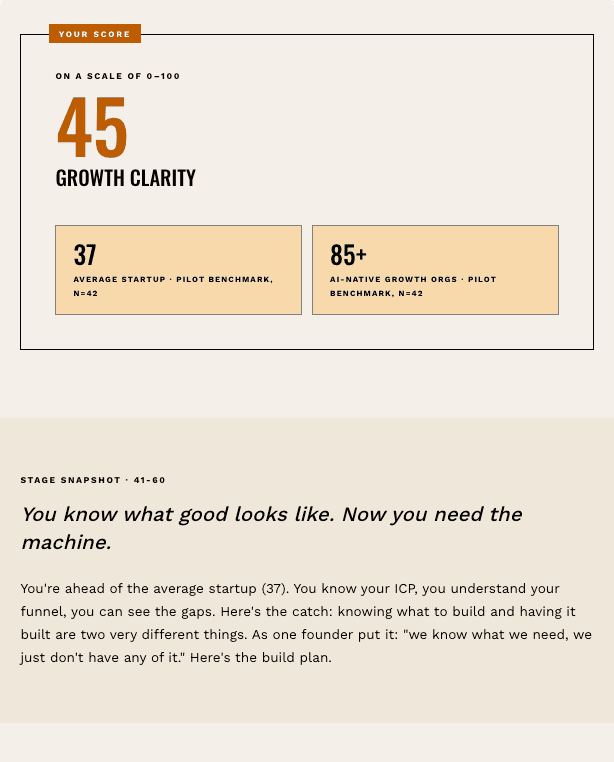
Is Your Startup Falling Behind Its AI-Native Competitors?
Beyond Copy: How To Use AI to Build GTM Systems That Scale
One Concrete Example: The Content & SEO Engineered GTM System
One of the first canvases an AI GTM engineer tackles is content and SEO.
In the world of go-to-market (GTM) strategies, content and SEO stand out as essential tools for driving consistent growth. Rather than relying on sporadic creative efforts, an AI-powered GTM system transforms content and SEO into a structured, revenue-focused process. This ensures that every step is measurable, scalable, and designed to generate predictable results.
At the heart of this system lies a data-first strategy. The engineer uses tools to:
- Run keyword research and build topic clusters
- Analyze search volume, competition, and user intent
- Organize related topics into content hubs to establish topical authority and show up in AI search
From there, they map a content plan that aligns with business goals and pipeline targets.
AI also plays a pivotal role in content creation and optimization:
- Drafting outlines, initial drafts, and research summaries in a consistent brand voice
- Suggesting semantic keywords and internal links
- Recommending technical improvements like meta descriptions and schema markup
To ensure the system delivers results, the engineer wires in performance tracking:
- Monitoring rankings, traffic, and engagement
- Connecting content performance to lead generation and revenue outcomes
- Feeding learnings back into the roadmap so the system gets smarter over time
Content stops being a creative lottery and becomes a designed GTM system that compounds value.
sbb-itb-e8c8399
Ownership Models for Startups
Different stages require different ways of filling the GTM engineer gap.
- Early-stage startups: Founders, particularly those with technical skills and a knack for systems thinking, often take charge of GTM efforts. They align customer acquisition strategies with product development, ensuring both grow together.
- Scaling startups: As startups grow, leadership bandwidth becomes limited. This is when hybrid roles – spanning marketing, sales, and operations – become critical. These roles help unify GTM systems and ensure cohesive execution.
- Well-funded startups: For those with more resources, hiring fractional CMOs can be a smart move. This option provides strategic leadership without the need for a full-time hire, balancing expertise with budget considerations.
Skills and Traits of an AI GTM Engineer
Once the ownership model is clear, the next step is identifying the skills that define a strong GTM engineer.
They typically combine:
- Technical fluency – Comfortable with APIs, integrations, data flows, and the GTM tool stack.
- Data-first mindset – Able to define metrics, build dashboards, and make decisions based on signal, not noise.
- Workflow and systems design – Skilled at mapping processes, identifying bottlenecks, and designing automation.
- Go-to-market intuition – Understands how marketing, sales, product, and success fit together to drive revenue.
- Cross-functional collaboration – Can work across teams to ensure technical solutions drive real business outcomes.
Workflow design is at the heart of their work. These professionals excel at creating integrated, automated systems that eliminate repetitive tasks and deliver measurable improvements in GTM performance. Their hands-on experience with AI tools allows them to identify and implement solutions that create visible, impactful results.
When to Rent an AI GTM Engineer Through Fractional CMO Services
As startups grow, founder-led GTM systems hit a ceiling. You still need an AI GTM engineer, but you may not be ready for a full-time senior hire.
This is where fractional CMO services that specialize in GTM systems and AI can step in and temporarily fill that role.
A great example is Lillian Pierson, founder of Data-Mania. Her background in data and AI consulting makes her uniquely equipped to deliver fractional CMO services. She specializes in designing and refining systematic GTM strategies tailored to tech-driven companies, bridging the gap between technical execution and marketing leadership.
Instead of guessing your way through AI adoption, you’re effectively renting an AI GTM engineer to architect the systems, then handing those systems to your internal team to run.
Conclusion: Building GTM Systems for Growth in 2026
Startups that scale successfully rely on engineered go-to-market (GTM) systems rather than relying on scattered, one-off tactics. As we approach 2026, the companies poised to lead their industries will be those that view GTM as a structured, engineering-driven discipline rather than just another marketing initiative.
AI-powered workflows and automation are the backbone of these systems, transforming fragmented efforts into unified strategies that deliver measurable outcomes. By embedding integrated feedback loops into your GTM infrastructure, you create a system that continuously evolves, responding in real time to market signals, customer behavior, and performance metrics.
Each GTM system – outbound, content and SEO, product-led, partner, community-led, and paid performance – serves as a unique growth pathway that can be designed, tested, and refined strategically. The most successful startups don’t rely on a single system. Instead, they layer multi-channel GTM growth engines, connecting them through shared data, unified workflows, and feedback loops. That’s where compounding growth comes from.
But systems don’t design or maintain themselves.
The real unlock is putting an AI GTM engineer in charge of that architecture… whether that’s a founder, a hybrid internal hire, or a fractional CMO. The winners of 2026 won’t just “use AI in marketing.” They’ll have someone who owns the AI-powered GTM system end to end.
The question isn’t whether you need engineered GTM systems.
It’s how quickly you can put the right owner in place to build them.
FAQs
What skills and qualities are essential for an AI GTM engineer to successfully build and manage growth systems?
To thrive as an AI GTM engineer, a mix of technical expertise, strategic thinking, and creativity is essential. Proficiency in data analysis, AI tool integration, and prompt engineering lays the foundation, alongside the ability to tailor software and systems to specific needs. On top of that, strong project management skills are vital for handling complex growth projects spanning multiple channels.
Equally critical is a solid grasp of business strategy and revenue operations, ensuring AI-powered systems align seamlessly with a company’s growth objectives. Traits like adaptability, problem-solving, and clear communication enable effective collaboration across teams, paving the way for scalable and consistent outcomes.
How can startups decide which of the six GTM systems to focus on based on their stage and resources?
Startups should shape their go-to-market (GTM) strategies based on their growth stage, available resources, and the audience they’re targeting. For early-stage startups working with tighter budgets, strategies like product-led growth (PLG) or a content and SEO-driven GTM approach can be effective. These methods allow startups to gain traction without requiring significant upfront investment. On the other hand, more established startups with larger teams and budgets might consider paid GTM or partner and channel GTM strategies to drive faster scaling.
When deciding on the right approach, take a close look at your team’s strengths, financial resources, and overall growth objectives. For instance, if your startup has an engaged community or loyal user base, a community-led GTM strategy might be a natural fit. The key is to focus on one or two strategies that play to your strengths and then expand as your capabilities and resources grow.
What challenges might arise when shifting from traditional GTM strategies to a system-driven approach, and how can they be addressed?
Shifting away from traditional go-to-market (GTM) strategies to a more system-driven approach often comes with its own set of hurdles. One major issue is that older tactics tend to operate like rigid, standalone projects. This rigidity makes it tough to adapt when there are shifts in the product, team structure, or customer behavior. Another common problem is the misalignment between sales, marketing, and customer success teams, which can lead to disjointed efforts and wasted resources.
To tackle these challenges, think of your GTM strategy as a living, breathing system rather than a one-time project. Break tasks into smaller, manageable sprints to stay flexible. Encourage collaboration across teams to ensure everyone is working toward shared goals. And don’t overlook the importance of keeping tools like your CRM accurate and up-to-date. By focusing on adaptability and seamless integration, you can build a GTM system that grows alongside your business.